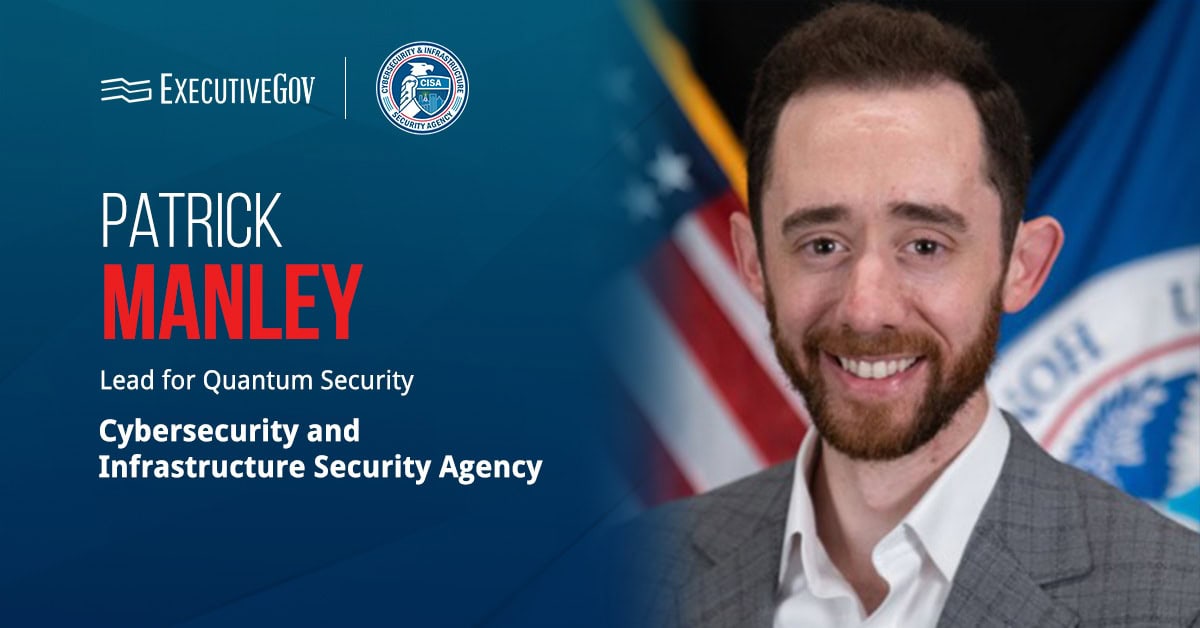
- Patrick Manley has weighed in on agency PQC readiness
- Smart identity cards remain a key hurdle in the PQC shift
- The 2026 Homeland Security Summit will feature several CISA leaders as speakers
Patrick Manley, lead for quantum security at the Department of Homeland Security’s Cybersecurity and Infrastructure Security Agency, said a complete accounting of cryptographic assets is the starting point for any agency’s transition to post-quantum cryptography, Federal News Network reported Friday.

As CISA guides agencies through the shift to quantum-resistant encryption, homeland security leaders will gather at the Potomac Officers Club’s 2026 Homeland Security Summit on Nov. 10 to examine how data and emerging technologies can help protect the nation’s borders and critical infrastructure. Bobby Thompson, acting associate director for threat hunting at CISA, will deliver a keynote address, while CISA’s Lauren Wind and Daryle Hernandez will join panel discussions on data and identity integration and trust in homeland security technologies. Sign up now!
Manley’s remarks come as agencies prepare to submit their PQC migration plans to the Office of Management and Budget and the Office of the National Cyber Director by Oct. 31.
Why Does Manley Say Inventories Should Come First?
Manley said agencies cannot weigh risk or sequence their migrations without first knowing which cryptographic systems they operate. He described the government as still working through the discovery stage, with that understanding shaping which systems must move immediately and which can transition later.
“The timelines are moving us left and left and left,” Manley said.
He added that each organization’s inventory will shape its migration plan, with high-value assets and mission-critical systems placed at the front of the line. At CISA, Manley explained, the goal is to complete an internal inventory, set priorities and identify candidate pilots to test interoperability and performance impacts before the close of the next fiscal year.
The inventories support White House targets calling for high-value assets and systems to be PQC-ready by 2030 and for all remaining systems to complete the transition by 2035.
What Hurdles Does Manley See Across Agencies?
Manley said federal civilian agencies are lagging in building their cryptographic inventories. He characterized the annual reporting process as inconsistent and checklist-driven, noting that agencies submit spreadsheets without gaining real insight into the cryptography across their networks.
He also pointed to staff departures, a lack of consistent PQC migration leads, shrinking budgets and limited ability to estimate transition costs, adding that cost projections are not being linked to budget requests. Manley said PQC funding should be a priority as Congress finalizes fiscal 2027 appropriations and agencies prepare their fiscal 2028 requests through OMB.
What Did DOW & NIST Experts Say About Identity Cards?
Britta Hale, director of PQC at the Department of War, said varying mission priorities across the department’s components complicate decisions about where migration work should begin. She identified identity and authentication as one of the largest obstacles, explaining that personal identity verification, or PIV, and common access cards, or CACs, must support the new algorithms. Because public key infrastructure must be PQC-capable by 2030, Hale said, systems and products across the department need to accept post-quantum algorithms by the end of 2029 to prevent users from losing access.
Bill Newhouse, a cybersecurity engineer and PQC project lead at the National Institute of Standards and Technology’s National Cybersecurity Center of Excellence, said NIST is developing new smart card standards that account for PQC. He added that agency chief information security officers will need to make the PIV/CAC challenge a priority.
What Other Federal Efforts Support the PQC Transition?
Manley’s remarks align with a CISA and G7 Cybersecurity Working Group call for organizations to begin PQC migration through a phased, risk-based approach that starts with identifying critical data, inventorying cryptographic assets and mapping dependencies. The push follows a June executive order directing agencies to accelerate the transition, designate PQC migration leads and move high-value assets and high-impact systems to quantum-resistant key establishment by Dec. 31, 2030.
Agencies still face gaps in that work. The Government Accountability Office found that the 24 federal agencies it reviewed have yet to fully prepare for the shift, citing limited cryptography expertise and a lack of processes for building inventories and identifying transition funding.
Other agencies are running their own efforts. The National Security Agency is developing PQC resources for national security systems, and the Department of War is seeking software-only encryption capabilities that can support its transition without hardware changes. The Federal Aviation Administration has requested industry input on moving the National Airspace System to post-quantum cryptography.