

- DIU has announced a leadership change
- Travis Metz’s background spans investing and AI consulting
- The 2027 Defense R&D Summit will explore unmanned systems and more
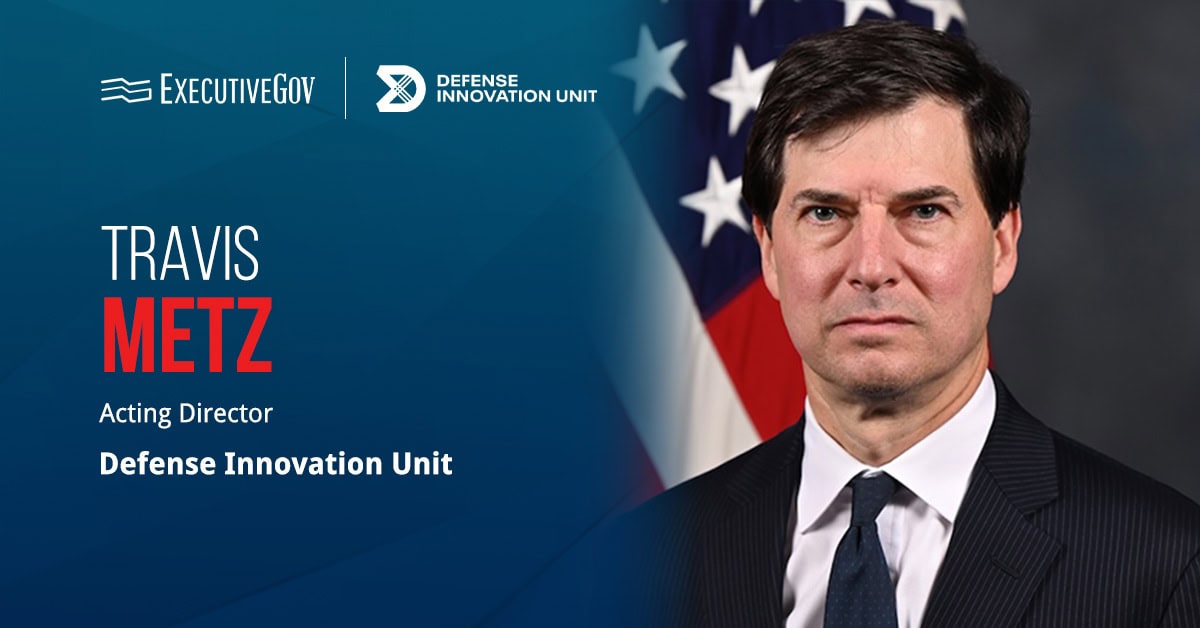
The Defense Innovation Unit has named Travis Metz, its deputy director and chief operating officer, as acting director.

As DIU transitions to new leadership and continues sourcing commercial unmanned and autonomous capabilities for the joint force, emerging defense technologies remain a key focus across the Department of War. The Potomac Officers Club’s 2027 Defense R&D Summit on Feb. 4 will feature DOW and national security technology leaders discussing unmanned systems, 5G and next-generation wireless, artificial intelligence, quantum computing, advanced space technologies, and more. Book your spot to join the conversation.
In a post on X Thursday, DIU said Metz takes over from Director Owen West, a 2026 Wash100 awardee, who is stepping aside to help launch Project Agincourt and the newly announced Autonomous Warfare Command.
Who Is Travis Metz?
Metz is a former private equity and venture capital investor who became DIU’s deputy director and COO in March. He previously worked in the Office of the Secretary of War, which he joined in June 2025, concentrating mainly on the Drone Dominance Program.
Before his DOW service, Metz established and ran timberlineDS, an AI consultancy serving government and commercial clients. Earlier in his career, he spent 25 years investing in and managing private equity and venture capital funds. He has also held seats on multiple private and nonprofit boards.
The Harvard College economics graduate holds a master’s degree in data science from the University of California, Berkeley.
What Other Efforts Has DIU Launched?
Metz’s appointment comes as Secretary of War Pete Hegseth, a two-time Wash100 honoree, named West CEO of the Direct Reporting Portfolio Manager for Unmanned Systems. In that role, West will lead Project Agincourt, the effort to stand up the planned Autonomous Warfare Command by Oct. 1, 2027. Hegseth previously created the DRPM-UxS role to oversee nearly all drone and counter-drone programs across the DOW.
DIU has rolled out a series of prize competitions to source commercial technologies for the joint force. In July, the agency opened a $100 million challenge for unmanned surface vessels paired with at least two strike-capable drones and reserved a separate $200 million for follow-on prototyping or production deals. That same month, DIU launched the $5 million Specular MIST Prize Challenge to identify maritime payload technologies for manned and unmanned surface vessels. It then introduced the Ground-Based Affordable Mass Prize Challenge, which seeks low-cost, long-range precision strike systems and has up to $250 million set aside for the prize and follow-on work.
DIU and the Navy launched a prize challenge to modernize mine countermeasure capabilities, seeking autonomous systems that can locate and neutralize mines under degraded or denied communications conditions. Most recently, DIU opened a $100 million prize challenge for low-cost intelligence, surveillance and reconnaissance platforms that can support DOW missions across land, littoral and maritime environments.
Beyond prize challenges, DIU is seeking private capital firms that invest in maritime counter-unmanned systems technologies. The request falls under the agency’s Bridge Program, which aims to expand the pool of nontraditional defense contractors that can meet operational requirements involving classified information.