

- DOE advisers have issued a science-first quantum plan
- The report backs diversity across quantum hardware platforms
- The 2026 FedCiv Summit will spotlight AI and other federal civilian IT priorities
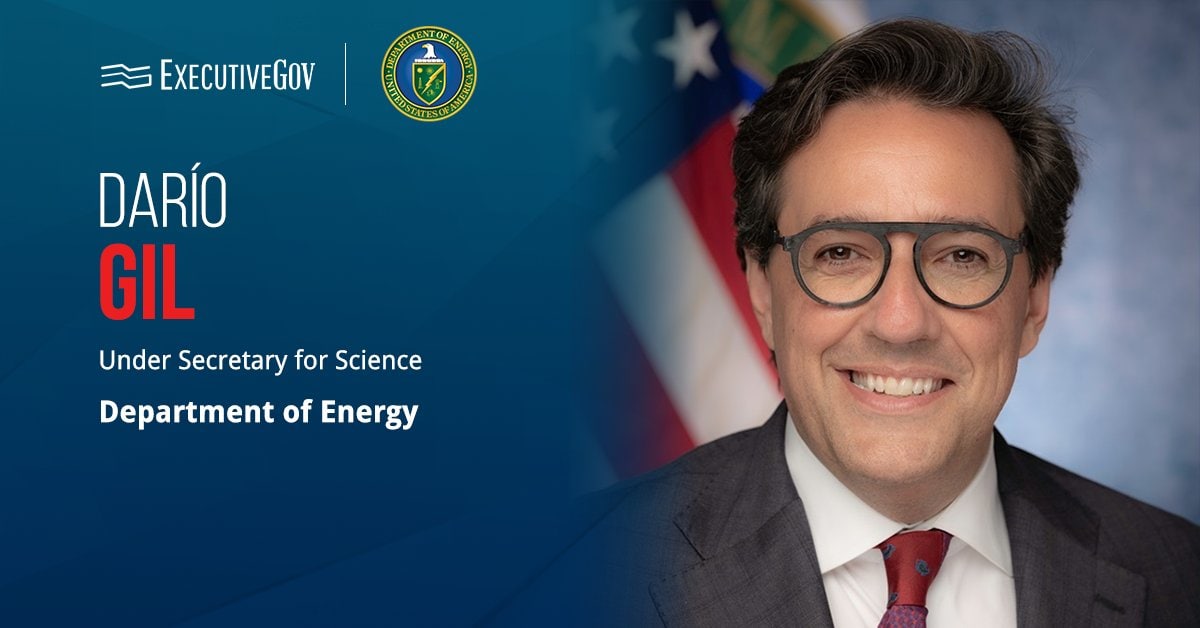
Dario Gil, under secretary for science at the Department of Energy, said a new report from the Office of Science Advisory Committee, or SCAC, lays out a phased plan for developing quantum computers that can advance scientific research.

Federal civilian agencies continue to evaluate how emerging technologies such as quantum computing and AI can strengthen mission outcomes and scientific discovery. DOE Chief Information Officer Dawn Zimmer, a 2026 Wash100 awardee, will deliver a keynote address at the Potomac Officers Club’s 2026 FedCiv Summit on Oct. 29. Emily Burdick, acting director of DOE’s Office of Cybersecurity, Energy Security, and Emergency Response, will also join a panel discussion on AI and data sharing across federal missions. Book your spot now to hear from leaders shaping federal civilian modernization priorities.
In a Sept. 17 blog post, Gil wrote that the report shows quantum computing has reached a turning point as the technology moves beyond fundamental laboratory work toward practical scientific use.
Gil wrote that he tasked SCAC’s quantum subcommittee with developing a milestone-based roadmap toward demonstrating a scientifically relevant, error-corrected quantum computer by 2028. He also asked the group to outline a long-term vision for a dedicated Quantum Computing User Facility.
What Is the Report’s 3-Phase Framework?
The subcommittee recommended a three-phase approach to building scientifically useful quantum computers, of which Gil said aligns with the national Quantum Genesis Initiative:
- Quantum Grand Challenges (2026 to 2028): DOE will launch competitive, multidisciplinary challenges that bring together national laboratories, universities and industry to jointly develop hardware, algorithms and software toward specific scientific targets by 2028.
- Quantum Computing User Facility: Drawing on lessons from the challenges, DOE will plan and establish an open, collaborative facility where researchers can work with technology providers on hardware architectures, control systems and software stacks, as opposed to a commercial cloud service.
- Integrated quantum future (2030 and beyond): The final phase envisions quantum co-processors, simulators and sensors embedded across DOE’s scientific enterprise to complement its AI and high-performance computing networks.
What Are the Key Findings of the Report?
According to the report, the committee based its six findings on stakeholder interviews, written submissions and a virtual community town hall.
- Recent technical progress in logical qubits, error correction and system integration indicates that quantum computing is moving closer to becoming a practical instrument for scientific research.
- Progress should be judged by the ability to address important scientific problems, with research challenges setting the requirements for hardware, software and algorithms rather than vice versa
- DOE can draw on its established quantum research ecosystem to co-design future systems alongside scientific users, following the model it used to develop accelerators, light sources and neutron facilities.
- Researchers need greater visibility into quantum hardware, including architectures, control interfaces and diagnostics, supported by new collaboration frameworks that continue to protect intellectual property.
- Continued investment is needed in foundational technologies such as coherence, cryogenics, control systems, modular architectures and manufacturability, areas where DOE’s expertise in superconductivity and microelectronics provides a strong base.
- Stakeholders broadly agreed that it is too early to commit to a single hardware approach, and the committee concluded that long-term national commitment will be required to realize the technology’s potential.
What Did Gil Say About DOE’s Quantum Priorities?
Gil said DOE’s quantum effort focuses on scientific problems that current computing methods cannot solve, with potential applications in drug development, manufacturing catalysts, fusion materials and early-universe physics.
“Our goal is not simply to build the largest quantum computer; it is to solve problems that are otherwise completely intractable,” he wrote.
He added that DOE is exploring new partnership models with industry and will remain technology-neutral across hardware approaches.
“The field is evolving too quickly to prematurely lock in a single hardware modality,” Gil wrote.
What Other Quantum Efforts Has DOE Launched?
The report follows President Trump’s June executive orders on quantum technology and post-quantum cybersecurity, one of which established the Quantum Computer for Application Development and Discovery Science initiative.
In June, DOE launched the Quantum Genesis initiative to deploy a fault-tolerant quantum computing capability for research by 2028. That month, the department announced over $320 million for 217 university and industry projects in quantum information science, advanced computing and other areas.
In September, DOE launched the $215 million Quantum Genesis Q Competition to accelerate the development of fault-tolerant quantum computers. DOE’s Fermi National Accelerator Laboratory later joined Microsoft Quantum as an initial partner in a new quantum hardware makerspace in Maryland.
In November 2025, DOE renewed its National Quantum Information Science Research Centers with a $625 million investment.