

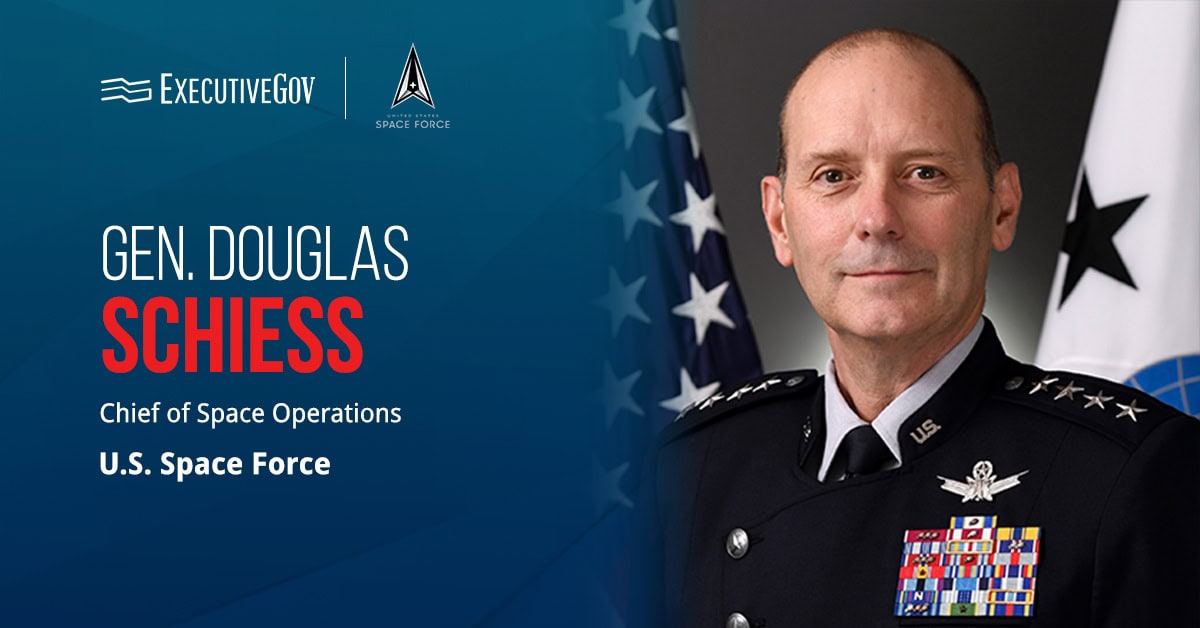
- Gen. Douglas Schiess has laid out three priorities for the Space Force
- Focus areas span culture, acquisition and force integration
- Schiess marked less than two weeks in his new role
Space Force Chief of Space Operations Gen. Douglas Schiess discussed his plans to reinforce the U.S. Space Force’s combat power during his keynote address at a conference Tuesday
Gen. Schiess plans to forge the Guardian ethos, arm and grow the Guardian force and integrate Guardian power at scale. The address came 12 days after he assumed responsibility as the Space Force’s senior uniformed leader following his Senate confirmation.
How Is the Space Force Approaching Acquisition Transformation?
The Space Force intends to make disciplined choices about how it builds and sustains its combat advantage. Schiess said this requires organizational structures and acquisition authorities that allow the service to deliver capabilities to the joint force more quickly.
As an example, Schiess pointed to a recent VICTUS HAZE mission, in which Space Systems Command, industry partners and Combat Forces Command launched and responded to an on-orbit threat within 17 hours.
He also said the Space Force faces adversaries that are developing counterspace systems at a rapid pace, and that the service must be prepared to defend the space domain rather than simply monitor it. Schiess noted that Guardians currently operate on-orbit weapons capable of defending the joint force against space-enabled attacks.
What Are Schiess’ Priorities for Guardian Ethos & Integrating Guardian Power?
Schiess said his top priority is building a Guardian ethos rooted in character, commitment, connection and courage, with every Guardian expected to identify as a Guardian first, regardless of specialty. He also cited support for Guardian families as part of that effort, pointing to ongoing work to strengthen support networks for those affected by operational stress.
On integrating Guardian power, Schiess said the Space Force is working to embed Guardians directly into joint operations, rather than in a supporting role. He cited one Guardian’s experience conducting non-kinetic fires under missile attack during Operation Epic Fury as an example of Guardians delivering spacepower directly into the fight.
How Do Schiess’ Priorities Align With Recent Space Force Developments?
During his confirmation testimony before Senate lawmakers, Schiess said the service must defend the nation’s space capabilities to enable Joint Force power projection, protect the Joint Force from space-enabled attack and deliver the capabilities needed to support its full range of missions.
A number of recent developments touch on those priorities. The Space Force is planning 2027 flight demonstrations for Golden Dome’s space-based interceptors and it has named Johns Hopkins APL as technical direction agent for the Space-Based Interceptor program. It has also committed more than $500 million in other transaction authorities to support its space combat power portfolio.
Separately, the service activated the 77th Surveillance Squadron for space-based target tracking, completed its Chalkydri IV battle management wargame, and tested the Hammer of the Gods system with the Army and Navy at Project Convergence Capstone 6.