
- More than half of federal technology executives said they are exploring agentic AI use within their agencies
- AI skills gap at federal civilian agencies can hamper technology adoption
- Learn more about the impact of agentic AI on the federal workforce at the 2026 FedCiv Summit on Oct. 29
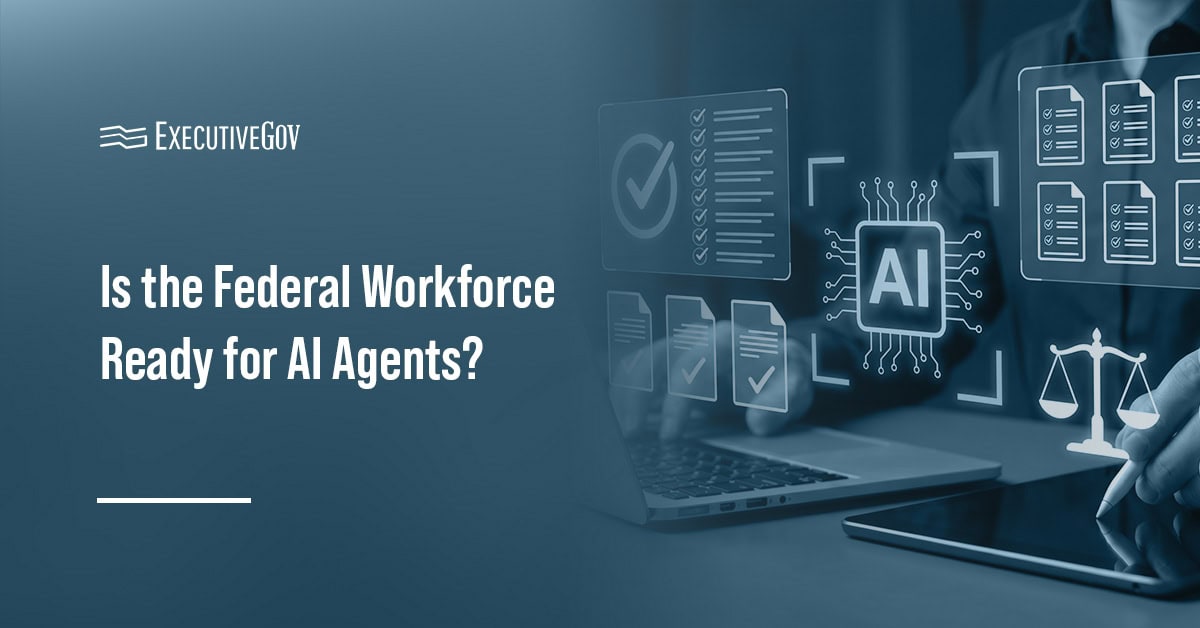
In 2026, government adoption of artificial intelligence has shifted from generative content creation to agentic AI, systems capable of managing multi-step processes with minimal human oversight.
According to a Market Connections survey sponsored by ServiceNow and reported by Nextgov/FCW, 53 percent of federal technology executives are exploring or actively piloting agentic AI. Another 15 percent said they have already implemented the technology within their agencies. Only 6 percent said they are still considering using agentic AI.
As autonomous systems assume greater operational responsibility across agencies, the federal workforce is undergoing a fundamental transformation, demanding new skills and redefining roles.

At the Potomac Officers Club’s 2026 FedCiv Summit on Oct. 29, the employment of agentic AI in the federal workforce will be the prime focus of the Digital Labor in the Workforce of Tomorrow panel. Attendees will hear about the technology’s impact on government workers directly from the agency leaders implementing modernization efforts and the industry innovators providing the advanced tools supporting federal workers. Secure your tickets today!
Table of Contents
How Are FedCiv Agencies Adopting Agentic AI?
At the Food and Drug Administration, agentic AI is already helping staff carry out various tasks, ranging from meeting management to pre-market reviews and post-market surveillance. Jeremy Walsh, the agency’s first chief AI officer, said the technology is expected to enable agency reviewers to streamline tasks and “ensure the safety and efficacy of regulated products.”
The Department of Veterans Affairs has deployed AI agents at its virtual contact center to support the collection of patient information for healthcare and treatment purposes. The agency awarded Salesforce a contract valued up to $1.6 billion in July to integrate AI into existing workflows. Salesforce said the AI agents will automate routing of triage cases and benefits verification and provide knowledge during live calls in real time.
The IRS has also implemented Salesforce’s AI platform, Agentforce, at the Office of Chief Counsel, Taxpayer Advocate Services and the Office of Appeals to process customer requests, Fox reported. Paul Tatum, executive vice president of global public sector solutions at Salesforce, assured that the AI agents will not disperse funds or make final decisions.
Federal AI adoption surged in 2025, with total use cases more than doubling year-over-year, according to the Office of Management and Budget. The Federal Agency AI Use Case Inventory issued in April has identified 3,611 use cases as more agencies deploy AI tools to support their missions.
How Does AI Skills Gap Affect Federal AI Adoption?
The lack of AI-relevant skills could become a barrier preventing agencies from reaping the technology’s benefits.
At the IRS, the Government Accountability Office warned in a March report that previous workforce cuts have led to a reduced number of employees with the skills needed to develop and support AI tools. The IRS also has not developed a workforce plan to address the skills gap, GAO added.
During a House Veterans’ Affairs Technology Modernization Subcommittee hearing in July, Rep. Nikki Budzinski, D-Ill., noted that some of the technologies that the VA has pushed to employees, such as automation and AI, produced incorrect information and even slow production, Nextgov/FCW reported.
Sterling Thomas, GAO’s chief scientist, told lawmakers that federal agencies need to build a workforce with the skills needed to harness new technologies. He proposed a federal digital services academy to help agencies, like the VA, create an AI-ready workforce.
At a recent event, Jessica Salyers, chief learning officer for the Veterans Health Administration, admitted that there is a growing need across the VA for AI skills development, adding that the agency is open to partnering with industry to support the integration of AI into functions, such as training and role-playing.
“We are open to trying to figure out what this could look like and make sure that it aligns with the priorities of the agency, the gaps in skills that we might be seeing, and doing it in a way where we still have enough trust in it that it makes sense for the type of conversations or the data that we would be presenting to it,” she shared via Federal News Network.
At the same event, John Salamone, chief human capital officer in the House of Representatives’ Office of the Chief Administrative Officer, explained that AI adoption requires overlapping skills.
“You need managing AI skills. You also need managing people skills — and then overlapping skills for both,” he explained. “I think any organization needs to be thinking about those things, in the maturity of their use of technology.”
Senior officials from the Department of Energy, General Services Administration (such as GSA Chief Human Capital Officer Arron Helm, pending confirmation), the Small Business Administration, the Department of Labor and other agencies will take the stage at the 2026 FedCiv Summit on Oct. 29. Register today!
What AI Hiring & Training Initiatives Has the Government Introduced?
The Office of Personnel Management, in partnership with OMB, the White House Office of Science Technology and Policy, General Services Administration and other agencies, established U.S. Tech Force, a program to recruit top technologists and fast-track AI adoption in government.
Under the program, early-career technologists can serve two-year employment terms in government, receive technical training, and engage with industry leaders and senior managers from tech companies partnering with Tech Force. Initial private sector partners include Amazon Web Services, Apple, IBM, Microsoft, Meta, NVIDIA and Palantir.
At the department-level, the VA previously said it was developing a workforce strategy that will establish an AI Corps, a group of 10 subject matter experts recruited through direct hiring or federal technology fellowship programs, to lead model design, data science and AI literacy. Additionally, as part of the strategy, employees who use computers will receive general-purpose training on the use of generative AI to ensure that staff at all levels can responsibly and effectively engage with the technology.
OPM also has an agency-wide ambassador program where employees learn how to use at least two AI platforms and then train five to 10 of their colleagues. Adam Starr, OPM’s chief information officer, revealed that roughly a quarter of the agency’s workforce has signed up for the program.
Who Are the Speakers on the 2026 FedCiv Summit‘s Digital Labor Panel?
The Digital Labor in the Workforce of Tomorrow panel at the 2026 FedCiv Summit on Oct. 29 will be an in-depth exploration of how agentic AI is transforming the federal workforce as more agencies adopt the technology in line with executive mandates and increased investments in IT. The discussion will cover the new skills the federal workforce needs to work with their new digital coworkers and the essential governance practices like monitoring key performance indicators, ensuring traceability and managing agent modifications.
All panelists are technology experts who have led initiatives to employ advanced AI capabilities to support operations. During the panel, they will share challenges they have experienced and strategies that worked within their respective organizations.
Andrea Brandon
Deputy Assistant Secretary for Budget, Finance, Grants and Acquisition
Department of the Interior
Brandon has served as the Interior Department’s DAS for budget, finance, grants and acquisitions since March 2019. In the role, she oversees department-wide budget, finance and related business IT systems.
She spearheaded department initiatives to employ robotic process automation technology to streamline contracting functions, including business data collection and document identification and review. She is also overseeing the development of DOI’s AI roadmap.
Brandon has had a storied career in government. Prior to her role at DOI, she served as deputy assistant secretary for the Office of Grants and Acquisition Policy and Accountability at the Department of Health and Human Services. She also held leadership roles at the Department of Homeland Security, the U.S. Department of Agriculture and OMBt.
She currently co-chairs the Grants Management Symposium working group for the National Academy of Public Administration and the OMB Chief Acquisition Officers Council and is a member of the Federal Acquisition Institute Board of Directors.
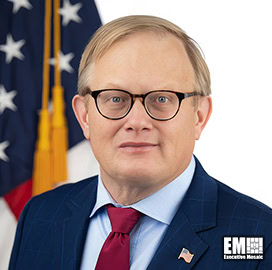
Gustav Chiarello
Assistant Secretary for Financial Resources
Department of Health and Human Services
The Senate confirmed Chiarello as assistant secretary for financial resources at HHS in October 2025. In March, his office launched the Audit Enforcement and Risk Oversight, or AERO, a national initiative that utilizes AI analytical tools to crack down on audit noncompliance and fraud in federally funded programs.
The antitrust and competition policy lawyer previously served as senior special counsel to the House Judiciary Committee and on the Subcommittee on the Administrative State, Regulatory Reform and Antitrust.
During the first Trump administration, he advised Maureen Ohlhausen, then acting chairman of the Federal Trade Commission, on matters related to antitrust and competition policy.
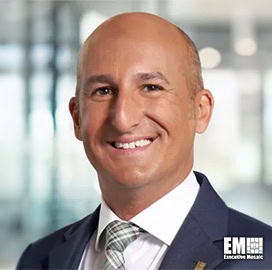
Karim Fadel
Vice President
Fadel is the head of AI go-to-market strategy and business development for CGI Federal’s Regulatory Agencies Programs business unit. In the role, he helps clients develop AI strategies that enhance efficiency and optimize operations.
CGI supports the modernization of agencies, such as DOI, the General Services Administration, the Environmental Protection Agency, the Nuclear Regulatory Commission, and the Department of Housing and Urban Development. Fadel shared in an interview with Federal News Network that, in collaboration with HUD, CGI deployed AI agents to call centers to record, transcribe, analyze and categorize tenant calls and provide data on a dashboard.
Fadel has been with CGI since 2010, when he joined the company as director of the federal proposal group. Prior to CGI, he served as senior manager and group lead for capture services at Deloitte. He also worked as a competitive intel manager and product marketing manager at ATG earlier in his career.
Connect with the leading figures in government and industry and join conversations that will shape the future of AI adoption in the federal landscape. Get your tickets for the 2026 FedCiv Summit today!