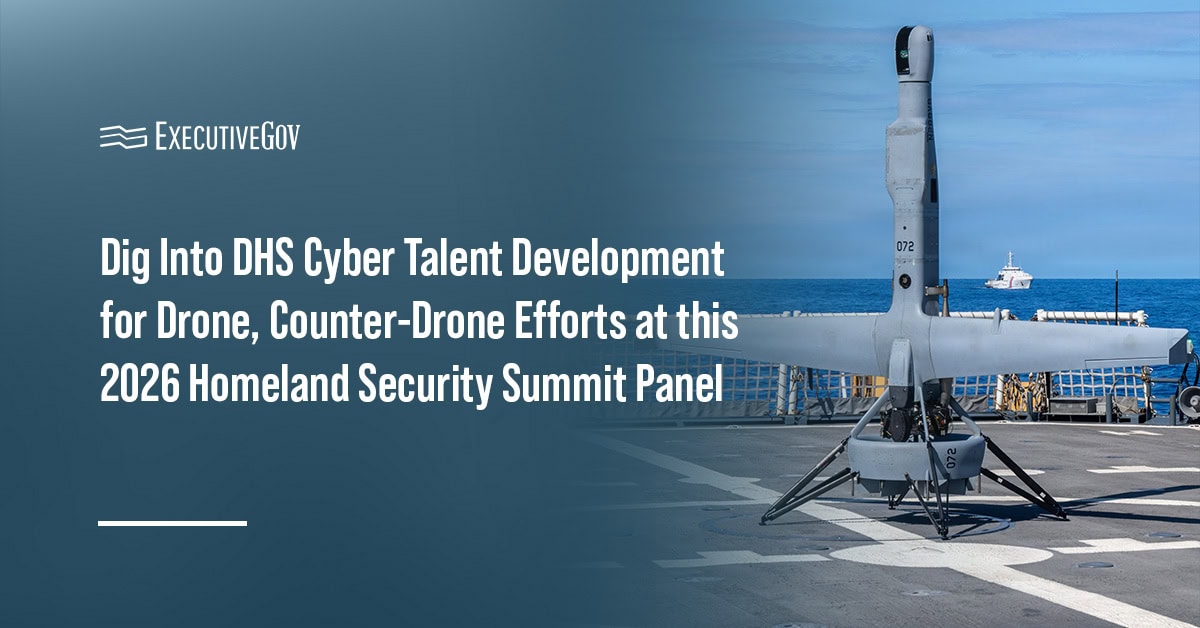
- DHS has a skilled cyber talent shortage while also investing in drone and counter-drone efforts
- Every drone network needs skilled cyber talent to protect it
- Learn about DHS cyber talent efforts and investment in UxS and C-UxS at the 2026 Homeland Security Summit!
The Department of Homeland Security finds itself in a unique pickle. On one hand, a persistent cybersecurity talent shortage has the department leveraging apprenticeships and Cybersecurity and Infrastructure Security Agency-led recruiting to staff operators who defend federal networks and critical infrastructure.
On another front, a newly-created Program Executive Office for Unmanned Aircraft Systems and Counter-Unmanned Aircraft Systems, supported by roughly $115 million, is streamlining UAS and C-UAS efforts across DHS subagencies like Customs and Border Protection and the Coast Guard. The goal is to counter fast-rising drone threats at the border, over essential infrastructure and at mass gatherings.
Neither fight succeeds on its own: every drone, sensor and counter-drone system runs on networks that someone has to secure. Fortunately, the Code and Drones panel at the Potomac Officers Club’s 2026 Homeland Security Summit on Nov 10 is a fantastic opportunity for GovCon technology professionals to dive into the details of how DHS subagencies are attracting and developing skilled talent for protecting drone networks while investing in both drone and counter-drone capabilities.
Let’s explore the context behind these critical efforts and learn why the Codes and Drones panel at the 2026 Homeland Security Summit is a can’t-miss engagement for every GovCon technology professional. Sign up now!
How Is DHS Attracting Skilled Talent for, and Investing in, Cyber and Unmanned Systems?
1. CISA Hiring Spree
About 250 potential CISA employees are awaiting clearance to start work having received tentative job offers, said acting Director Nick Anderson, according to NextGov/FCW. Anderson went on to describe the number as approximate and said CISA anticipates welcoming “hundreds” of new employees in the near future.
This hiring effort comes on the heels of drastic workforce cuts at CISA under the Trump administration that impacted roughly one-third of the office. Anderson previously described plans to hire about 330 people, while Markwayne Mullin, homeland security secretary, previously said that the agency needed about 600 more employees and that it could take about one year to bring them on.
2. CISA Workforce Training Efforts
DHS is performing a variety of workforce training efforts to develop the skilled talent necessary for these key positions. The agency’s Cybersecurity Apprenticeship Program, targeted to college students, offers part time positions throughout the agency.
The CAP hopes that allowing students to work side-by-side with experts in cyber will help them develop valuable work experience and allow them to apply concepts, protocols and tools acquired through their academic coursework. Participants may have the opportunity for conversion to full-time employment upon graduation. Participating DHS subcomponents in the CAP include CISA, Immigration and Customs Enforcement, DHS headquarters and U.S. Secret Service.
CISA’s Cybersecurity Workforce Development and Training Program, or CWD, leverages cooperative agreements with community-based non-profits to provide outreach to, and training, for potential cybersecurity staff of all ages. The program offers cyber scholarships of up to $27,000 for undergraduate degrees and as much as $37,000 for graduate degrees.
CWD works with organizations such as Per Scholas, which seeks to connect skilled talent to employment in cities including Newark, Chicago and St. Louis; and the South Memphis Renewal Community Development Corporation, based in Memphis, Tenn.
3. CISA Reforming Pay Incentives
CISA has revised a pay incentive policy under criteria that binds eligibility to employment series and performance ratings, Federal News Network reported.
The agency will continue offering the Cybersecurity Retention Incentive program through FY27. The effort can boost pay for qualifying employees by up to 25 percent of their base salary.
CISA previously intended to eliminate the incentives program. This was in the wake of a DHS inspector general report that found the agency mismanaged the program.
Under the revised program, employees have to be in the IT Management Series, the Mathematical Science Series or the Computer and Electronics Engineering Series to qualify for the incentive payments. Staff also must spend more than 51 percent of their time on cyber work to be eligible.
4. Budget Commitments in UAS and C-UAS
DHS subagencies are budgeting for new UAS and C-UAS tech. The Coast Guard requested $69 million for drone and $22 million for counter-drone capabilities in fiscal year 2027. It’s also seeking $130 million for the initial operational capability of the Program Executive Office for Robotics and Autonomous Systems, a.k.a PEO RAS, among other activities.
PEO RAS, launched in August, has a goal of speeding up the development, procurement, deployment and sustainment of robotic and autonomous systems across the USCG. The office supervises the capability lifecycle, including contracting and setting requirements.
CBP requested $80 million in FY27 to improve C-UAS to improve its C-UAS capabilities. It also requested a $3 million increase for its UAS program to account for cost escalation and increased flight hours of its General Atomics MQ-9 UAS. CBP operates nine MQ-9s.
Who Will Be on the Code and Drones Panel at the 2026 Homeland Security Summit?
Let’s dive into the unique backgrounds and attributes of the speakers on the Codes and Drones panel.

Vice President for Mission Acceleration and Electronic Warfare, CACI
Erik Grant is VP for mission acceleration and electronic warfare at CACI. He previously served as the company’s VP for counter-unmanned systems for four years, helping develop the SkyValor C-UAS system in under six months for the Falcon Peak 25.2 demonstration. Prior to CACI, Grant spent 16 years at Raytheon in various senior business and engineering leadership roles.

CEO, Xpect Solutions
Yusuf Abdul-Salaam is CEO of Xpect Solutions, a systems integrator providing IT and physical security services. The company has expertise in enterprise security and IT services and the digital, data and cybersecurity realms. Abdul-Salaam previously served in leadership roles at Paradyme, ECS and DHA Group.

Chief Strategy and Corporate Development Officer, Everfox
Clarence Hinton is chief strategy and corporate development officer at Everfox. He has more than 20 years experience delivering over $50 billion in enterprise value through strategic transformation, mergers and acquisitions, and venture investment. At Everfox, Hinton is shaping and scaling strategic partnerships across the defense, intelligence and technology ecosystem. He previously spent seven years at CyberArk as chief strategy officer and head of corporate development.

Vice President for Secure Communications, BlackBerry
David Wiseman is VP for secure communications at BlackBerry. He works with governments and enterprise customers around the world, especially in the defense sector, to provide communications capabilities with certifications up through classified. He also manages all phases of the product lifecycle by identifying market needs, designing product vision and strategy, and defining a go-to-market strategy through sales channel development, customer enablement and success. He has served in vice president positions at BlackBerry since 2014.

CEO, Protora (moderator)
Dave Abel is CEO of Protora, a radar and surveillance company. He has more than 30 years of experience leading growth, complex transformations and platform creation in mission-critical markets. Prior to joining Protora, Abel was CEO of Aventiv Technologies, a technology company serving corrections and law enforcement, generating over $600 million in annual net revenue. Abel earlier in his career held senior leadership roles at IBM and PwC.