
- USPTO has tapped a new leader for AI and emerging technology
- The agency has fielded more than 20 AI tools, with more under evaluation
- The 2026 FedCiv Summit on Oct. 29 will explore AI-driven modernization and more
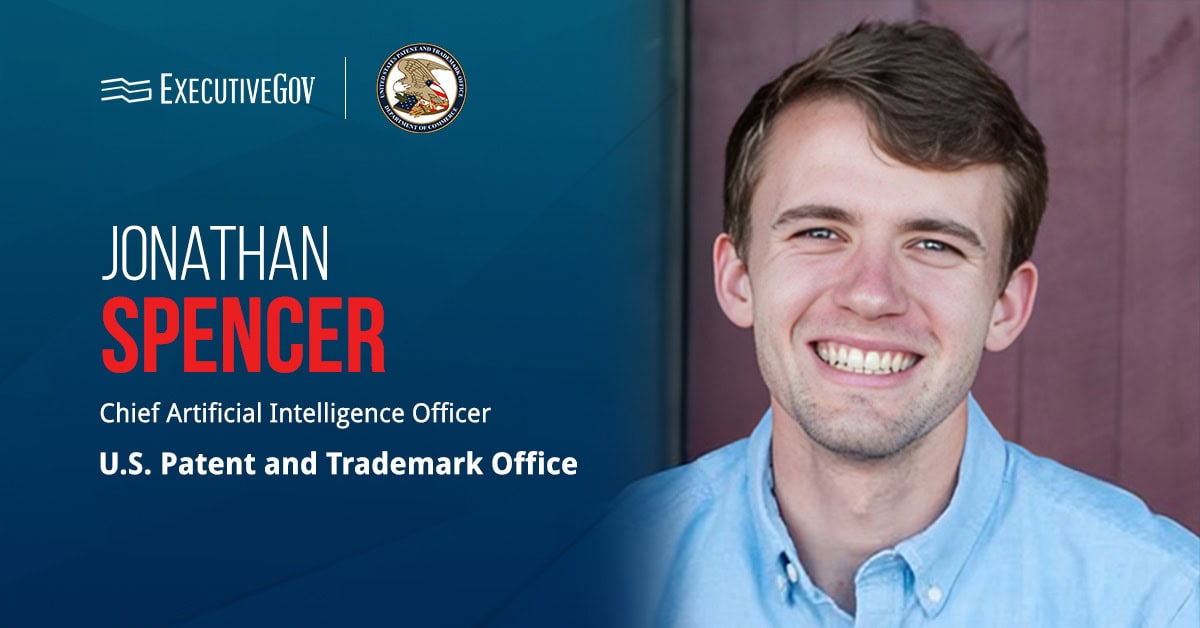
The U.S. Patent and Trademark Office has appointed Jonathan Spencer, a machine learning researcher and former Waymo technologist, as chief artificial intelligence officer.

Federal civilian agencies are expanding their use of AI to modernize operations and improve services to the public. Senior officials and industry executives will examine these efforts at the Potomac Officers Club’s 2026 FedCiv Summit on Oct. 29, which will feature panel discussions on using AI to speed agency modernization and migration, the future of federal shared services, AI’s role in civilian IT and mission outcomes, and interoperability and trusted information-sharing. Save your spot to hear how agencies are putting AI to work.
What Will Spencer Do at USPTO?
In his new role, Spencer will lead the agency’s work on AI and emerging technologies, USPTO said Tuesday. He will collaborate with agency leadership to develop, modernize and deploy AI systems, with a focus on using new technologies to benefit innovators. The appointment is also intended to support wider AI use across agency workflows and engagement with stakeholders.
John Squires, director of USPTO and under secretary of commerce for intellectual property, said Spencer’s expertise in AI, machine learning and emerging technologies will support the agency’s ongoing effort to modernize its systems and processes.
“Jonathan will help us ensure that the USPTO remains at the forefront of deploying innovative technologies and advancing the mission of American ingenuity,” Squires added.
How Is USPTO Using AI?
The new leadership role coincides with a broader push by USPTO to integrate AI into its operations. Chief Information Officer Deborah Stephens said Wednesday during a webinar that USPTO has deployed more than 20 AI capabilities as it transitions to fully cloud-based operations, FedScoop reported.
According to Stephens, the agency has applied AI in its call centers to close service gaps affecting both employees and the public, and it launched an internal service portal with a chatbot in September. She said an enterprise adoption team, an AI academy, an AI hub and an AI governance council support the office’s AI efforts.
Stephens, who became the agency’s permanent CIO in June, said USPTO is finalizing an AI strategy it plans to publish. Until then, the office is “looking at adoption metrics and usage all the time,” she added.
She also discussed future tools under evaluation, including solutions to locate trademark evidence and to draft office actions for patents and trademarks.
Who Is Jonathan Spencer?
Spencer is an electrical and software engineer whose research and industry work covers AI, machine learning, language modeling and robotics.
He spent four years at Waymo developing AI models for the company’s autonomous vehicles, helping grow fully driverless travel from 5,000 miles to 5 million miles per week. He has also co-founded several startups using AI in healthcare, telecommunications and hardware testing.
Spencer holds a doctorate in electrical engineering from Princeton University, where his research focused on imitation learning algorithms for training physical AI systems with human input. He also earned bachelor’s and master’s degrees in the field from Brigham Young University.
In addition, he has lectured on AI, reinforcement learning, electrical engineering and radar signal processing. He also holds a patent for a phased array radar design.
What Other AI Initiatives Has USPTO Advanced?
The latest appointment follows USPTO’s move in October 2025 to open applications for a new chief AI officer, a role designed to serve as the principal adviser to the CIO and deputy CIO on delivering business value through AI and machine learning implementation.
Spencer’s appointment comes as the agency deploys AI tools across its patent and trademark operations. In March, USPTO launched Class ACT, an AI platform that assigns international classes, design search codes and pseudo marks to unclassified trademark applications, and said it plans to introduce additional AI-enabled trademark tools in the future.
The agency also rolled out an AI-based pilot program to streamline patent applications in October 2025. Squires described the pilot as the inaugural release in a wave of planned AI pilots to support patent examiners and applicants.