
- Gen. Christopher LaNeve has set FASCOM’s autonomy agenda
- Army corps to experiment with autonomous formations and mission sets
- The 2027 Defense R&D Summit will explore trusted AI, quantum and more
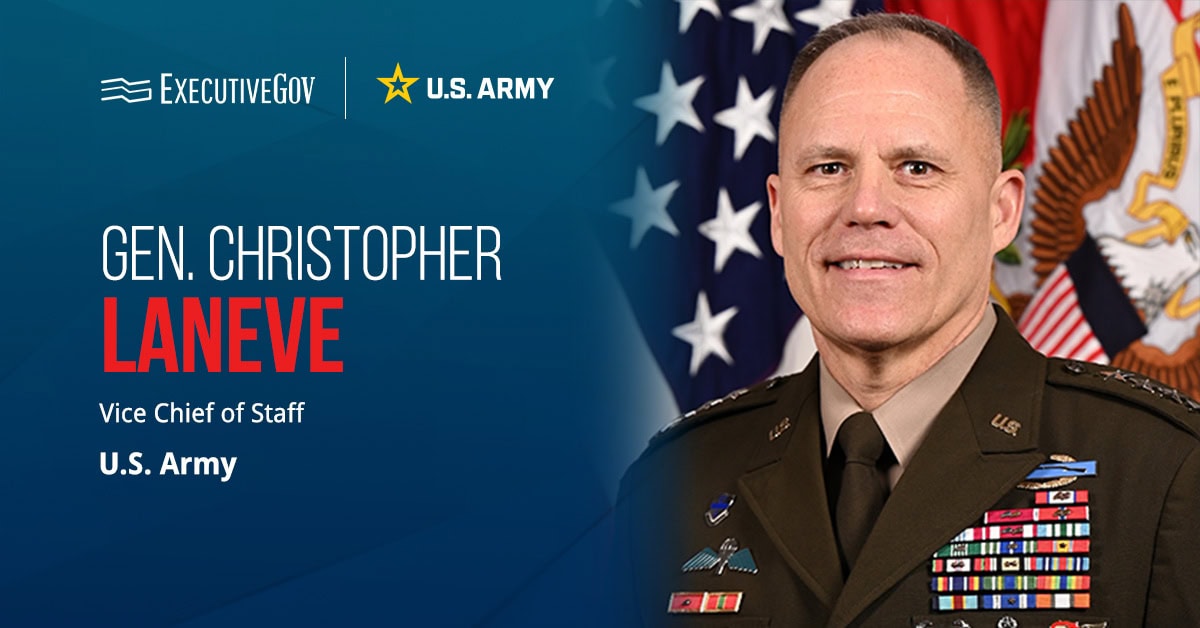
Gen. Christopher LaNeve, the Army’s vice chief of staff and acting chief of staff, has picked U.S. Army Futures and Concepts Command to be renamed Army Futures and Autonomous Systems Command, or FASCOM, as part of the service’s push to bring autonomous technologies into its formations.

As the Army realigns its modernization enterprise around autonomy, research and development investment continues to shape how the service and its industry partners prepare for future conflict. The Potomac Officers Club’s 2027 Defense R&D Summit on Feb. 4 will bring together DOW and national security technology officials to discuss unmanned systems, trusted artificial intelligence and autonomy, quantum computing, directed energy and more. Register now to gain insight into where defense R&D budgets are headed.
The Army said Tuesday LaNeve made the decision after Acting Army Secretary Adam Telle issued a memo on Oct. 1 outlining the service’s autonomous initiatives.
What Is FASCOM?
FASCOM is a three-star-led Army command that will bring together and speed up work across Combat Capabilities Development Command, Medical Research and Development Command, Joint Modernization Command, 75th Innovation Command and the Transformation Decision Analysis Center.
Combining these organizations gives the Army’s new Portfolio Acquisition Executive for Autonomy a single base of technical expertise to draw from as it carries out Telle’s order for the fast integration of autonomous systems across the force.
Telle’s directive, which assigned the Army vice chief to stand up FASCOM, also makes autonomous fires, combat vehicles, breaching, watercraft resupply, reconnaissance and crewed-uncrewed teaming the service’s acquisition and deployment priorities through fiscal year 2028.
What Has LaNeve Directed FASCOM to Do?
LaNeve’s first task for FASCOM is to build corps-level autonomous capabilities. All five Army corps will test equipment, assess tactics and recommend ways to carry out autonomous missions, with proven concepts to be expanded across the service.
The experiments include autonomous fires, watercraft, armored reconnaissance, breaching, aerial intelligence, surveillance and reconnaissance, and lift units across I Corps, III Corps, V Corps and XVIII Airborne Corps. In 8th Army, attack aviation pilots will control unmanned aircraft sensors for over-the-horizon targeting, a concept developed at Fort Rucker in Alabama, which LaNeve has designated as the Army’s UAS Autonomy Center of Excellence.
FASCOM will also form capability-based formations centered on autonomous long-range fires, protection, tanks, logistics and obstacle breaching. These formations align with the four elements of the Army’s recently released operational warfighting guidance and will receive some of the service’s first 390A Robotic Technicians.
What Did LaNeve Say About FASCOM?
LaNeve said FASCOM’s mission extends past unmanned aircraft.
“This goes beyond drones. FASCOM will pioneer operational concepts that harness autonomous capabilities across all warfighting functions,” the general said.
He added that the Army must move toward rethinking how it fights rather than adding technology onto existing approaches.
“We’ve got to change our approach from bolting on technology to rethinking how we fight. Acting Secretary Telle and I see things the same way. Technology doesn’t fight; Soldiers do. Our job is to get them the best kit; theirs is to make it lethal. It’s that magic between industry, leadership, and Soldiers that keeps our Army ahead of anyone looking to do America harm,” LaNeve noted.