
- Sandia has appointed its first chief AI officer
- Leland will guide AI adoption across the lab’s national security work
- The 2026 FedCiv Summit will explore AI, shared services and more
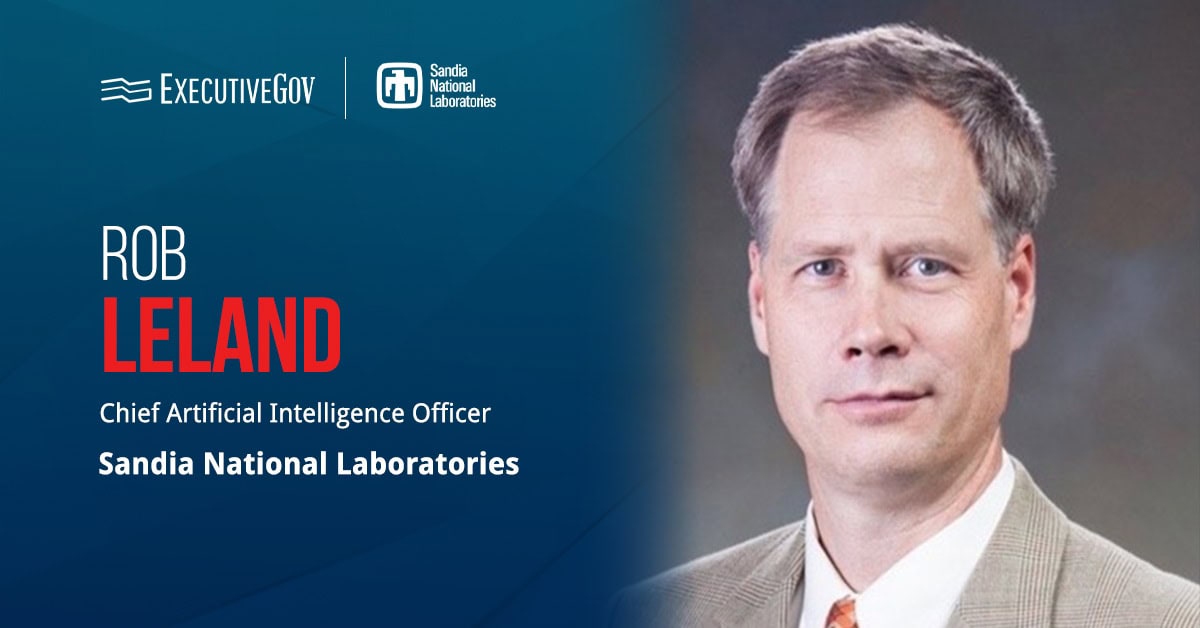
Rob Leland, who previously led the Nuclear Deterrence Systems Center at Sandia National Laboratories, has been named the lab’s first chief artificial intelligence officer.

As Sandia moves to embed AI into its national security missions, federal civilian agencies are also advancing their own technology modernization agendas. The Potomac Officers Club’s 2026 FedCiv Summit on Oct. 29 will bring together government and industry leaders to discuss AI, federal shared services, OneGov, AI-driven IT modernization and more. Save your seat now to hear from the officials shaping the future of federal civilian technology.
Sandia Labs Director Laura McGill made the appointment to advance rapid and responsible AI adoption across the lab, Sandia said Thursday.
What Are Leland’s Priorities as Chief AI Officer?
Leland has outlined three priorities for the role: using AI to speed up engineering work for national security; raising the productivity of Sandia’s supporting operations; and enhancing each employee’s experience with AI at work.
“If we can adopt this technology effectively, we can have a profound effect on the national security posture of the country,” Leland said.
On the engineering front, he aims to build on the Aires Tide project, which produced an AI-designed, 3D-printed concept flight test vehicle, and transition that capability into a program of record. Leland said productivity gains in support operations would allow staff to make faster progress on mission work.
To improve access to AI, Sandia is expanding infrastructure, tools and training, and plans to offer automated coding tools to the broader workforce early next year following a pilot.
Leland added that the lab must deploy AI safely and securely in high-consequence environments.
“We should be leaders in articulating the right approach to secure AI use,” he said.
Who Is Rob Leland?
Leland is a longtime Sandia executive whose career spans computing research, IT and national security programs. In his most recent role as head of the Nuclear Deterrence Systems Center, he directed work showing how AI could speed up the engineering design of nuclear weapons components and systems.
He joined Sandia in 1990 as a high-performance computing researcher and later held director-level posts overseeing computing research, computing and network services, and climate security. He went on to serve as vice president for science and technology and chief technology officer, managing the lab’s research organization, and also led its Climate Change Security Center.
From 2017 until his return to Sandia in 2021, Leland served as associate lab director for scientific computing and energy analysis at the National Renewable Energy Laboratory. His government experience includes a 2014 stint at the White House Office of Science and Technology Policy, where he led development of the National Strategic Computing Initiative, and a 1995 White House fellowship at the Department of the Treasury.
Leland holds a bachelor’s degree in electrical engineering from Michigan State University and a doctorate in applied mathematics from Oxford University.
What Other Recent Developments Involve Sandia?
Leland’s appointment comes as Sandia expands its work in emerging technologies. In August, the lab partnered with IonQ to advance quantum technology development. The two organizations are working together on quantum system co-design and mission-focused applications.
The lab is expanding its research infrastructure through a plan to invest $5 billion in new research and development facilities over 10 years, supporting work in areas such as AI, quantum computing and materials science. Sandia has joined the National Semiconductor Technology Center to help bolster U.S. semiconductor manufacturing and research.