
- Homeland Security Investigations has a three-pronged strategy for acquiring better tech tools
- This includes modernization of Investigative Case Management and using AI and machine learning
- Hear from HSI’s Shawn Fallah at the 2026 Homeland Security Summit this coming Tuesday—Nov. 10!
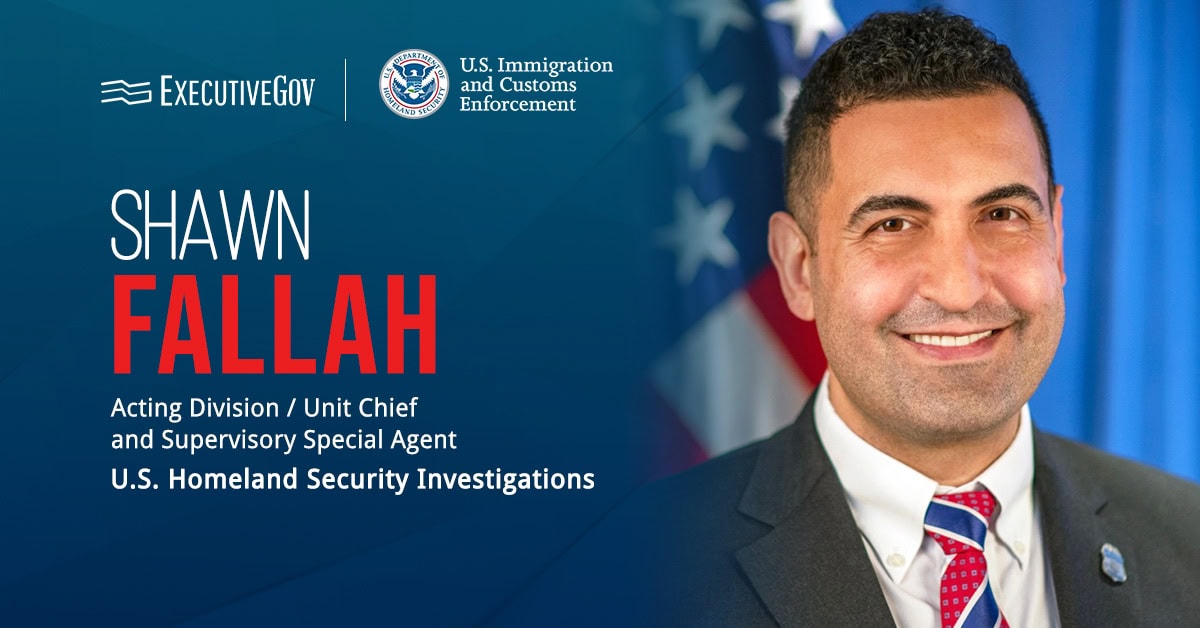
Homeland Security Investigations’ Shawn Fallah wants to free the agency’s agents and analysts to do what humans do best: make judgement calls.
Fallah, HSI acting division/unit chief and supervisory special agent, gave ExecutiveGov an exclusive interview ahead of his appearance on the Connecting the Dots panel at the Potomac Officers Club’s 2026 Homeland Security Summit on Nov. 10. Fallah said HSI has a three-pronged strategy for giving investigators better technology tools: modernizing the Investigative Case Management platform, releasing Investigative Analytics, a cloud-based, government-owned apparatus used at the HSI Innovation Lab, and using AI and machine learning to reduce manual work.
“Investigators shouldn’t spend their days fighting their tools,” Fallah said. “If we get the technology right, agents and analysts get time back for the work that needs a person. Technology is a force multiplier.”
Get your pressing questions answered by Fallah at the Potomac Officers Club’s 2026 Homeland Security Summit this Tuesday, Nov. 10. At the Connecting the Dots panel discussion, hear Fallah dive into AI-driven entity resolution and link analysis, and linking financial travel and social media data. Discover uncovering connections traditional methods miss. Secure your seat today!
Why Is HSI Transitioning to ICM 2.0?
HSI’s transition to ICM 2.0, a low-code / no-code platform, will allow agents to change workflows in days instead of waiting on a long development cycle. This is a big win for agents and analysts, Fallah said. HSI, which is a division of Immigrations and Customs Enforcement, has a goal of going live with ICM 2.0 in summer 2027.
Investigative Analytics is built to flex as the mission changes. Fallah said agents and analysts can upload and analyze data, search across databases, surface connections agents miss, and prioritize and validate targets based on what the data shows.
HSI also has its Athena suite of rapid prototyping tools, built with national labs and federally-funded research and development center, or FFRDC, partners and shaped by field feedback. Fallah said people use it to search datasets, map communication networks, clean up and standardize data and share findings.
How Is HSI Using AI and ML?
HSI is using AI and ML to help agents and analysts spend their time building solid cases. Fallah said narcotics and financial cases that used Athena in FY25 saw around 60 percent more seizures and about 30 percent more arrests.
“Technology doesn’t replace judgement,” Fallah said. “It clears the clutter so people can use it.”
HSI in September released its Athena AI Assistant that lives inside the Athena chat. It can help draft documents, organize case files in workspaces, walk users through a tool and analyze uploads.
Are you a GovCon technology professional? Then you cannot afford to miss the Potomac Officers Club’s 2026 Homeland Security Summit this coming Tuesday, Nov. 10. Our stellar lineup of keynote speakers from the top echelons of federal leadership will provide technology spending insights unavailable anywhere else to power your GovCon revenues in fiscal year 2027:
- Sean Curran, U.S. Secret Service director
- Bobby Thompson, U.S. Cybersecurity and Infrastructure Security Agency acting associate director for threat hunting
- Troy Edgar, Department of Homeland Security deputy secretary
- Sonny Bhagowalia, U.S. Customs and Border Protection chief information officer and Office of Information and Technology assistant commissioner
- Paul Courtney, DHS chief procurement officer (pending confirmation)
Sign up now for this essential GovCon conference!
HSI’s New Superuser Network
Fallah believes that technology that doesn’t get buy-in from field agents doesn’t last. That’s why HSI is building a Superuser network across its 29 Special Agent in Charge offices. These Superusers, he said, act as the go-to person in their area, helping test early builds, keep colleagues up to speed, answer first-line questions and bring honest feedback to the program team and its second line. Interest has been strong in the Superuser network, Fallah added.
Technology doesn’t replace judgement. It clears the clutter so people can use it.
Fallah is most excited about open-source and open-weight models. He said they are opening up many practical use cases because they are now capable enough to run on local, secure servers inside an organization’s own environment.
This will be transformative for HSI’s most sensitive cases, Fallah said, such as child sexual abuse material investigations, where images are vectorized so they can be linked and mapped to previously identified victims in support of prosecution. Users don’t always need a giant frontier model in the cloud and, sometimes, it’s best to host models locally to safeguard the data, Fallah said.
“I’m bullish on where AI and ML are going,” he said. “The tools are getting better and more practical, and the cost of using them keeps dropping.”