

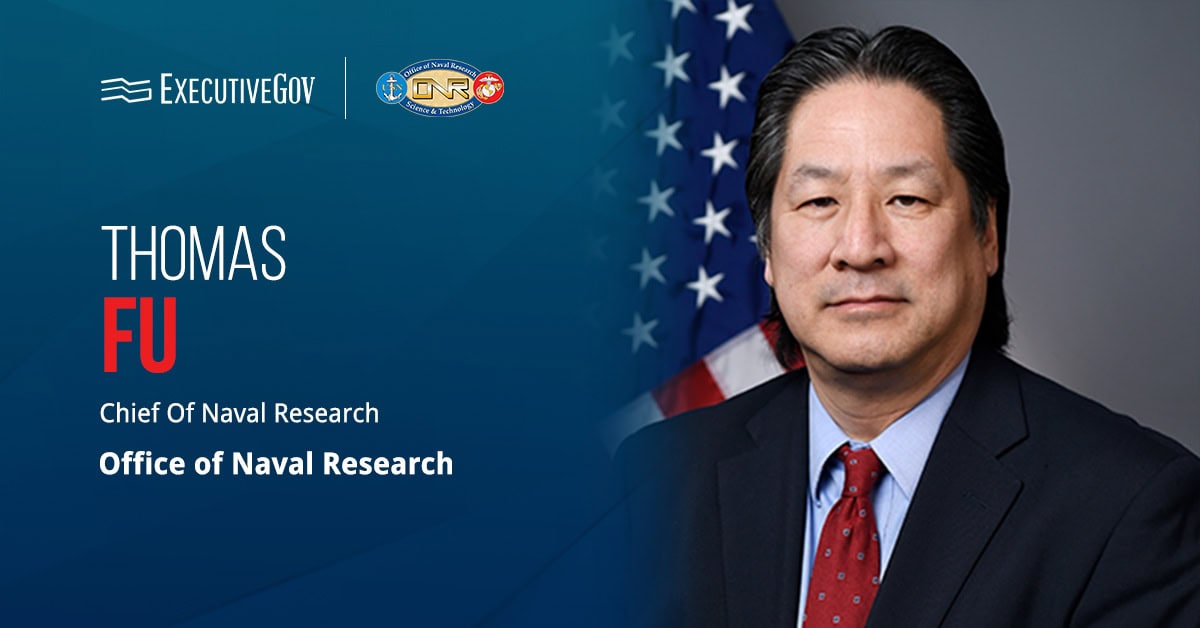
- Dr. Thomas Fu now leads the Office of Naval Research as chief of naval research
- Acting Secretary of the Navy Hung Cao said Fu’s continuity keeps ONR an “essential bridge” for new technology
- Fu pledged to advance disruptive technologies like directed energy for the Fleet
Dr. Thomas Fu has been named chief of naval research at the Office of Naval Research, or ONR, by Acting Navy Secretary and 2026 Wash100 Award popular vote winner Hung Cao. In his elevated role, Fu, who also serves as ONR’s chief scientist and executive director, will lead the Navy’s primary science and technology command, succeeding Dr. Rachel Riley.
Who Is Dr. Thomas Fu and What Is His Background?
Fu brings nearly four decades of federal civilian service and expertise in naval hydrodynamics and platform engineering to the top leadership role at ONR.
His career began in 1988 at the Naval Surface Warfare Center Carderock Division, where he led breakthroughs in acoustic stealth, propulsion efficiency and platform survivability before taking charge of the Resistance & Propulsion Division. He entered the Senior Executive Service in 2015 as director of the Advanced Naval Platforms Division and later headed ONR’s Sea Warfare and Weapons Department, directing research in power systems, undersea weaponry and platform autonomy.
An author of over 140 technical publications, Fu holds degrees from Purdue University, the Scripps Institution of Oceanography and Johns Hopkins University. His honors include the SNAME David W. Taylor Medal, the David Packard Excellence in Acquisition Award and recognition as Asian-American Engineer of the Year.
How Does Fu’s Appointment Affect ONR’s Leadership Continuity?
Fu’s appointment provides leadership stability for the Navy’s science and technology enterprise as outgoing Chief of Naval Research Dr. Rachel Riley transitions to an organizational change role. Cao, a speaker at the recently concluded Potomac Officers Club’s 2026 Navy Summit, stated that Fu’s institutional knowledge ensures ONR remains a bridge between laboratory research and fleet deployment.
“Maintaining a technological advantage in an era of strategic competition requires disciplined, experienced and uninterrupted leadership focused on rapid innovation and warfighter support,” Cao said. “As Dr. Rachel Riley departs the office, the continuity provided by Dr. Fu ensures ONR will continue to serve as an essential bridge.”
What Priorities Will Fu Pursue as ONR Marks Its 80th Anniversary?
As ONR marks its 80th anniversary, Fu will prioritize transitioning autonomous systems, directed energy weapons, advanced sensors and combat systems to U.S. forces. He will oversee these efforts across ONR headquarters, ONR global and the Naval Research Laboratory while expanding partnerships across academia, industry and government.
“Providing America’s warfighters with the most sophisticated technologies and disruptive capabilities is critical on the modern battlefield,” Fu said. “I am honored to step into this role and lead ONR’s mission to articulate and coordinate amongst the world’s best minds across academia, industry and government.”
The office recently outlined its 2026 science and technology strategy, and the Navy stood up a new robotic and autonomous systems office.