

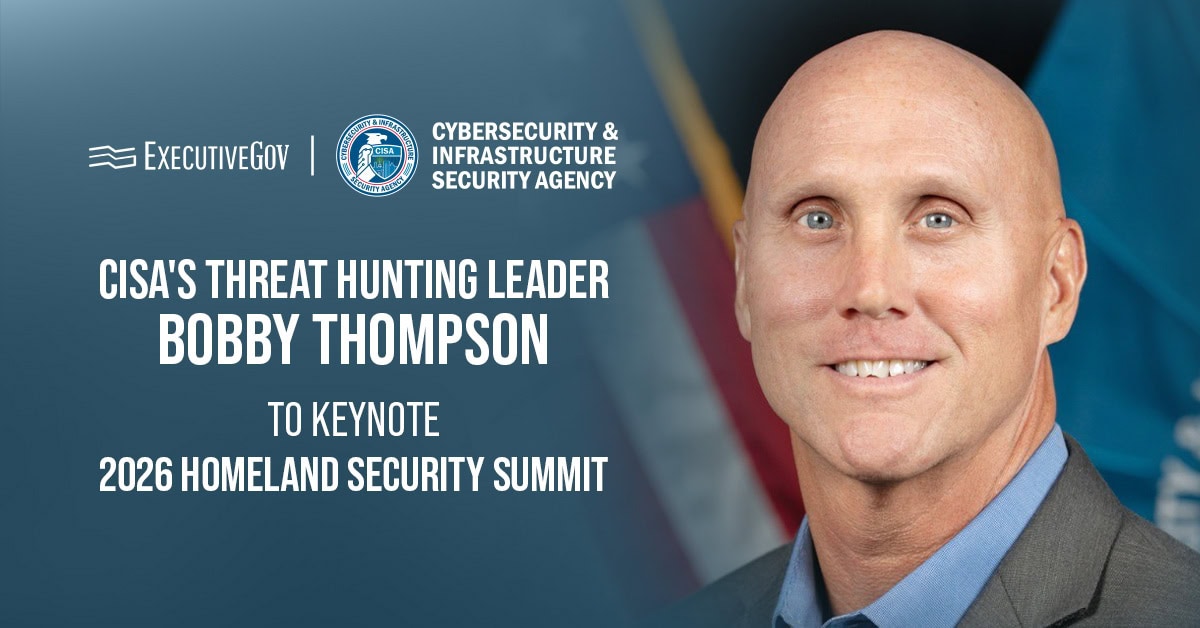
- Thompson played a key role in the government’s response to Salt Typhoon and SolarWinds cyberattacks
- Thompson’s keynote comes ahead of CISA’s planned competition for a $100M threat hunting contract
- His 2026 Homeland Security Summit keynote may cover AI use in threat hunting and industry partnership opportunities
Bobby Thompson, acting associate director for threat hunting at the Cybersecurity and Infrastructure Security Agency, will keynote the Potomac Officers Club’s 2026 Homeland Security Summit on Nov. 10 at the Ritz-Carlton, Tysons Corner in Virginia.
He joins a stellar lineup of keynote speakers who lead some of the nation’s most critical Homeland Security programs:
- Troy Edgar, deputy secretary of the Department of Homeland Security
- Paul Courtney, chief procurement officer at DHS (pending approval)
- Sean Curran, director of the U.S. Secret Service
- More will be announced soon!
The administration has requested a $2.49 billion budget for CISA in fiscal 2027. The proposal, according to budget documents released by the White House, will refocus the agency to its core mission of securing the cyber domain and safeguarding critical infrastructures.

Thompson can provide insight into how CISA is evolving to meet the president’s vision for the agency and countering sophisticated cyberthreats fueled by advanced technologies, such as agentic artificial intelligence, while operating in a more constrained financial environment. Get your tickets here to get insights from one of the federal government’s top cyber defenders!
Who Is Bobby Thompson?
Thompson is a cybersecurity expert with over 20 years of experience focused on national security and safeguarding critical infrastructures. He was appointed as acting associate director of the unit after Jermaine Roebuck stepped down from the role in early 2026, Nextgov/FCW reported.
Thompson also serves as deputy associate director of the threat hunting unit, overseeing a team of more than 700 professionals tasked with safeguarding the nation’s most critical networks.
He played a key role in the government’s response to high-profile hacking events, such as the Salt Typhoon attack, during which a China-backed cyber group infiltrated U.S. telecommunication networks, and the SolarWinds Russian malware attack, which experts have linked to Russia’s Foreign Intelligence Service.
He also previously held the role of deputy assistant director for vulnerability management at CISA.
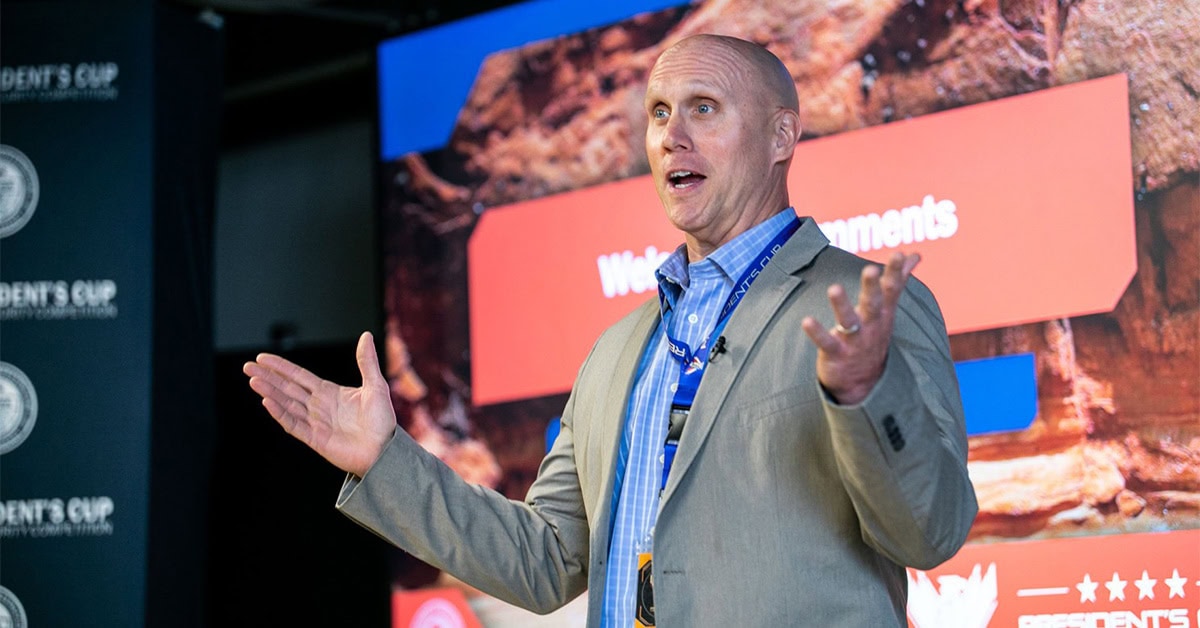
What Are the Responsibilities of CISA’s Threat Hunting Unit?
The threat hunting unit works with intelligence analysts and law enforcement to identify malicious cyber activities and mitigate threats to U.S. organizations and infrastructure. According to a congressional report released in 2023, the unit, a subdivision of CISA’s Cybersecurity Division, is uniquely positioned to access data from federal civilian executive branch agencies, the intelligence community, the Department of War, federal law enforcement partners, and state, local, territorial and tribal agencies to execute its mission.
It also engages with the private sector through CISA’s Joint Cyber Defense Collaborative and partner cybersecurity firms to detect, monitor, understand and rapidly mitigate cyberthreats.
What Are the Upcoming Contract Opportunities at CISA’s Threat Hunting Unit?
Thompson’s keynote comes ahead of CISA’s upcoming competition for the $100 million Cyber Technology Services contract to support cybersecurity operations, including incident response and threat hunting. In an entry on the Department of Homeland Security’s Acquisition Planning Forecast System posted in June, CISA said it expects to compete the requirement through the General Services Administration Schedule contract vehicle.
Under the planned contract, the selected contractor will support the sustainment of government operational networks and technologies used for incident response and proactive cyber hunting missions. The contractor will also provide custom tool development, management and maintenance to ensure integration with DHS and CISA enterprise and mission networks.
CISA did not provide an exact timeline when an official request for proposal will be issued, but the agency anticipates that a contract award will be made in the fourth quarter of FY27.
What Will Bobby Thompson Discuss During His Keynote?
Thompson is expected to provide an inside look at the federal government’s frontline cyber defense operations and how CISA’s threat hunting unit is positioning itself to protect federal networks and critical infrastructure from increasingly sophisticated adversaries during his 2026 Homeland Security Summit keynote.
Drawing from his experience in threat hunting and vulnerability management, attendees may hear about:
- Lessons from Salt Typhoon and SolarWinds cyberattacks
- China- and Russia-linked threats to critical infrastructure
- The role of the private sector in incident response and proactive hunt missions
- Industry partnerships and CISA’s upcoming Cyber Technology Services
- Information sharing across government and industry
- The use of emerging technology, such as AI, in threat hunting
His perspective may help companies anticipate upcoming requirements, identify partnership opportunities and position their offerings to support the agency’s evolving needs.
Why Should GovCons Attend the 2026 Homeland Security Summit?
The Potomac Officers Club’s 2026 Homeland Security Summit is an important gathering where the top decision-makers across DHS and its components meet with industry leaders to discuss how the private sector can respond to the department’s technology needs.
DHS is seeking funding of $118 billion for FY27. The summit creates an opportunity for GovCons to hear directly from agency leaders how those funds will be invested to support border security, cybersecurity, critical infrastructure protection and other mission areas.
Other speakers from government include:
- Jay Alalasundaram, deputy assistant commissioner for software applications and services at the U.S. Customs and Border Protection
- Julie Brewer, executive director for the Office of Innovation and Collaboration at DHS’ Science and Technology Directorate
- Capt. Chad R. Brick, inaugural chief of the Coast Guard’s Office of Rapid Response and Prototyping RAPTOR
- Anthony C. Crane, executive director of the Countering Unmanned Aircraft Systems Defense Capability Group at CBP
- Baibhav “BoBo” Devkota, executive director of the Border Enforcement and Management Systems Directorate at CBP
- Matthew Elliston, assistant director for enforcement and removals operations at the U.S. Immigration and Customs Enforcement
- Shawn Fallah, chief of the Cyber and Operational Technology Directorate at Homeland Security Investigations
- Daryle Hernandez, head of the Interagency Security Committee at CISA
- Russ Hott, assistant director of enforcement and removal operations for the Public Safety Partnership Division at ICE
- Chris Kraft, chief information officer at the U.S. Secret Service
- Adam Luke, principal deputy under secretary for the DHS Office of Intelligence and Analysis
- Eric McLoughlin, assistant director at HSI
- Gary Owen, associate administrator for the Drug Enforcement Administration
- Ruynard Singleton, executive director for the CBP’s Program Management Office Directorate
- Scott St. Pierre, chief information officer of the U.S. Coast Guard
- Robert A. Thorne, acting deputy chief information officer at ICE
- Roberto Vaquero, executive director for CBP’s Office of Field Operations
- Steven Willoughby, executive director and program executive officer for UAS and C-UAS at DHS
- Dr. Lauren Wind, acting deputy chief technology officer at CISA
Agency leaders will join nine panels on countering the national security threats posed by drones, integrating AI into investigative intelligence, delivering edge capabilities at borders, private-public collaboration to strengthen security ahead of the 2028 Olympics and other agency priorities. Tickets are selling fast — sign up today to secure your seat!