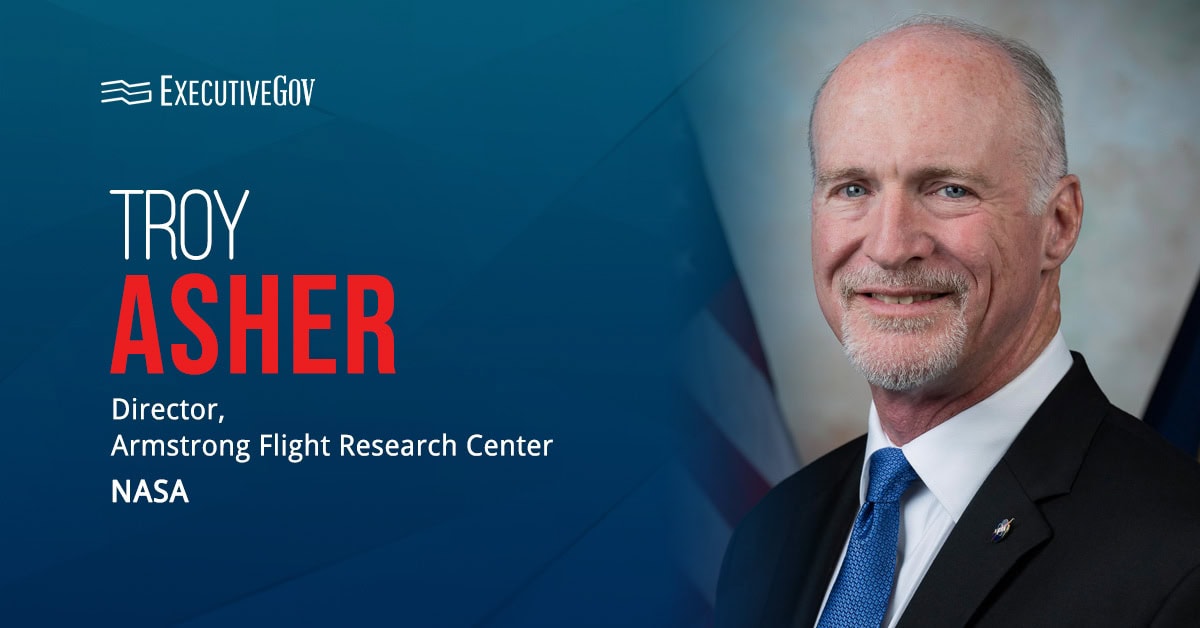
- Troy Asher moves from acting to permanent director of NASA’s flight research hub in Edwards, California
- The retired Air Force lieutenant colonel claimed 25 world speed records in a B-1B bomber in 2003
- Asher takes charge as Armstrong works to expand NASA’s X-plane lineup and advance X-59 testing
NASA has appointed Troy Asher to permanently head Armstrong Flight Research Center, the agency’s California home for experimental aircraft testing.
Administrator Jared Isaacman, a 2026 Wash100 Award recipient, announced the appointment Thursday. Asher, who has led the center on an interim basis since March, replaces Bradley Flick, whose retirement that month closed a NASA career of nearly 40 years.
What Will Asher Oversee as Armstrong Director?
Asher will manage the center’s personnel and daily operations at the Edwards Air Force Base in the Mojave Desert of California while guiding NASA’s work in flight research, aircraft operations and emerging aviation technology. Under an agencywide realignment announced in May, Armstrong became NASA’s Flight Test and Aircraft Operations Center of Excellence. The designation makes the center a focal point for NASA’s plan to rebuild its X-plane fleet and extend high-speed flight research. Armstrong also flies airborne science missions and supports flight research for other parts of the agency.
What Did NASA Leaders Say About Asher?
Isaacman cited Asher’s experience both piloting experimental aircraft and directing the teams that support flight missions. He said that background will prove valuable as Armstrong works to restore NASA’s flight-test capacity and pursue aircraft that fly “higher, farther, and faster” than the agency has in decades.
Amit Kshatriya, NASA’s associate administrator and chief engineer, said flight testing requires technical skill, sound operational judgment and confidence in mission teams, qualities he said Asher has displayed since his Air Force days. Kshatriya added that Asher will help reshape how NASA matures, assesses and flies emerging technologies.
Who Is Troy Asher?
Before taking the interim post, Asher directed Armstrong’s flight operations, supervising its pilots, engineers, maintenance crews and specialized research fleet. In January, he commented on the arrival of two retired Air Force F-15s acquired for supersonic research, noting that NASA’s F-15s have carried dozens of scientific experiments over the decades.
He joined NASA in 2008 as a research test pilot and aerospace engineer, flying research missions on the F-15, F/A-18, Gulfstream III and the uncrewed X-56A. He was lead test pilot during development of the Stratospheric Observatory for Infrared Astronomy, or SOFIA, and flew global airborne science campaigns on the agency’s DC-8.
Asher previously spent 24 years in the Air Force, retiring as a lieutenant colonel. He instructed at the service’s Test Pilot School at Edwards Air Force Base, commanded the 419th Flight Test Squadron and directed the Bomber Combined Test Force. In 2003, he flew the B-1B to 25 world speed records. He holds an astronautical engineering degree from the Air Force Academy and a master’s in mechanical engineering from California State University, Fresno.
How Is Armstrong Advancing Quiet Supersonic Flight?
The X-59, built by Lockheed Martin‘s Skunk Works to replace the sonic boom with a softer thump, is the center’s highest-profile program. In July 2025, researchers used an F-15B as a stand-in for the X-59 during a full-scale rehearsal of the noise-measurement campaign. The aircraft made its maiden flight in October 2025, departing Palmdale and landing near Armstrong, then exceeded the speed of sound for the first time in June, reaching about Mach 1.1 at 43,400 feet. NASA plans to fly the X-59 over U.S. communities in upcoming quiet supersonic demonstrations.
What Other Missions Does Armstrong Support?
The center reached 80 years of operations in September. Its origins date to 1946, when five National Advisory Committee for Aeronautics engineers arrived at Muroc Army Airfield to pursue supersonic flight, a goal achieved in the X-1 within two years.
Today, Armstrong backs the Artemis lunar program, using a 737 for spacesuit testing and a G-III to gather Artemis II heat-shield data. An F/A-18 at the center previously tested autopilot for the Space Launch System rocket. Its ER-2, C-20A and Gulfstream aircraft collect data on wildfires, glacier melt, pollution and minerals. The center also works with other agencies, industry and academia on aviation safety, autonomy and efficiency.