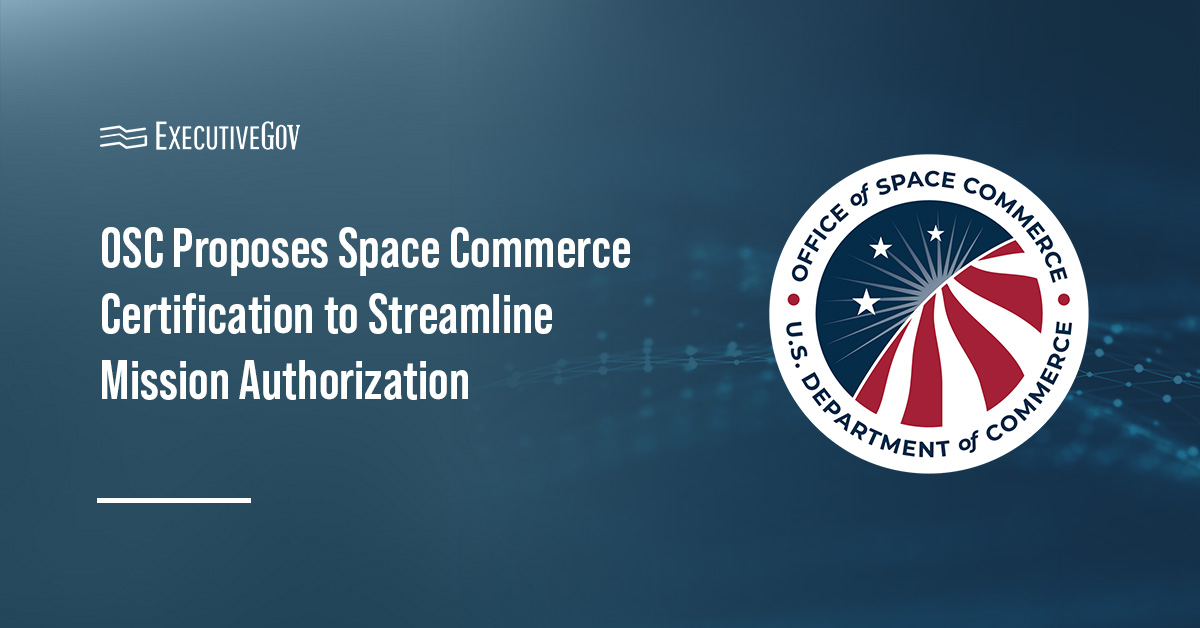
The Office of Space Commerce has released a proposal to overhaul how the U.S. authorizes emerging commercial space activities.
The draft framework, issued in response to Executive Order 14335, introduces a new opt-in Space Commerce Certification designed to streamline approvals and deliver decisions in as little as 120 days, OSC said Tuesday. It targets a growing category of novel space activities — such as satellite servicing, in-space manufacturing, orbital computing and lunar operations — that fall outside clear existing regulatory pathways.

The Potomac Officers Club’s 2026 Air and Space Summit, set for July 30, will convene U.S. Air Force, U.S. Space Force and industry leaders for discussions on emerging technologies and evolving challenges across the air and space domains. Register now!
What Problem Is the OSC Proposal Addressing?
Today’s regulatory system requires companies to navigate multiple approval processes across agencies such as the Federal Aviation Administration, Federal Communications Commission and the Department of Commerce, often involving overlapping reviews and inconsistent timelines.
According to the proposal, this fragmented structure creates uncertainty for the industry and can slow the development and deployment of new space capabilities.
How Would Space Commerce Certification Work?
Under the proposed model, companies could opt into the single, coordinated certification process, under which applications would undergo an interagency review covering national security, foreign policy, international obligations and safety considerations. If no major issues are identified, certification would be granted within a defined timeline — generally 120 days, with the option to extend to 180 days.
The framework emphasizes “light-touch” requirements and a presumption of approval unless agencies identify specific risks that cannot be mitigated.
The certification would not replace current authorities held by the FAA, FCC or Commerce’s remote sensing regulator for areas such as launch licensing, spectrum use and safety. Instead, it is designed to simplify how organizations obtain permissions and requirements from the agencies.
What Types of Activities Are Covered?
The proposal focuses on activities not clearly addressed under existing regulations, including rendezvous and proximity operations, in-space computing, space resource utilization and commercial space stations..
The proposal is open for stakeholder feedback as the Commerce Department refines the framework.