

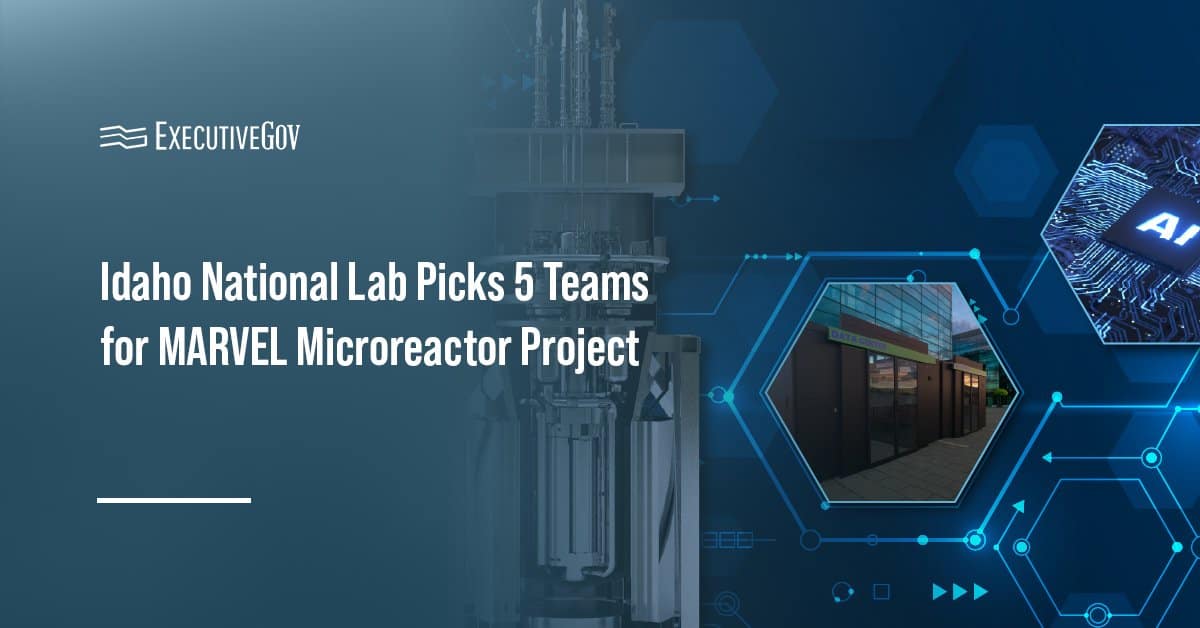
The Idaho National Laboratory has selected five teams to conduct initial experiments as part of the Department of Energy’s Microreactor Application Research Validation and Evaluation, or MARVEL, demonstration project.
“With access to MARVEL, companies can explore how microreactors will potentially help us win the global AI race, solve water challenges and so much more. The MARVEL testbed exemplifies how nuclear energy can open the door to a stronger, safer and more prosperous future for our country,” John Jackson, national technical director for the DOE Office of Nuclear Energy’s Microreactor Program, said in a statement published Thursday.
The chosen teams are Amazon Web Services; DCX USA and Arizona State University; General Electric Vernova; Radiation Detection Technologies; and Shepherd Power, NOV and ConocoPhillips.
AWS has proposed using and combining the MARVEL reactor with a modular data center. Meanwhile, Radiation Detection Technologies has proposed to use MARVEL to evaluate high-performance sensor systems that could help track the performance of advanced reactors.
The teams will work with DOE and national lab staff members to develop implementation plans for their proposed projects. According to INL, final agreements for the projects are expected to be announced in 2026.
What Is DOE’s MARVEL Project?
Led by INL under the DOE Microreactor Program, MARVEL is designed to advance the development of a nuclear microreactor demonstration test bed.
The project features a sodium-potassium cooled microreactor that will generate 85 kilowatts of power. INL expects the project to advance the testing of microreactor applications, explore various electrical and non-electrical uses and help develop regulatory processes.
MARVEL will be linked to the national lab’s first nuclear microgrid and is expected to be operational by late 2027. It aims to provide companies with an opportunity to demonstrate new use cases and advance the technological maturity of microreactors.