
NASA has announced agencywide initiatives aimed at advancing the Trump administration’s National Space Policy and strengthening U.S. leadership in space.

The agency's latest initiatives underscore the accelerating priorities shaping U.S. leadership in space, from lunar missions to commercial low Earth orbit and advanced propulsion. These developments come as government and industry leaders prepare to gather at the 2026 Air and Space Summit in the summer. Book your spot now to join the discussion.
NASA said Tuesday the initiatives, unveiled during the agency’s “Ignition” event, focus on accelerating lunar exploration, transitioning low Earth orbit operations to commercial platforms, expanding science missions and advancing nuclear propulsion capabilities.
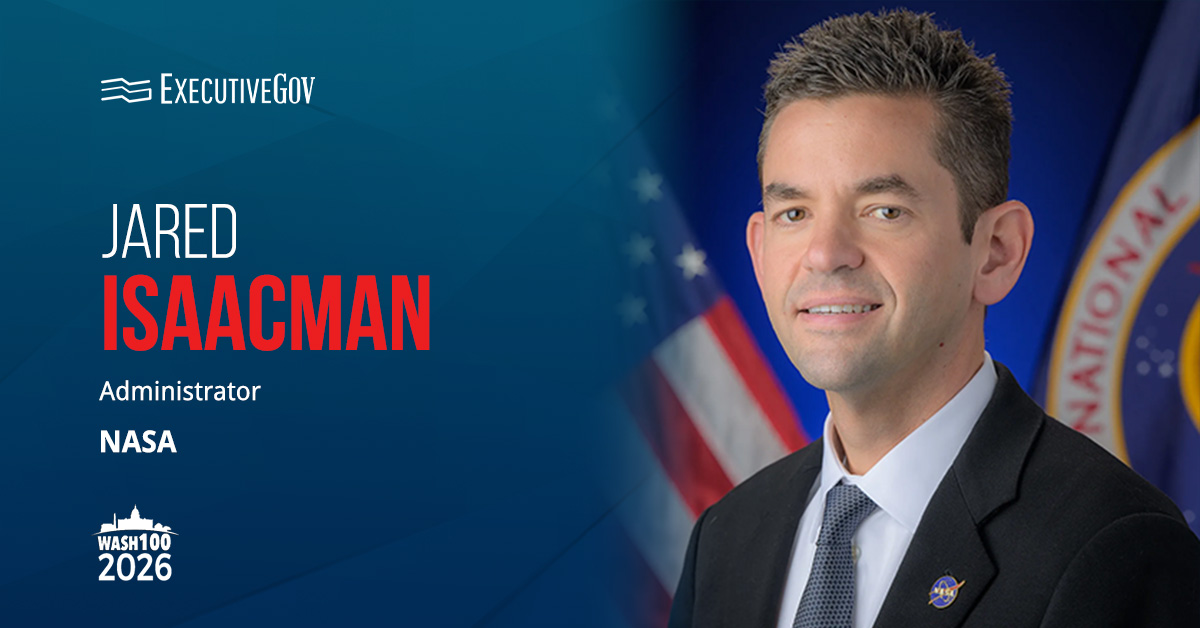
NASA Administrator Jared Isaacman said the agency will prioritize returning astronauts to the moon before the end of Trump’s term and establishing a sustained human presence on the lunar surface. He emphasized aligning agency resources, workforce and industry partnerships to meet accelerated timelines.
“If we concentrate NASA’s extraordinary resources on the objectives of the National Space Policy, clear away needless obstacles that impede progress, and unleash the workforce and industrial might of our nation and partners, then returning to the Moon and building a base will seem pale in comparison to what we will be capable of accomplishing in the years ahead,” added Isaacman, a 2026 Wash100 awardee.
What Changes Is NASA Making to the Artemis Program?
NASA said it will continue updates to the Artemis program, including standardizing the Space Launch System rocket and adding a mission in 2027. Artemis III will test integrated systems in Earth orbit ahead of a planned lunar landing under Artemis IV.
The agency plans annual lunar landings and aims to increase frequency using commercially procured, reusable systems, targeting crewed missions every six months. NASA also said it will shift focus from the current Gateway configuration to surface infrastructure while repurposing existing hardware and leveraging international partnerships.
What Are the 3 Phases of Lunar Base Development?
NASA outlined a three-phase plan to establish a sustained lunar presence. In the first phase, “Build, Test, Learn,” the agency will expand Commercial Lunar Payload Services missions and the Lunar Terrain Vehicle program to deliver rovers, instruments and technology demonstrations supporting mobility, power, communications and science.
The second phase, “Establish Early Infrastructure,” will introduce semi-habitable systems and recurring logistics to support regular astronaut operations. This phase will incorporate international contributions, including Japan’s pressurized rover and additional partner payloads and infrastructure.
In the third phase, “Enable Long-Duration Human Presence,” NASA will deploy cargo-capable human landing systems to deliver larger infrastructure for a continuous human presence. Planned contributions include habitats from the Italian Space Agency and a lunar utility vehicle from the Canadian Space Agency.
What Is NASA's LEO Strategy?
NASA said it will maintain its commitment to low Earth orbit while transitioning from the International Space Station to commercial platforms. The agency plans a phased approach that avoids gaps in U.S. human spaceflight capabilities and supports development of a commercial ecosystem.
Under the strategy, NASA would procure a government-owned core module attached to the space station, followed by commercial modules that would later detach into free-flying stations. The agency also plans to expand industry opportunities, including private astronaut missions and competitive awards. The space agency said an industry request for information will open Wednesday, March 25, to gather feedback and inform financing, partnership structures and risk mitigation.
What Are the Upcoming Space Science Missions?
NASA highlighted several upcoming science missions, including the Nancy Grace Roman Space Telescope, which could launch as early as this fall to study dark energy. The Dragonfly mission is scheduled to launch in 2028 and arrive at Saturn’s moon Titan in 2034.
The agency also plans to launch and deliver the European Space Agency's Rosalind Franklin rover to Mars in 2028, along with a new Earth science mission designed to improve extreme weather prediction.
NASA said it will expand lunar science efforts through an increased cadence of robotic landings beginning in 2027, supporting payloads from industry, academia and international partners, including missions such as VIPER and LuSEE-Night.
What Is Space Reactor-1 Freedom?
The agency will launch Space Reactor-1 Freedom, a nuclear-powered interplanetary spacecraft, to Mars before the end of 2028. The mission will demonstrate nuclear electric propulsion for deep space operations.
The spacecraft will deploy a payload of helicopter systems at Mars and establish flight heritage for nuclear systems. NASA said the program will support future missions requiring high-power propulsion beyond the capabilities of solar energy.