Processing....

Logo

Digital News Coverage of Government Contracting and Federal Policy Landscape
Sticky Logo
  • Home
  • Acquisition & Procurement
  • Agencies
    • DoD
    • Intelligence
    • DHS
    • Civilian
    • Space
  • Cybersecurity
  • Technology
  • Executives
    • Profiles
    • Announcements
    • Awards
  • News
  • Articles
  • About
  • Wash100
  • Contact Us
    • Advertising
    • Submit your news
    • Jobs
Logo
Government Technology/News
DIU Seeks Commercial Tech for 5G Expeditionary Applications
by Naomi Cooper
Published on July 29, 2022
DIU Seeks Commercial Tech for 5G Expeditionary Applications

The Defense Innovation Unit is soliciting proposals from potential sources of commercial 5G technologies designed to support command and control applications and maritime expeditionary operations.

DIU said in a solicitation notice that it seeks to identify and develop 5G applications with advanced capabilities to facilitate command and control and situational awareness for small tactical units supporting expeditionary advanced base operations.

According to the agency, the proposed commercial prototype must present broadly-sourced, aggregated and synthesized data to decision-makers and operators using intuitive displays.

The selected vendors will demonstrate their technologies during a series of mission scenario sprints to be held at the training areas on Marine Corps Base Camp Pendleton in California and other military bases on the West Coast and Hawaii.

Interested parties have until Aug. 8 to respond to the solicitation.

Executive Moves/News
Lt. Gen. Bradley Chance Saltzman Nominated as Next Chief of Space Operations
by Naomi Cooper
Published on July 29, 2022
Lt. Gen. Bradley Chance Saltzman Nominated as Next Chief of Space Operations

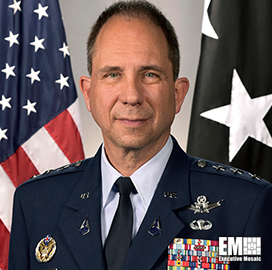
U.S. Space Force Lt. Gen. Bradley Chance Saltzman has received a nomination from President Joe Biden to serve as the next chief of space operations.

If confirmed by the Senate, Saltzman would succeed Gen. John “Jay” Raymond, who has held the role since the Space Force’s establishment in December 2019 and is expected to retire later in 2022, the U.S. Air Force said Thursday.

Saltzman currently serves as the deputy chief of space operations for operations, cyber and nuclear at the Space Force’s headquarters in Washington, D.C.

His military career includes roles such as deputy commander of U.S. Air Forces Central Command and deputy combined force air component commander of U.S. Central Command.

“His extensive space experience and deep understanding of how to integrate space into the defense of our nation have made him indispensable to the establishment of this service and Guardians the world over will not find a more loyal teammate,” said Raymond, a 2022 Wash100 Award winner.

Frank Kendall, secretary of the Air Force and a previous Wash100 Award winner, commended Raymond for leading the Space Force and said he “has worked tirelessly to create a strong foundation” for the service branch and its members.

In a general officer announcement posted Thursday, Lloyd Austin, secretary of the Department of Defense and a two-time Wash100 Award recipient, said Saltzman is also appointed to the grade of general.

GovCon Expert/Industry News/News
GovCon Expert Mark Amtower: Five Keys to Year-End Success on LinkedIn
by William McCormick
Published on July 29, 2022
GovCon Expert Mark Amtower: Five Keys to Year-End Success on LinkedIn

Mark Amtower, a managing partner of advisory firm Amtower & Co. and a member of Executive Mosaic’s GovCon Expert program, recently posted his most recent featured article via LinkedIn to discuss the 80 percent of government contracting executives and companies who are not leveraging LinkedIn as a valuable ressource to drive their business forward in our industry. 

In addition, GovCon Expert Mark Amtower also highlighted the importance of agency-based marketing and how LinkedIn can assist in those efforts to expand your network in targeted accounts as well as how content marketing is significant to the GovCon sector. 

“Your sales and BD people should be letting marketing know what the pain points are with customers so marketing can align content that addresses each issue where your company can help,” Amtower explained. 

“Addressing pain points and reminding your customers which vehicles they can use to access your products and services is important year-round, but especially at end-of-FY. LinkedIn remains the top venue for sharing B2B and B2G content.”

Visit LinkedIn to read the full article from GovCon Expert Mark Amtower.

If your company needs to step-up its activity on LinkedIn, drop me a line and let’s discuss how I can help: markamtower@gmail.com or message me here at LinkedIn.

Recently, Mark Amtower also shared his invaluable insights into content creation in a video interview with Executive Mosaic to discuss the most critical steps to ensure your social media activity is highlighting exactly who you are and what you bring to the market.

Watch the full video interview with GovCon Expert Mark Amtower and see interviews from our past participants at ExecutiveMosaic.com. 

Big Data & Analytics News/Industry News/News
Bipartisan Legislation Introduced to Strengthen Protections for Federal Data Centers; HSGAC Chairman Gary Peters Quoted
by William McCormick
Published on July 29, 2022
Bipartisan Legislation Introduced to Strengthen Protections for Federal Data Centers; HSGAC Chairman Gary Peters Quoted

On Friday, U.S. Senators Jacky Rosen (D-NV) and John Cornyn (R-TX), alongside Homeland Security and Governmental Affairs Committee (HSGAC) Chairman Gary Peters (D-MI), introduced the bipartisan Federal Data Center Enhancement Act of 2022 to provide legislation in order to protect Data Centers from potential cyberattacks, natural disasters and acts of terrorism.

“The federal government is responsible for storing considerable amounts of sensitive and personal information…We must ensure this data is stored securely and used in a way that does not violate civil rights and liberties,” Sen. Peters explained.

The bipartisan Federal Data Center Enhancement Act of 2022 requires the Office of Management and Budget (OMB) to develop strong minimum requirements for federal data centers related to cyber intrusions, data center availability, mission-critical uptime, and resilience against physical attacks and other natural disasters, which includes ensuring that federal agencies have secure, reliable, and protected data facilities that are safe from potential attacks.

Sen. John Cornyn detailed how the new legislation would help secure federal data and encourage optimization, which will save taxpayer dollars and protect Americans who entrust their information to the federal government.”

Since 2010, more than 6,000 federal data centers have been consolidated with resulting cost savings and cost avoidance of $5.8 billion. The Federal Data Center Enhancement Act of 2022 builds on this success, shifting the policy focus from consolidation to optimization, security, and resiliency.

In addition, Sen. Jacky Rosen also highlighted the critical importance of ensuring the integrity of our nation’s critical information by protecting data centers. “This bipartisan bill will enact a new set of security and resiliency standards to keep our data safe.”

Sen. Rosen. also specifically mentioned the Data Center “Switch” located in Las Vegas. Betsy Fretwell, executive vice president for Strategy at Switch, recognized the need for data centers and government agencies to meet higher standards for greater resiliency and availability.

“Switch takes pride in building the world’s most advanced, secure, and sustainable data centers and applauds Senator Rosen’s work to reduce the unnecessary risk of taxpayers losing access to important data provided by the federal government due to substandard data centers,” Betsy Fretwell explained.

Since 2010, more than 6,000 federal data centers have been consolidated with a resulting cost savings and cost avoidance of $5.8 billion. The Federal Data Center Enhancement Act of 2022 builds on this success, shifting the policy focus from consolidation to optimization, security, and resiliency.

Government Technology/News
Treasury Pilot Program Seeks Insight Into Climate-Related Financial Risks
by Mary-Louise Hoffman
Published on July 29, 2022
Treasury Pilot Program Seeks Insight Into Climate-Related Financial Risks

The Department of the Treasury’s financial research office has launched a data-driven pilot project that will focus on identifying and assessing the possible impacts of climate change on financial system stability. 

Participants in the Climate Data and Analytics Hub initiative will have access to high-performance computing tools and software platforms designed to visualize and analyze information, the Treasury said Thursday.

The Federal Reserve Board of Governors and the Federal Reserve Bank of New York are the initial users of the hub.

Nellie Liang, undersecretary for domestic finance at the Treasury, noted the department intends to help regulators gain insight into financial risks from shifting weather events through a shared database.

“Financial regulators need both financial and non-financial data, as well as high-powered computing capabilities, to effectively research climate-related financial risks,” said James Martin, acting director of the Office of Financial Research.

The hub will also support the integration of public supervisory data with government information such as precipitation, wildfires and crop conditions, precipitation.

OFR will look to expand hub access to all agencies that are part of the Financial Stability Oversight Council.

Government Technology/News
Navy’s Unmanned Influence Sweep System Achieves Initial Operating Capability
by Christine Thropp
Published on July 29, 2022
Navy’s Unmanned Influence Sweep System Achieves Initial Operating Capability

An unmanned surface platform Textron developed for the U.S. Navy has reached initial operating capability following the completion of formal testing and delivery of logistics and training material for mission execution.

The Program Executive Officer for Unmanned and Small Combatants said Thursday the Unmanned Influence Sweep System received IOC designation from the Office of the Chief of Naval Operations and is on track to add to the service branch’s suite of mine countermeasure technologies.

UISS will conduct acoustic or magnetic minesweeping operations as part of the Mine Countermeasures Mission Package. It could be integrated into littoral combat ships, shore or vessels of opportunity and be paired with MCM unmanned surface vehicle.

“Over the years, the program has worked tirelessly to mature and field the UISS system that will keep the Navy’s most valuable asset, our sailors, safer by keeping them out of the minefield. With this declaration, the program is inching closer toward system-wide IOC for the MCM MP,” said Capt. Godfrey Weekes, LCS Mission Modules (PMS 420) program manager. 

News
Senate Democrats Draft Appropriations Bill Seeking $850B in 2023 Defense Funds
by Mary-Louise Hoffman
Published on July 29, 2022
Senate Democrats Draft Appropriations Bill Seeking $850B in 2023 Defense Funds

Democratic leaders of the Senate Appropriations Committee put forward a nearly $1.7 trillion government spending proposal for fiscal year 2023 that includes $850 billion in discretionary funds for national defense.

Committee Chairman Patrick Leahy, D-Vt., unveiled the package as his mark version of 12 annual appropriations bills Thursday.

The plan allocates $118.7 billion for medical care programs at the Department of Veterans Affairs and another $21 billion for public health initiatives through emergency supplemental funding.

Proposed defense funds under the package reflect an 8.7 percent increase over current funding levels and are aligned with the House’s bipartisan National Defense Authorization Act for the next fiscal year.

A summary of the bill from the Senate Appropriations defense subcommittee would provide $792.1 billion to the Pentagon and related activities.

“This bill modernizes our armed forces to address the evolving threats of the 21st Century, ensuring the Defense Department is able to compete with China and other adversaries across the globe,” Leahy said.

“It includes additional funds to help address the consequences of inflation, which has impacted government programs at every level – both defense and non-defense.”

Industry News/News
DOE Launches $165M Initiative to Advance Geothermal Energy Deployment
by Christine Thropp
Published on July 29, 2022
DOE Launches $165M Initiative to Advance Geothermal Energy Deployment

The Department of Energy has introduced the Geothermal Energy from Oil and Gas Demonstrated Engineering effort with up to $165 million in funding to support the expanded deployment of geothermal energy through industry technologies.

DOE said the initiative will initially allocate $10 million to establish a consortium that will create a roadmap for bridging geothermal energy technology and knowledge gaps.

“Leveraging the extensive knowledge, technology, skill and experience of the oil and gas sector is the perfect way to tackle barriers to geothermal deployment while also giving fossil-fuel-based communities and workers a role in the transition to clean energy,” said Jennifer Granholm, Energy secretary.

In a funding opportunity announcement, DOE said it is seeking an administrator for GEODE to lead the consortium. Responsibilities include managing collaborative research, development and demonstration efforts in support of consortium priorities, creating a structure and methodology for research agenda execution and attracting and securing consortium membership.

Responses to the FOA are due Oct. 28.

News/Technology
Radiant Digital Solutions Collaborates with ServiceNow Partner Program; Jon Clark Quoted
by Charles Lyons-Burt
Published on July 29, 2022

Radiant Digital Solutions Collaborates with ServiceNow Partner Program; Jon Clark Quoted

Information technology company Radiant Digital Solutions has entered into the ServiceNow Partner Program, becoming a part of its customer and employee-focused initiative as well as its technology and operations endeavor.

The ServiceNow platform assists with the introduction and execution of digital transformation efforts in order to sustain and deepen the delivery of these services to customers, the Vienna, Virginia-based company said Thursday.

Jon Clark, senior vice president at Radiant, shared that he thinks the partnership with ServiceNow will allow the company to render its clients’ digital assets “more agile, efficient, and competitive.”

Clark also described how Radiant’s digital transformation services will be rendered more efficient; now, Clark asserts, “we can deliver modernized workflows much faster.”

The Radiant Digital Solutions team performs three types of digital transformations: IT transformation, application transformation and workforce transformation.

The company’s IT transformation entails outfitting an intelligent infrastructure by updating systems, installing cloud platforms and utilizing data. Its application efforts are aimed to increase the speed of innovation cycles, cut down on expenditures and sharpen competitive edge, while its workforce transformation strategies include helping businesses embrace change and implementing structure.

Articles
U.S. Space Force Ranks: List of Ranking in Order
by Dawn Pamulaya
Published on July 29, 2022
U.S. Space Force Ranks: List of Ranking in Order

The United States Space Force (USSF) is the sixth, separate branch of the United States Armed Forces. USSF organizes, trains, and equips Guardians to carry out global space operations.

Missions and operations in the dynamic space domain are the responsibility of the United States Space Force. U.S. Space Force rank structure has different levels. Enlisted members of a diverse group have their tasks. Each member also undergoes a specialty knowledge test and promotion fitness examination. Here is the U.S. Space Force list of ranking in order:

Table of Contents

  • Space Force ranks: Specialist
    • Specialist 1 (Spc1)
    • Specialist 2 (Spc2)
    • Specialist 3 (Spc3)
    • Specialist 4 (Spc4)
  • Space Force Ranks: Non-Commissioned Officer (NCO)
    • Sergeant (Sgt)
    • Technical Sergeant (TSgt)
  • Space Force ranks: Senior Non-Commissioned Officer
    • Master Sergeant (MSgt)
    • Senior Master Sergeant (SMSgt)
    • Chief Master Sergeant (CMSgt)
    • Chief Master Sergeant of the Space Force (CMSSF)
  • Space Force ranks: Company Grade officers, Field Grade officers, and General Officers
  • Second Lieutenant (2d Lt)
    • First Lieutenant (1st Lt)
    • Captain (Capt)
    • Major (Maj)
    • Lieutenant Colonel (Lt Col)
    • Colonel (Col)
    • Brigadier General (Brig Gen)
    • Major General (Maj Gen)
    • Lieutenant General (Lt Gen)
    • General (Gen)
    • Check here the ranks of the other military branches:

Space Force ranks: Specialist

Space force's highly competitive new members

Specialist 1 (Spc1)

Grade: E1

Terms of address: Specialist, Spec1, or Specialist 1

Specialist 1 space force guardians are the Space Force members who have transitioned from the Air Force. Specialists in the Air Force are treated the same as any other new recruit and must complete basic training.

As long as performance and conduct requirements are met, promotions to E-2 are typically automatic. Time in grade and years of service are the only criteria for advancement in the Air Force.

Specialist 2 (Spc2)

Grade: E2

Terms of address: Specialist, Spec2, or Specialist 2

Being a Specialist 2 in the Space Force means committing to military culture and learning one’s trade effectively. For the Space Force, this involves following the Air Force’s basic training with specialized education in the subject of space systems operations (1C6).

As long as the supervisor maintains the necessary service and conduct levels, automatic promotion to E-2 will be granted. After basic training, Guardians who wish to advance to the rank of specialist two must complete coursework in space systems operations.

There is a 10-month minimum service requirement for promotions from Specialist 2 to Specialist 3. It takes an average of 16 months of service in the Air Force before a person is promoted to Airman First Class.

Specialist 3 (Spc3)

Grade: E3

Terms of address: Specialist, Spec3, or Specialist 3

Guardians at the Specialist 3 level are deemed to have successfully transitioned to the Space Force and military life. Their responsibilities now center on carrying out their assignments promptly and effectively while continuing to hone their professional abilities.

Guardians of this level are expected to perform routine tasks and develop expertise in space system operations.

Specialist 4 (Spc4)

Grade: E4

Terms of address: Specialist, Spec4, or Specialist 4

Space Force Specialist 4 guardians and Air Force Senior Airmen are expected to conduct themselves according to prescribed standards, offering a positive influence and example for subordinates and peers.

The specialist four rank, or E-4, is a middle tier in the Space Force. Managers at the top level count on their guards to continue their education and serve as role models for those under them.

Space Force Ranks: Non-Commissioned Officer (NCO)

space force released enlisted ranks, Non-Commissioned Officer

Sergeant (Sgt)

Grade: E5

Terms of address: Sergeant

For the Space Force, the rank of Sergeant is the entry point into the Non-Commissioned Officers (NCOs) ranks. These watchmen should be at least level five (journeyman) or seven (craftsman) and actively hone their technical and managerial abilities.

In addition, the Sgt is responsible for actively pursuing opportunities to grow in their technical and managerial expertise. The Air Force equivalent of the Space Force Sergeant rank is Staff Sergeant, and the average active duty period to achieve that rank is almost four years.

Technical Sergeant (TSgt)

Grade: E6

Terms of address: Sergeant, Technical Sergeant, or Tech Sergeant

The United States Security Forces’ second-highest noncommissioned officer rank is a technical sergeant. The duties of a technical sergeant are similar to those of a staff sergeant in that they involve supervision and complex technical work. They are responsible for their subordinates’ professional growth and ensuring that everyone has access to the resources they need to do their jobs well.

To guarantee optimum performance and complete mission success, the TSgt must provide all enlisted soldiers with the required resources. The standard active duty period needed to advance to Technical Sergeant in the Air Force is 12 years.

The basic qualifications for promotion to Tech Sergeant are the same as those for promotion to Staff Sergeant, including a 7-skill level and five years of Time-in-Service. The TIG requirement is reduced to 23 months.

Space Force ranks: Senior Non-Commissioned Officer

senior noncommissioned officers, senior ncos

Master Sergeant (MSgt)

Grade: E7

Terms of address: Sergeant or Master Sergeant

Master Sergeants should have a deep understanding of the technical aspects of their profession. More leadership roles are assigned to them.

MSgts are senior-level commanders with extensive technical expertise. MSgt is an expert in seven areas. This position calls for a broader technological and administrative viewpoint and comes with significantly increased responsibility. When serving in the Air Force, the typical time commitment to reach the rank of Master Sergeant is over 17 years.

Master Sergeant promotions in the Space Force and Air Force are identical to those in the E-5 and E-6 levels, with the following exceptions: A 7-skill level is required, as well as eight years of Time-in-Serve and 24 months of Time-in-Grade.

Senior Master Sergeant (SMSgt)

Grade: E8

Terms of address: Senior or Senior Master Sergeant

When you reach the rank of senior master sergeant, you’ve served for 15-30 years. The role of the old master sergeant is to oversee and direct the work of those under their command. Gaining promotion to the position of senior master sergeant is difficult. The central promotion board can only elevate 2% of enlisted personnel to SMSgt.

One must be evaluated on their professional competence, performance, experience, leadership, education, and other aspects by a central evaluation board before they may be promoted to the rank of senior master sergeant.

Air Force Senior Master Sergeant promotions are heavily influenced by the Central Evaluation Board (CEB). The Air Force’s primary evaluation board, made up of many 3-person panels, meets twice yearly: once in January for Senior Master Sergeant and once in October for Chief Master Sergeant. Each Air Force promotion board looks at the history of promotions for a distinct set of AFSCs (jobs). The evaluation boards in the Space Force are anticipated to be comparable.

Panels review candidates’ past promotion histories and assign scores based on several factors, including but not limited to performance, professional competence, leadership, job responsibility, breadth of experience, specific achievements, and level of education.

Chief Master Sergeant (CMSgt)

Grade: E9

Terms of address: Chief or Chief Master Sergeant

A CMSgt is given a Chief Enlisted Manager (CEM) code, which provides them with authority to serve in any managerial capacity and undertake any task not explicitly forbidden by law or order. On average, it takes more than 22 years of active service to reach the rank of Chief Master Sergeant in the United States armed forces.

Unless you want to join the Space Force, the rank of chief master sergeant is the highest you can get. In the military, a guardian who achieves the level of chief master sergeant is responsible for management, advice, and leadership. An E-9 rank is reserved for only 1% of the active duty personnel.

Chief Master Sergeant of the Space Force (CMSSF)

Grade: E9

Terms of address: Chief or Chief Master Sergeant of the Space Force

Besides the Chief Master Sergeant of the Space Force or Command Chief Master Sergeant, the rank of Chief Master Sergeant is the highest enlisted position in the Space Force. It’s the law that the command chief master sergeants be paid a different amount for their regular salary and retirement.

Space Force ranks: Company Grade officers, Field Grade officers, and General Officers

air force higher rank structure

Second Lieutenant (2d Lt)

Grade: O1

Terms of address: Lieutenant or Second Lieutenant

One gold bar represents the Second Lieutenant rank. “Second Lieutenant” and “Lieutenant” are appropriate forms of address. Some Air Force officers with commissions may choose to skip this level entirely. After 24 months “in grade” (the Air Force’s terminology for rank), a second lieutenant is usually promoted to the first lieutenant.

First Lieutenant (1st Lt)

Grade: O2

Terms of address: Lieutenant or First Lieutenant

First lieutenants perform duties similar to those of second but earn more money and have more authority. After 24 months of service, an Air Force first lieutenant is normally considered for promotion to captain.

Captain (Capt)

Grade: O3

Terms of address: Captain

Captains are responsible for and assigned to a specific Flight. When in this role, one is known as the company commander. The standard time required for a captain to become eligible for promotion to major in the Air Force is 24 months.

Major (Maj)

Grade: O4

Terms of address: Major

Majors in the Air Force, the Air Force’s second-highest officer rank, serve as the primary staff officers for brigade-sized formations.

You’ll be tasked with managing and supervising others when you reach the major level. Their standard scale of operation is a squadron or wing. They may take charge of a squad in some situations. All majors are required to pursue a master’s degree or higher to graduate.

Lieutenant Colonel (Lt Col)

Grade: O5

Terms of address: Colonel or Lieutenant Colonel

You are also expected to take on a leadership role as a lieutenant colonel. Assisting the colonel in his duties are these officers. When you reach the rank of lieutenant colonel, you’ll be expected to take on additional responsibilities, such as advising less senior commanders.

Colonel (Col)

Grade: O6

Terms of address: Colonel 

The position of colonel is the highest among field officers. Typically, they will have completed graduate studies. The mission of the colonel’s office is to increase base efficiency and quality of life. They oversee training facilities and may be in charge of as many as four thousand military men at once.

space force general, space force chief, navy air force,

Brigadier General (Brig Gen)

Grade: O7

Terms of address: General or Brigadier General

The road to becoming a Brigadier General is a long and difficult one. The process begins with a group of general officers compiling a list of potential candidates and concludes with the President making their promotion decisions. Generals who have served for 30 years or more or held the rank of Brigadier General for five years are required to retire.

Generals of the rank of brigadier general oversee more extensive military installations and often overlook the most senior personnel at the Pentagon and other organizations. They take part in activities designed to boost spirits and morale. Regular leadership and administrative responsibilities also come with the position.

Major General (Maj Gen)

Grade: O8

Terms of address: Major General or General

Major General is the next step up for general officers. Joint force commanders and other senior officers responsible for up to 10,000 troops report to major generals.

Major General is the second-highest rank in the Air Force, and advancement to this position is similar to that of Brigadier General.

Lieutenant General (Lt Gen)

Grade: O9

Terms of address: Lieutenant General or General

The President appoints Lieutenant Generals from within the ranks of current Air Force General Officers. After their term ends, they will no longer hold that position.

Typically, lieutenant generals are in charge of leading major installations and outposts. Overall morale and direction among their troops are mainly in their hands.

General (Gen)

Grade: O10

Terms of address: General

Commanders with four stars are the most senior posts in the military and oversee expansive areas of responsibility.

The highest position attainable in the Space Force is that of General. Each of these people is a top official at the Pentagon and other institutions.

Check here the ranks of the other military branches:

U.S. Army Ranks: A Guide for Federal Defense Contractors

U.S. Marine Corps Ranks: List of Ranking in Order

U.S. Coast Guard Ranks: A Guide For Defense Contractors

What Are the U.S. Air Force Ranks?

U.S. Navy Ranks: List of Ranking

Previous 1 … 806 807 808 809 810 … 2,661 Next
News Briefing
I'm Interested In:
Recent Posts
  • FCC Appoints UNC Professor Jonathan Williams as Chief Economist
  • DOE Selects 3 Companies for $2.7B Uranium Enrichment Capacity Initiative
  • Space Force Eyes Commercial Options for Space, Ground-Based Environmental Sensing
  • US, Allies Test AI-Enabled Human-Machine Teaming in Coalition Battle Management Sprint
About

ExecutiveGov, published by Executive Mosaic, is a site dedicated to the news and headlines in the federal government. ExecutiveGov serves as a news source for the hot topics and issues facing federal government departments and agencies such as Gov 2.0, cybersecurity policy, health IT, green IT and national security. We also aim to spotlight various federal government employees and interview key government executives whose impact resonates beyond their agency.

Read More >>

RSS ExecutiveBiz
  • Allocore CEO Bill Webner on Closing the Government Technology Gap
  • Michael Vishion Joins Terran Orbital as Program Management VP
  • Ultra I&C to Deliver Knox-5 Processors for Marine Corps MQ-9B Fleet
  • Zscaler Executive Discusses How AI Can Transform Federal IT Compliance
  • PTC Names Jennifer DiRico as Chief Financial Officer
  • Second Front Systems, Paramify Collaborate to Advance Federal Compliance Automation
RSS GovConWire
  • The AI & Quantum Revolution: Redefining Research & Development, Manufacturing & Technological Exploration
  • Aydin Mohtashamian Named Kagwerks & DTC North America President
  • Sabel Systems Announces Centil Acquisition
  • Sally Wallace Elevated to Chief Operating Officer at Leonardo DRS
  • 22nd Century Technologies Completes BT Federal Acquisition, Launches New Subsidiary
  • NGA Awards Raytheon $110M GDTS IV Contract for GEOINT Data Service Modernization
Footer Logo

Copyright © 2025
Executive Mosaic
All Rights Reserved

  • Executive Mosaic
  • GovCon Wire
  • ExecutiveBiz
  • GovCon Exec Magazine
  • POC
  • Home
  • Acquisition & Procurement
  • Agencies
    • DoD
    • Intelligence
    • DHS
    • Civilian
    • Space
  • Cybersecurity
  • Technology
  • Executives
    • Profiles
    • Announcements
    • Awards
  • News
  • Articles
  • About
  • Wash100
  • Contact Us
    • Advertising
    • Submit your news
    • Jobs
Go toTop