


Artificial intelligence is rapidly moving from concept to mission-critical capability for the National Guard—and industry will play a major role in making it operational. In an exclusive interview with ExecutiveGov, Dr. Delester Brown, chief data and AI officer of the National Guard Bureau, revealed how the Guard is prioritizing AI-driven tools for object detection, predictive analytics and data-enabled risk modeling to improve disaster response and operational decision-making, signaling major opportunities for technology providers supporting defense and homeland missions.
 Hear more from Dr. Brown during the Operationalizing AI at Scale-Bridging the Gap from Prototype to Mission Impact panel discussion at the Potomac Officers Club’s 2026 Artificial Intelligence Summit on March 18. He’ll discuss his perspective on how defense organizations are approaching AI adoption in practical, mission-focused ways, enabling interoperable ecosystems and operationalizing trustworthy data. Don’t wait — reserve your seat today!
Table of Contents
How Does AI Support Disaster Response and Operational Awareness?
One of the National Guard’s most immediate use cases for AI lies in disaster response, where speed, visibility and resource coordination can mean the difference between life and death.
Dr. Brown pointed to object detection and asset relocation as key capabilities the Guard is exploring.
“One thing that you’ll hear me always staying focused on would be asset relocation and things like object detection,” he said, noting that the goal is to quickly identify and respond to people in danger during emergencies.
AI-enabled tools can help identify individuals in dangerous situations and direct personnel and equipment to the right locations more efficiently. As Dr. Brown explained, responders need the ability to understand the context of what they are seeing in real time: “We want to know the difference between a person hanging out on the roof [during] a flood [or] a person that may be underneath a collapsed building or structure.”
These capabilities extend beyond simple image recognition. By analyzing video feeds and data from aviation assets, AI tools can enhance situational awareness with augmented reality overlays, helping responders understand blast radiuses, environmental hazards or the impact of infrastructure failures such as pipeline ruptures. These insights help leaders determine how terrain and infrastructure might change during a crisis and where resources should be positioned ahead of time.
Ultimately, these tools are designed to give users, like guardsmen, real-time decision support. Dr. Brown envisions a future where guardsmen can monitor evolving risk on a tablet or dashboard, allowing them to quickly assess how an emerging event, such as a regional power outage, might affect resourcing and readiness.
How Is the National Guard Implementing AI?
While AI is often discussed in terms of automation, Dr. Brown emphasizes a different concept: “amplified intelligence.”
Rather than focusing on AI as a replacement for human decision-making, he sees the technology as a way to enhance the expertise of leaders and personnel across the National Guard’s 54 states and territories. His role, he explained, is to advise senior leadership on how emerging technologies can strengthen mission effectiveness and ensure resources are applied to impactful use cases.
“I’m looking to enhance who we are — the best of you, of our government, the best of our department, the best of the National Guard.”
Dr. Brown is particularly focused on democratizing access to these tools, expressing, “I want to be able to have everyone at every echelon to be able to use [AI].” By implementing no-code environments and user-friendly systems, the Guard aims to ensure AI capabilities are accessible to personnel at every level, not just technical specialists.
Equally important is maintaining an open and interoperable ecosystem. The Guard’s unique environment includes soldiers, airmen, civilians, state and local partners, tribal organizations, and academic collaborators. Any technology introduced into this ecosystem must be flexible and vendor-agnostic so that all stakeholders can participate and benefit.
Don’t miss Dr. Delester Brown in conversation with Artificial Intelligence Officer of the Defense Logistics Agency Ruksana Lodi and Robert Hammer, Deputy Executive Associate Director of the Office of Management and Administration,
U.S. Immigration and Customs Enforcement. Reserve your spot today!
How Is Emerging AI Shaping Defense Operations?
Looking ahead, Dr. Brown sees several areas where AI will transform defense operations:
Supply chain intelligence: AI could track components across their entire lifecycle, from small parts to major platforms, improving logistics planning and maintenance readiness. Brown described the potential to follow everything “from the nuts and bolts … all the way onto maybe an aircraft or a tank,” tracking how those components move through deployments and maintenance cycles.
Cybersecurity operations: AI will increasingly play a dual role in cyber defense, where human operators working with AI systems must counter adversaries who are also leveraging AI-driven tools. Brown described this future environment as “AI and human versus AI and human.”
Edge-enabled decision support: Future systems may provide AI assistance directly to personnel in the field. Brown envisions a digital assistant that acts as a mission companion, saying he hopes one day there will be “a [tool] that is your battle buddy that flows with you in and out of combat… and helps enhance how you complete your mission.”
Digital twin technology: Dr. Brown also highlighted the promise of digital twins for disaster recovery and operational resilience. By simulating infrastructure and operational environments in advance, organizations can reduce recovery times dramatically. If digital twins can shrink outages “from what used to be days and weeks and possibly months… to minutes and seconds, then we’re doing our job,” he said.
Continuing the Conversation on AI’s Future
Despite the rapid pace of technological advancement, Dr. Brown believes one factor remains essential: ongoing dialogue between government, industry and academia.
Open conversations—such as those taking place at the 2026 Artificial Intelligence Summit—help spark new ideas, build partnerships and ensure that emerging technologies are applied responsibly and effectively across national security missions.
“We must continue to have the dialogue and discussion,” Brown said. “We can’t lose our spark.”
With innovations advancing faster than ever, he believes the next breakthrough may be closer than many expect. “The next is just around the corner.”
Join Dr. Brown and many other federal chief AI or information officers at the 2026 Artificial Intelligence Summit, on March 18th, to learn more about how government leaders are thinking about the future of AI in their organizations, their key pain points and priorities. Register today!

Related Articles
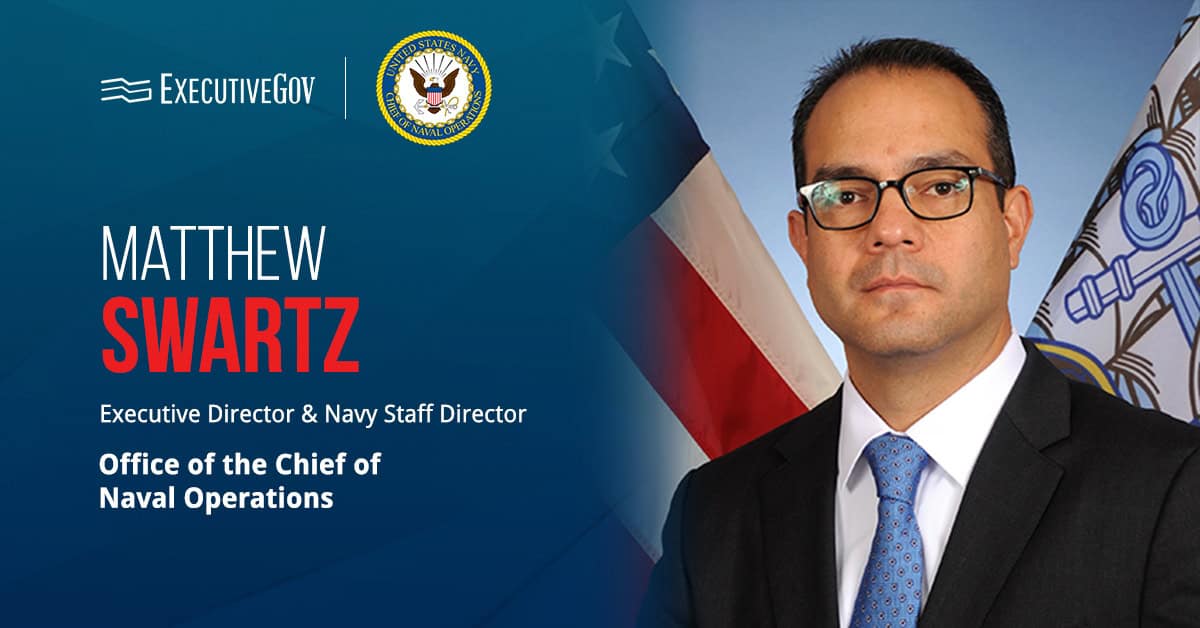
Matthew Swartz has assumed the role of Navy staff director while continuing to serve as executive director on the chief of naval operations’ staff, the U.S Navy announced Wednesday. Register now for the Potomac Officer Club’s 2026 Navy Summit on Aug. 27 to hear senior Navy leaders, defense officials and industry executives discuss how emerging technologies are shaping the future of naval operations. Why Is the Navy Consolidating Leadership Roles? CNO Adm. Daryl Caudle said the dual-hatted leadership structure is intended to sharpen accountability and decision-making speed as the Navy shifts from a peacetime posture to a more operationally focused
U.S. Secretary of the Army Daniel Driscoll, a 2026 Wash100 awardee, and Romania’s national defense minister have signed an agreement to enable the southeastern European country to buy counter-unmanned aerial systems through the Joint Interagency Task Force 401, or JIATF-401, marketplace. As the Army expands initiatives like the JIATF-401 marketplace to strengthen allied defense capabilities against drone threats, these priorities will take center stage at upcoming forums. Attend the 2026 Army Summit to hear military leaders and industry executives discuss artificial intelligence, hyperconnected battlefield, air defenses and other emerging mission needs and priorities. Sign up now! The Army said Wednesday
The Intelligence Advanced Research Projects Activity has launched five new artificial intelligence-focused research programs under its Emerging Technology Accelerator framework, opening new pathways for industry to support mission-critical intelligence capabilities through prototype other transaction agreements. The effort aligns with the Office of the Director of National Intelligence’s ODNI 2.0 initiative to accelerate the transition of emerging technologies into operational use and strengthen collaboration with the private sector, IARPA said Wednesday. According to IARPA Director Russell Miller, the agency is positioning itself as the entry point for intelligence community technology requirements, with a focus on tapping commercial innovation. Register now for