
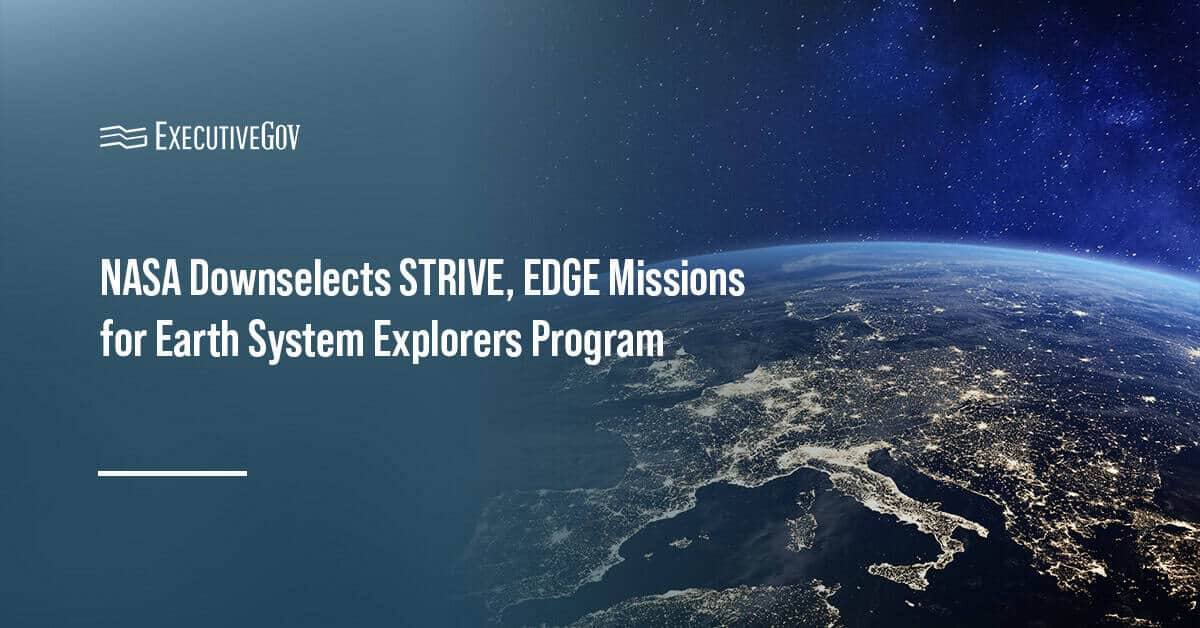
NASA said Thursday that it has selected two missions for continued development under the Earth System Explorers, or ESE, program, which seeks to enable high-quality Earth system science investigations in line with recommendations from the National Academies of Sciences, Engineering and Medicine 2017 Decadal Survey for Earth Science and Applications from Space.
The chosen projects are the Stratosphere Troposphere Response using Infrared Vertically-resolved light Explorer, or STRIVE, mission and the Earth Dynamics Geodetic Explorer, or EDGE, mission.
What Is the STRIVE Mission?
Led by Lyatt Jaegle of the University of Washington in Seattle, STRIVE seeks to take measurements of the temperature, aerosol properties and various atmospheric elements from the upper troposphere to the mesosphere. Unlike previous missions, STRIVE seeks to take these measurements at a much higher spatial density. High-resolution and near-global readings are to be provided on a daily basis.
STRIVE also aims to support the understanding of how the ozone layer is recovering. To achieve this, the mission will work to measure vertical profiles of ozone and trace gasses.
What Is the EDGE Mission?
Led by Helen Amanda Fricker of the University of California San Diego, EDGE aims to advance the measurements being recorded by NASA’s Ice, Cloud, and land Elevation Satellite 2 and the Global Ecosystem Dynamics Investigation mission. EDGE will work to make observations of the surface topography of glaciers, ice sheets and sea ice as well as the three-dimensional structure of terrestrial ecosystems.
How Were the ESE Program Missions Selected?
The selection process for the Earth System Explorers Program began with the choosing of four proposals in May 2024 following the issuance of the program’s final announcement of opportunity a year earlier. Each proposal was to receive $5 million for a one-year concept study, after which NASA would choose two to go forward.
STRIVE and EDGE are now set to undergo a confirmation review in 2027 to assess mission progress and funding availability. If confirmed, the missions will launch no sooner than 2030.
Minus the launch itself, each mission is expected to cost $355 million at most.