
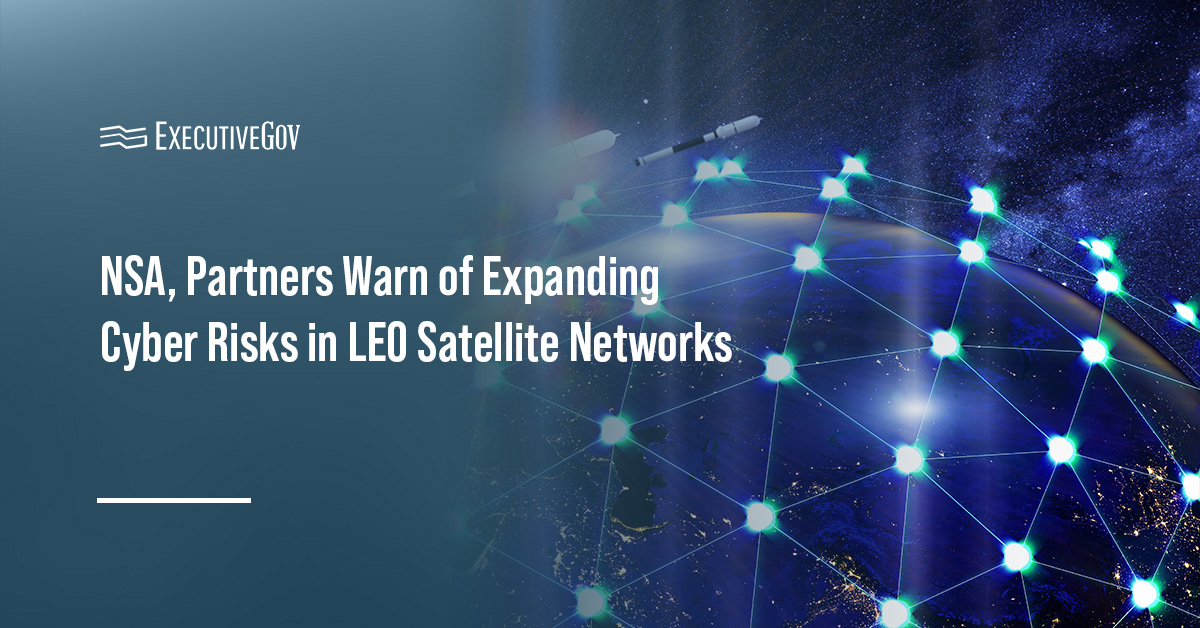
The National Security Agency and international partners are warning that the rapid expansion of low Earth orbit satellite communications systems is increasing cyber risk exposure, as distributed architectures and radio frequency links create new vulnerabilities to jamming, spoofing and interception.

The Potomac Officers Club's 2026 Cyber Summit will bring together government and industry leaders to discuss evolving cyberthreats and strategies to strengthen federal cybersecurity. Registration is now open.
In a cybersecurity information sheet the NSA released Tuesday, the agency — alongside Australian cyber and space authorities and other allied partners — outlines mitigation strategies to secure LEO satcom systems across their full operational architecture.
What Risks Do LEO SATCOM Systems Face?
The report, titled “Securing space: Cyber security for low earth orbit satellite communications,” highlights how LEO systems — designed to improve connectivity and resilience — introduce a broader attack surface spanning satellites, ground infrastructure, user devices and supply chains.
Unlike traditional networks, LEO constellations operate in highly distributed environments with limited physical access to space-based assets, increasing reliance on remote management and wireless communication links.
These characteristics make systems particularly susceptible to signal interference, data interception and exploitation of weak points across interconnected segments.
What Mitigation Strategies Are Recommended?
The guidance outlines segment-specific security measures to reduce risk and strengthen resilience.
For satellites, agencies recommend techniques such as frequency-hopping signals, anti-jam capabilities and redundant communication paths to maintain operational continuity.
Ground systems should implement continuous monitoring and anomaly detection, while user devices and applications require stronger endpoint protection and secure access controls.
How Is LEO Adoption Increasing System Complexity?
The agencies note that the scale and architecture of LEO constellations introduce operational complexities beyond those of traditional satellite systems.
Large numbers of interconnected satellites and ground nodes require continuous coordination, making it more difficult to maintain visibility, enforce consistent security controls and manage configurations across the network.
The report also highlights risks tied to supply chain dependencies and the use of commercial components, which can introduce vulnerabilities if not properly vetted and secured.