Processing....

Logo

Digital News Coverage of Government Contracting and Federal Policy Landscape
Sticky Logo
  • Home
  • Acquisition & Procurement
  • Agencies
    • DoD
    • Intelligence
    • DHS
    • Civilian
    • Space
  • Cybersecurity
  • Technology
  • Executives
    • Profiles
    • Announcements
    • Awards
  • News
  • Articles
  • About
  • Wash100
  • Contact Us
    • Advertising
    • Submit your news
    • Jobs
Logo
Industry News/News
GAO Offers Recommendations to Help Agencies Protect Federal Research From Foreign Influence
by Jane Edwards
Published on October 6, 2021
GAO Offers Recommendations to Help Agencies Protect Federal Research From Foreign Influence

The Government Accountability Office has recommended that federal agencies ensure that their conflicts of interest policies address non-financial COI and come up with written procedures to address cases in which researchers failed to divulge required information to help protect U.S. research programs from foreign influence.

GAO assessed the National Science Foundation, National Institutes of Health, NASA and the departments of Defense (DOD) and Energy (DOE) for its December 2020 report and found that only three have agency-wide COI policies.

Although NSF, NIH and NASA have agency-wide COI policies in place, those policies do not address non-financial interests.

“In the absence of agency-wide COI policies and definitions for non-financial interests, researchers may not fully understand what they need to report on their grant proposals, leaving agencies with incomplete information to assess the risk of foreign influence,” the GAO report reads.

The congressional watchdog found that the agencies were collaborating with the White House Office of Science and Technology Policy (OSTP) on initiatives to safeguard federally funded research initiatives.

As of September, OSTP is developing guidance to protect federal research programs from foreign influence and is expected to issue the document in November.

Executive Moves/Industry News/News/Wash100
Veritas Technologies Names Carlyle Group’s Frank Finelli to Public Sector Advisory Board
by William McCormick
Published on October 5, 2021
Veritas Technologies Names Carlyle Group’s Frank Finelli to Public Sector Advisory Board

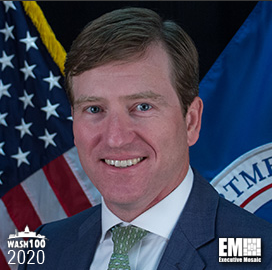
Veritas Technologies, an industry leader in enterprise data protection, announced on Tuesday that Frank Finelli, managing director of the Carlyle Group and a previous Wash100 Award recipient, has been appointed to the company’s Public Sector Advisory Board.

The board consists of renowned public sector experts focused on solving the unique and complex challenges of government organizations who demand guaranteed and simplified recoverability in the face of the heightened global threat landscape.

Finelli has served as the managing director for the Carlyle Group since 1998 and is responsible for the company’s investments in the defense and aerospace sector. Over his tenure, he has led numerous acquisitions and developed Carlyle’s cross-portfolio purchasing and functional initiatives.

Prior to joining the Carlyle Group, Finelli served as a legislative assistant for then-Senator Dan Coats (R-IN). In addition, he was a special assistant to the Chairman of the Joint Chiefs of Staff for the first Quadrennial Defense Review (QDR) in 1997.

He also worked for the Vice-Chairman in restructuring the Joint Requirements Oversight Council (JROC). Finelli retired as an Army Lieutenant Colonel and also was an associate professor of Economics at the U.S. Military Academy from 1986 to 1989.

Along with Finelli, Veritas Technologies named former CIO of the Department of Homeland Security (DHS) Karen Evans, retired U.S. Navy Vice Admiral Nancy Norton, also a previous Wash100 Award winner, and Dr. Barry West, founder and CEO of West Wing Advisory Services to the board of advisors for the company.

The advisory board will work closely with Veritas executives to prioritize and guide Veritas’ direction on strategic business opportunities and go-to-market, route-to-market, customer and operational strategies for the public sector. It will also help strengthen the company’s position in the cyber ecosystem.

“The significant Veritas public sector customer base will benefit greatly from the breadth and depth of public sector experience this elite group of leaders brings to the table,” said Kevin Youngquist, vice president of U.S. public sector sales at Veritas.

“I’m very excited for the strategic advice and guidance they will provide to help us ensure closer alignment with public sector customer cybersecurity and data protection needs,” Youngquist added.

Government Technology/News
Navy Test-Flies Kratos-made Subsonic Aerial Target; Don Blottenberger Quoted
by Nichols Martin
Published on October 5, 2021
Navy Test-Flies Kratos-made Subsonic Aerial Target; Don Blottenberger Quoted

The U.S. Navy tested a new subsonic aerial target last month with the USS Barry destroyer at the Japan-based Pacific Missile Range Facility, Detachment-Far East.

The BQM-177A target underwent back-to-back test flights from Sept. 9th to 10th as the Navy seeks to achieve the technology's full operational capability this year, Naval Air Systems Command said Monday. Kratos Defense and Security Solutions produced the target.

BQM-177 is designed to simulate anti-ship cruise missiles flying at subsonic speeds from land, air, surface or underwater locations. 

“We learned a lot from these events and to scale this capability in the future to other surface ships we now know how to move forward,” said Don Blottenberger, program manager of the Navy's aerial target program office known as PMA-208.

Government Technology/News
Air Combat Command Concludes Design Certification Test of B61-12 Nuclear Bomb; Lt. Col. Daniel Jackson Quoted
by Nichols Martin
Published on October 5, 2021
Air Combat Command Concludes Design Certification Test of B61-12 Nuclear Bomb; Lt. Col. Daniel Jackson Quoted

Air Combat Command (ACC) and its maintenance partners have completed the final flight test exercise required to certify the B61-12 bomb‘s nuclear design.

A pair of F-35A units dropped B61-12 joint test assemblies during the aircraft’s first full weapon system demonstration, ACC said Monday.

Pilots dropped the JTAs at Tonopah Test Range while observing operationally realistic flight envelopes. The test’s completion concludes the B61-12 design’s on-aircraft testing and has produced data for further analyses by the departments of Defense (DOD) and Energy (DOE).

“The B61 series weapons are tactical gravity nuclear weapons that can be used on dual-capable aircraft like the F-15E and F-16C/D,” said Lt. Col. Daniel Jackson, division chief of strategic deterrence and nuclear integration at ACC’s headquarters.

“Adding ‘nuclear capable’ to a 5th-Gen fighter that already brings several conventional-level capabilities to the table adds strategic-level implication to this jet,” Jackson added.

Executive Moves/News
Former Jacobs Exec Vernon Saunders Joins SAIC as SVP, National Intelligence
by reynolitoresoor
Published on October 5, 2021
Former Jacobs Exec Vernon Saunders Joins SAIC as SVP, National Intelligence

SAIC has named two-time Wash100 Award winner Vernon Saunders as the senior vice president of national intelligence.

Saunders is a certified Project Management Professional with over two decades of experience in information technology and business management and over six years of service in the U.S. Air Force. 

Throughout his career, Saunders has obtained deep expertise in shaping strategies, building and leading global high-performance teams and executing technology initiatives for private and public sector organizations.

Prior to his new role with SAIC, Saunders served as general manager of data & mission IT at Huntington Ingalls Industries’ technical solutions division for over two years.

His previous experience also includes 14 years at Verizon’s Federal Network Systems, which Jacobs acquired in 2014. During his 5 years at Jacobs following the acquisition, Saunders rose from FNS’ deputy general manager to vice president and general manager. 

Currently, Saunders serves as a board member for the non-profit social service organization, Northern Virginia Urban League.

Saunders received his B.S. in Electronics from Norfolk State University and his MBA from Averett University. Additionally, Saunders holds a masters certificate in federal government contracting from Villanova University.

Contract Awards/News
IARPA Selects 8 Teams to Develop Portable Power Systems for Intell Community Missions; Dawson Cagle Quoted
by Angeline Leishman
Published on October 5, 2021
IARPA Selects 8 Teams to Develop Portable Power Systems for Intell Community Missions; Dawson Cagle Quoted

The Intelligence Advanced Research Projects Activity (IARPA) has awarded separate contracts to eight teams to develop systems for supplying power to electronic platforms that can support the intelligence community's demanding missions.

The Robust Energy Sources for Intelligence Logistics In Extreme, Novel and Challenging Environments initiative is seeking power sources for vertical takeoff and landing unmanned aircraft and unattended devices, IARPA said Monday.

Research teams for the effort will be led by Rutgers University, Saft America, Teledyne Scientific and Imaging, Conamix, SRI International, II-VI Aerospace & Defense, Solid Power and CAMX Power.

The U.S. Army's Command, Control, Communication, Computers, Cyber, Intelligence, Surveillance and Reconnaissance Center will test and evaluate the resulting systems.

“Most people assume that they can recharge the batteries in their electronics wherever they go,” said Dawson Cagle, a program manager at IARPA. “The goal of the RESILIENCE program is to assure maximum power source reliability in extreme conditions where recharging is not possible."

Contract Awards/News
AT&T’s FirstNet Selected to Provide U.S. Air Force With First Responder Communications Platform; Lance Spencer Quoted
by reynolitoresoor
Published on October 5, 2021
AT&T’s FirstNet Selected to Provide U.S. Air Force With First Responder Communications Platform; Lance Spencer Quoted

The U.S. Air Force has tapped AT&T to provide its FirstNet broadband communications platform to enhance communications for public safety personnel and first responders at 15 bases across the country, with the possibility for future expansion.

FirstNet, a platform built through a public-private partnership with the First Responder Network Authority and AT&T, will support secure interoperable voice, data and video communications with priority and preemption for on- and off-base first responders, AT&T said Tuesday. 

Additionally, the network will feature a dedicated lane of connectivity for the Air Force’s military and public safety community for faster, more reliable access to mission-critical information and improved collaboration capabilities in response to safety threats. 

“We aim to be the network provider of choice as the Air Force moves more deliberately toward consuming advanced communications capabilities,” said Lance Spencer, client executive vice president of defense at AT&T Public Sector and FirstNet.

“It’s an honor to deliver FirstNet to support base personnel and first responders to help ensure the safety of each base and its surrounding community,” Spencer continued.

The Air Force Civil Engineer Center (AFCEC) and AT&T have struck an agreement that will deliver FirstNet services for 21 years, which covers the remainder of the public-private partnership between AT&T and the U.S. government.

Under the agreement, the U.S. Air Force will have access to a dedicated fleet of over 100 land-based and airborne portable cell sites for ensured connectivity in critical response efforts during significant events.

FirstNet operates across the LTE – Band 14 spectrum and the platform’s core has been upgraded to enable 5G connectivity, providing the Air Force with increased network capacity, high throughput speeds and 5G-powered edge computing capabilities. 

Government Technology/News/Wash100
DHS Unveils Roadmap for Post-Quantum Cryptography Transition; Secretary Alejandro Mayorkas Quoted
by Carol Collins
Published on October 5, 2021
DHS Unveils Roadmap for Post-Quantum Cryptography Transition; Secretary Alejandro Mayorkas Quoted

The Department of Homeland Security has released a guidance to assist organizations in securing their data and systems and mitigating risks and in preparing for the transition to post-quantum cryptography.

The roadmap was developed in collaboration with the Department of Commerce’s National Institute of Standards and Technology (NIST)  and was meant to offer guidance on the identification, prioritization and protection of susceptible data and algorithms, DHS said Monday. 

Alejandro Mayorkas, secretary of DHS and 2021 Wash100 Award recipient, noted that as quantum computing emerges as a scientific breakthrough, it also poses new risks to data privacy and cybersecurity. 

One of the roadmap’s recommendations is to instruct chief information officers to expand their engagement with standards developing institutions to gain information on the latest developments and changes in protocols. 

The guidance also suggested the creation of an inventory for the most sensitive and critical data needed to be secured for prolonged periods of time.

“This information will inform future analysis by identifying what data may be at risk now and decrypted once a cryptographically relevant quantum computer is available,” the roadmap reads. 

Earlier in March, Mayorkas indicated that the adoption of post-quantum encryption algorithms is a priority of the agency and the private sector is slated to manage the effort’s implementation. 

Cybersecurity/Government Technology/News
Bipartisan Senate Bill Seeks to Update FISMA
by Angeline Leishman
Published on October 5, 2021
Bipartisan Senate Bill Seeks to Update FISMA

Two senators have introduced a bipartisan bill that would reform a law governing information technology system protection at federal agencies.

Senate Homeland Security and Governmental Affairs Committee Chairman Gary Peters, D-Mich., authored the Federal Information Security Modernization Act of 2021 with Ranking Member Rob Portman, R-Ohio, in a push to ensure that government organizations have the funds and tools to confront an evolving cyber threat landscape, according to a press release posted Monday on Peters' official website.

The legislation would give the Cybersecurity and Infrastructure Security Agency (CISA) more authority to handle attacks on civilian IT networks and ensure the timeliness of incident or breach reports from agencies and their contractors.

The FISMA reform proposal also seeks to implement high-level security measures for systems and sensitive government data through the codification of President Biden's cybersecurity directive.

Congress last updated the law in 2014 and the committee led by Peters plans to take it up on Wednesday.

Government Technology/News
IG Report: DOD Uses Middle Tier of Acquisition Pathways to Rapidly Deliver Capabilities to Warfighters
by Jane Edwards
Published on October 5, 2021
IG Report: DOD Uses Middle Tier of Acquisition Pathways to Rapidly Deliver Capabilities to Warfighters

The Department of Defense’s (DOD) office of inspector general (OIG) conducted an audit of DOD's use of the middle tier of acquisition (MTA) pathway and found that acquisition personnel employed the MTA approach for 11 reviewed programs in accordance with the department's guidance to rapidly build and deploy technologies to meet the needs of warfighters.

The OIG said in a Sept. 28th report that the use of MTA pathways helped streamline acquisition processes and accelerate prototyping and fielding efforts, leading to increased effectiveness and efficiencies.

There are two MTA types and the first is the Rapid Prototyping Pathway, which focuses on innovative tech platforms to accelerate the development of fieldable prototypes to address emerging military requirements. The Rapid Fielding Pathway deals with proven systems to deploy production quantities of updated or new platforms.

The inspector general also found that acquisition executives at DOD backed the use of MTA pathways, while program managers and program management offices employed the flexibilities that MTA pathways offer.

According to the report, DOD components had 69 programs using MTA pathways valued at approximately $31.1 billion as of Sept. 30, 2020. Of those programs, 56 are rapid prototyping initiatives and the rest are using the Rapid Fielding Pathway.

“Because the MTA programs are still in the early stages of execution and DoD acquisition reform remains a work in progress, the DoD must continue to balance management and oversight of these programs with the risk involved to ensure the efficient delivery of needed, useful, capabilities at a fair and reasonable cost,” the report reads.

Previous 1 … 1,028 1,029 1,030 1,031 1,032 … 2,667 Next
News Briefing
I'm Interested In:
Recent Posts
  • Charles Wall Named ICE Deputy Director
  • SEC Appoints Russell McGranahan as General Counsel
  • US Aims to Revitalize Domestic Semiconductor Sector Via Trade Deal With Taiwan
  • VA Forms Commission to Select Under Secretary for Benefits Candidates
About

ExecutiveGov, published by Executive Mosaic, is a site dedicated to the news and headlines in the federal government. ExecutiveGov serves as a news source for the hot topics and issues facing federal government departments and agencies such as Gov 2.0, cybersecurity policy, health IT, green IT and national security. We also aim to spotlight various federal government employees and interview key government executives whose impact resonates beyond their agency.

Read More >>

RSS ExecutiveBiz
  • Booz Allen’s Chris Christou on New Developments in 5G, Connectivity & AI
  • IBM Launches Software to Help Deploy Self-Managed, AI-Ready Environments
  • OCH Technologies Achieves CMMC Level 2 Certification
  • Tyler Technologies Leaders Share Federal Modernization Best Practices
  • Raft Partner Program Launched to Accelerate Defense Software Deployment
  • Navy Awards BAE Systems $62M Hawkeye IFF Maintenance Contract
RSS GovConWire
  • CesiumAstro Secures $200M EXIM Financing for US Space Manufacturing Expansion
  • PsiQuantum Names 3 New Members to Government Advisory Board
  • LMI Realigns 3 Executives Under New CEO
  • MDA Awards 340 Additional Spots on Potential $151B SHIELD Contract
  • NVIDIA Appoints Groq Executive Rich Wajsgras as Senior Manager
  • Parsons Buys Altamira for $375M
Footer Logo

Copyright © 2025
Executive Mosaic
All Rights Reserved

  • Executive Mosaic
  • GovCon Wire
  • ExecutiveBiz
  • GovCon Exec Magazine
  • POC
  • Home
  • Acquisition & Procurement
  • Agencies
    • DoD
    • Intelligence
    • DHS
    • Civilian
    • Space
  • Cybersecurity
  • Technology
  • Executives
    • Profiles
    • Announcements
    • Awards
  • News
  • Articles
  • About
  • Wash100
  • Contact Us
    • Advertising
    • Submit your news
    • Jobs
Go toTop