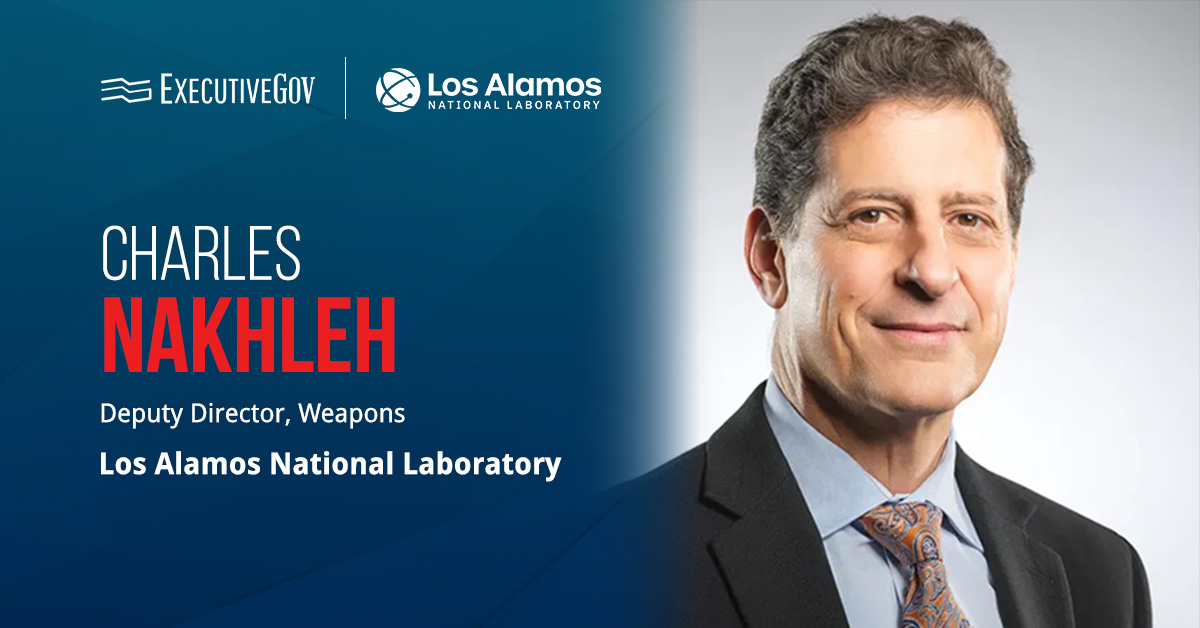
Los Alamos National Laboratory has named Charles Nakhleh as deputy laboratory director for weapons, effective April 1. LANL said Thursday that Nakhleh will lead all laboratory programs and organizations associated with the National Nuclear Security Administration’s weapons programs, including four directorates: weapons physics, engineering, production and plutonium infrastructure.
He succeeds Robert Webster, who is retiring after more than four decades of service.
Who Is Charles Nakhleh?
Nakhleh currently serves as associate laboratory director for LANL’s weapons physics directorate, where he oversees weapons physics and design, dynamic experimentation and multiphysics computational simulations.
Since joining the laboratory in 1996, he has held multiple roles of increasing scope and responsibility, including head of the X Theoretical Design division and executive officer for weapons programs. He also spent time at Sandia National Laboratories, where he oversaw target design and analysis for inertial confinement fusion and high-energy-density physics experiments.
In addition to his leadership roles, Nakhleh served in advisory roles across the nuclear security enterprise, including as a founding member of the NNSA’s Predictive Science Panel and as an adviser to the under secretary of energy for science on the Department of Energy’s National Ignition Campaign.
“Throughout his career, Charlie has exemplified the integrity, rigor and sense of purpose that define Los Alamos, and the Lab's leadership team and I firmly believe he is the right person for the job,” LANL Director Thom Mason.
Nakhleh holds a doctorate in physics from Cornell University.
How Do National Laboratories Support US Weapons Programs?
National laboratories such as Los Alamos support weapons programs through research, testing, manufacturing and modernization efforts.
LANL designed five of the seven current weapons systems in the U.S. stockpile. The lab is also responsible for the maintenance and modernization of the B61 family of gravity bombs and the W76, W78, and W88 warheads.
Meanwhile, at Lawrence Livermore National Laboratory, researchers are testing whether U.S. nuclear warheads can infiltrate enemy missile defense systems using the National Ignition Facility, which simulates the extreme conditions weapons may encounter as they enter enemy territory.
LLNL is also supporting the development of the W87-1 warhead to replace the aging W78. W87-1 will be deployed on the Air Force’s Sentinel intercontinental ballistic missile system.