

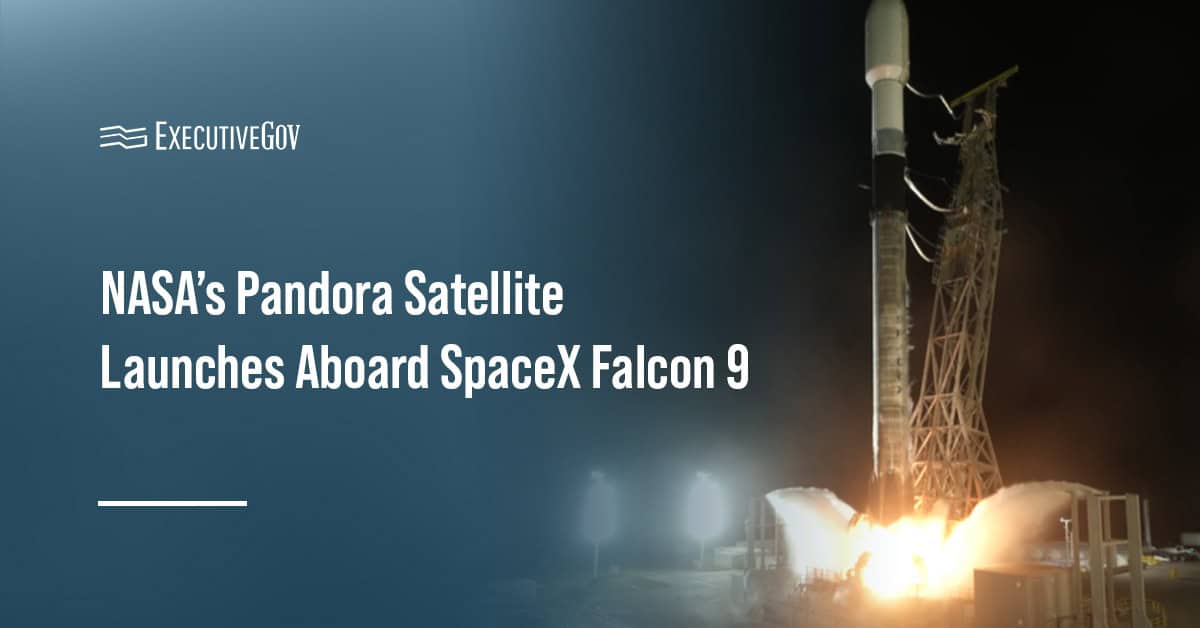
NASA launched its Pandora small satellite on a SpaceX Falcon 9 rocket from Space Launch Complex 4 East at Vandenberg Space Force Base in California on Jan. 11 as part of the Twilight commercial rideshare mission.
What Is NASA’s Pandora Small Satellite?
The agency said the Pandora satellite is a spacecraft designed to study the atmospheres of distant exoplanets while monitoring the behavior of their host stars. It will operate in a sun-synchronous orbit, enabling it to observe targets under consistent lighting conditions by passing over the same point on Earth at nearly the same local time each day. By examining at least 20 exoplanet systems, Pandora will help researchers distinguish atmospheric chemical signals from effects caused by stellar activity, enhancing the accuracy of exoplanet observations.
How Will Pandora Perform Its Mission?
According to Elisa Quintana, principal investigator for Pandora at NASA’s Goddard Space Flight Center, the mission aims to “disentangle the atmospheric signals of planets and stars using visible and near-infrared light.”
Using its onboard telescope, the spacecraft will gather visible and infrared light from each target system during extended observation campaigns. It will observe each system up to 10 times, with each session lasting up to 24 hours. These prolonged, multi-wavelength observations will allow scientists to separate planetary signals from stellar activity and identify the sources of elements and molecules such as water and oxygen.
Data collected by Pandora will help scientists identify the origins of elements and compounds, supporting efforts to determine signs of life. Furthermore, it is also expected to enhance NASA’s James Webb Space Telescope’s ability to study exoplanet atmospheres.
BlackCAT & SPARCS CubeSat Missions
The launch also carried dozens of additional satellites, including two NASA-sponsored CubeSats. The Star-Planet Activity Research CubeSat, or SPARCS, will monitor ultraviolet emissions from low-mass stars to evaluate the effects of stellar activity on nearby planets. The Black Hole Coded Aperture Telescope, or BlackCAT, will study gamma-ray bursts and other transient cosmic events using advanced X-ray detection technology.