

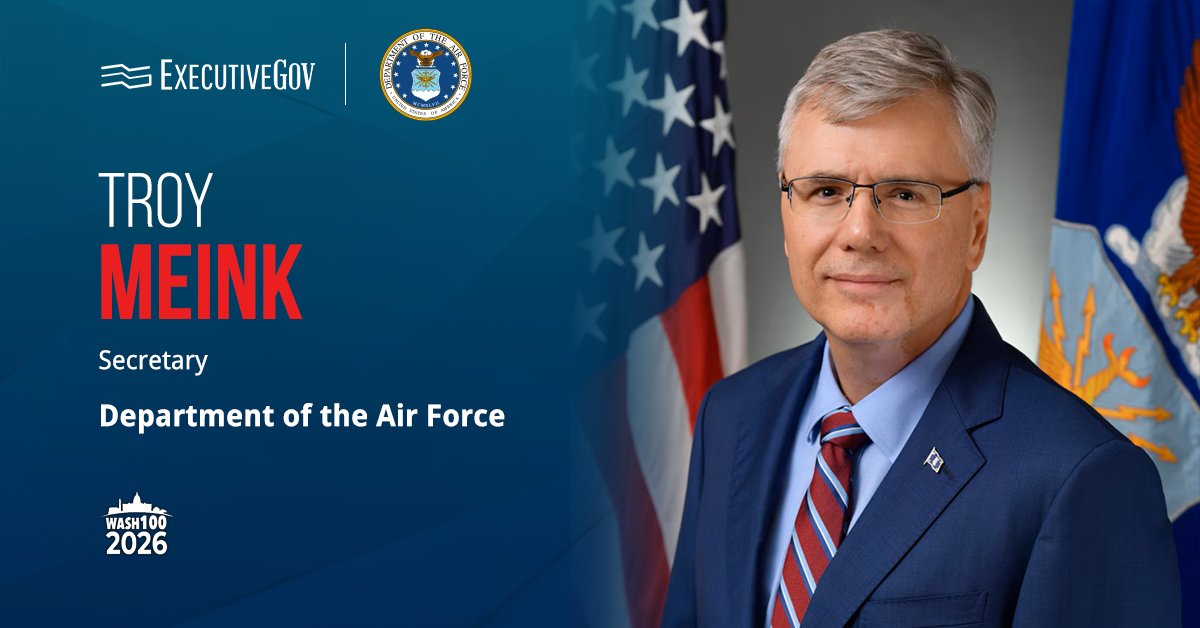
Secretary of the Air Force Troy Meink said acquisition reform will play a central role in strengthening the Department of the Air Force’s ability to compete and maintain dominance during a period of rapid technological change, the U.S. Space Force reported Thursday.

As defense leaders continue to emphasize acquisition reform and workforce priorities, forums like the 2026 Air and Space Summit provide an opportunity to stay informed on evolving priorities across the sector. Sign up now for the July 30 event to hear experts discuss the capabilities and trends shaping national security innovation across two critical domains.
Table of Contents
How Is DAF’s Acquisition Reform Reshaping Decision-Making?
Meink, a 2026 Wash100 awardee, said DAF is pushing authority down to lower levels to enable faster and more flexible program execution.
In March, the Space Force announced six mission areas to be managed by portfolio acquisition executives, or PAEs. The move came two months after the Air Force began implementing the Warfighting Acquisition System by announcing the first tranche of five PAEs overseeing fighters and advanced aircraft; command, control, communications and battle management; nuclear command, control and communications; weapons; and propulsion.
“As a rule, we’re delegating nearly every decision authority that we’re legally allowed to down to the PAE level,” he said.
The secretary added that the department has delegated 85 percent of contracting authorities to PAEs, with that figure reaching 92 percent for the Space Force.
Why Is the Department Shifting to a Minimum Viable Product Approach?
Meink highlighted the need to drive a cultural shift in acquisition and noted that the new approach should focus on building minimum viable products rather than pursuing fully optimized systems with expanded requirements.
“It doesn’t matter if we have something that works perfectly under all conditions,” he said. “If it is too expensive and we can’t build enough of them to be effective, it’s a failed program.”
Meink on Need for Talent
Meink said talent remains a critical factor in executing acquisition reform and modernization efforts.
He emphasized the need to recruit and retain personnel with science, technology, engineering and mathematics expertise to support program development and decision-making.
Related Articles
The National Science Foundation has started seeking proposals for national-scale data infrastructure projects as part of the Integrated Data Systems and Services, or IDSS, program. NSF’s new solicitation underscores continued federal focus on advancing cyberinfrastructure and research capabilities. As government and industry stakeholders track these developments, the 2026 Cyber Summit on May 21 will explore topics, such as artificial intelligence in cyber defense, zero trust, quantum computing and post-quantum cryptography. Register now! What Is the NSF IDSS Program? Launched in August 2025, the IDSS program supports national-scale operational cyberinfrastructure systems and services designed to enable open, data-intensive and AI-driven science
The U.S. Air Force has appointed Meghan Rosso, Marcus Green and Jennifer Robaina to functional roles within the Cyber and Networks Directorate, the Air Force Life Cycle Management Center said Thursday. The appointments align with efforts to integrate leadership across program management, contracting and human resources. “We are fortunate to have such a talented team stepping into these critical roles,” said Brig. Gen. Joshua Williams, program executive officer for the Cyber and Networks Directorate. “Their collective experience and leadership will strengthen how we deliver capabilities, support our workforce and execute our mission for the Department of the Air Force.” Who Is Meghan Rosso? Green
The National Institute of Standards and Technology has implemented changes to how it processes cybersecurity vulnerabilities and exposures, or CVEs, in its National Vulnerability Database, or NVD, shifting to an enhanced prioritization approach. Escalating cyberthreats have made government data a primary target in modern conflict. Explore how leaders are responding to these threats at the Potomac Officers Club’s 2026 Cyber Summit on May 21. Register today! What Changes Are Being Made? NIST said Wednesday it has started to prioritize enriching CVEs that appear in the Cybersecurity and Infrastructure Security Agency’s Known Exploited Vulnerabilities catalog, those for software used within the federal