Processing....

Executive Gov

Digital News Coverage of Government Contracting and Federal Policy Landscape
Sticky Logo
  • Home
  • Acquisition & Procurement
  • Agencies
    • DoD
    • Intelligence
    • DHS
    • Civilian
    • Space
  • Cybersecurity
  • Technology
  • Executives
    • Profiles
    • Announcements
    • Awards
  • News
  • Articles
  • About
  • Wash100
  • Contact Us
    • Advertising
    • Submit your news
    • Jobs
Logo
Government Technology/News
CYBERCOM Plans to Consolidate Army, USAF Software Factories Under Joint Cyber Warfighting Architecture; Khoi Nguyen Quoted
by Jane Edwards
Published on June 7, 2024
CYBERCOM Plans to Consolidate Army, USAF Software Factories Under Joint Cyber Warfighting Architecture; Khoi Nguyen Quoted

U.S. Cyber Command intends to combine some of the software factories of the U.S. Army and U.S. Air Force under the Joint Cyber Warfighting Architecture and establish a new program executive office using new acquisition authorities, Breaking Defense reported Thursday.

There are six program offices within JCWA and each has its own DevSecOps platforms.

Khoi Nguyen, command acquisition executive and director of the cyber acquisition and technology directorate (J9) at CYBERCOM, said the move to consolidate the platforms of those offices will help reduce duplication and cybersecurity vulnerabilities associated with operating redundant systems.

Congress mandates the creation of the JCWA PEO by 2027. The new office will be composed of six program managers from each program office: the Air Force’s Unified Platform, the USAF’s Joint Cyber Command and Control, the Army’s Persistent Cyber Training Environment, the Army’s Joint Common Access Program, CyberCom’s sensors and the Joint Development Environment, which is run by the Army and overseen by the command.

Nguyen said the planned consolidation will help CYBERCOM improve its ability to defend its supply chain for software development efforts and enable the program offices to use the same “technology stack.”

“In the effort to reduce redundancy, we’re looking to combine or develop a singular platform that then we would GFE [provide as Government-Furnished Equipment] to all the program shops and say, ‘Hey, this is a common platform, [like a] Kubernetes environment, that we’re going to define, and you will just deliver your applications as containers or as virtual machines onto this common platform,” he added.

Nguyen noted that the command expects the common platform to be deployed in the cloud, edge processing and other environments.

DoD/News
Leonel Garciga Offers Guidance on Army’s Transition to Internet Protocol Version 6
by Jane Edwards
Published on June 7, 2024
Leonel Garciga Offers Guidance on Army’s Transition to Internet Protocol Version 6

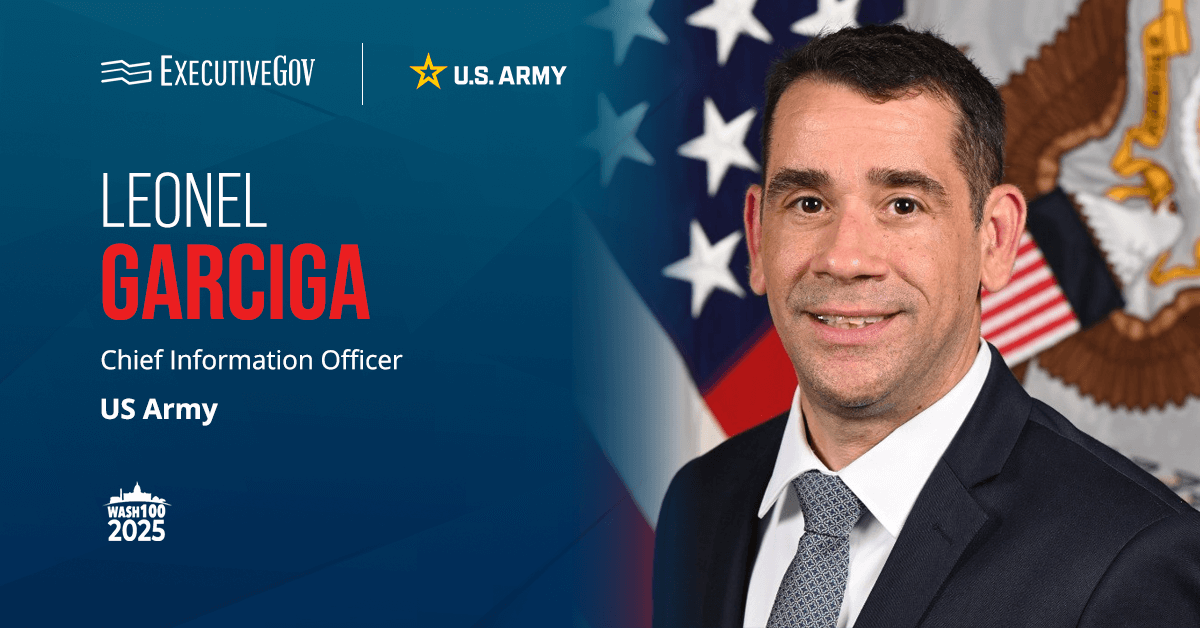
Leonel Garciga, chief information officer of the U.S. Army, has signed a memorandum providing guidance for the military branch’s transition to Internet Protocol Version 6 and operational deployment of IPv6 across all networked information systems, applications, devices and services of the Department of the Army.

According to the May 31 memo, all new Army information systems that use IP technologies must be IPv6-enabled before implementation and operational use starting fiscal year 2025.

IPv6 offers a strategic opportunity to improve IP mobility and efficiency when it comes to delivering information services.

By the end of FY 2025, systems and networks that cannot be moved to IPv6-only must operate in a dual-stack environment.

The service’s information systems that cannot be transitioned to IPv6 must be identified and justified under an approved plan of action and milestones schedule for retiring or replacing systems by the end of FY 2025.

“In rare circumstances where there will be difficulties conforming to IPv6 transition requirements, the responsible system owner should submit a waiver request to the Army’s Unified Network Council (AUNC) to waive this requirement,” the document states.

The memo also assigns responsibilities for the Army CIO, deputy chief of staff G-6, assistant secretary of the Army for acquisition, logistics and technology and system owners and command administrators.

POC - 2024 Army Summit

Garciga, a 2024 Wash100 awardee, will be one of the keynote speakers at the Potomac Officers Club’s 2024 Army Summit on June 13. Register here.

Executive Moves/News
John Sherman to Step Down as DOD Chief Information Officer; Lloyd Austin Quoted
by Jane Edwards
Published on June 7, 2024
John Sherman to Step Down as DOD Chief Information Officer; Lloyd Austin Quoted

John Sherman, chief information officer of the Department of Defense and a 2024 Wash100 awardee, will step down from his role at DOD by the end of June.

In a Thursday statement announcing the move, Defense Secretary Lloyd Austin acknowledged Sherman’s leadership and efforts in helping the department address digital challenges and advance mission readiness by equipping the service branches with capabilities for modern warfighting.

“Under his leadership during the past two and a half years, the Department has restructured its approach to cybersecurity. Today we are better positioned to take advantage of technological developments and respond to digital threats,” Austin, a three-time Wash100 awardee, said of Sherman.

Texas A&M University announced Thursday that Sherman will take on the role of dean of the Bush School of Government and Public Service, effective Aug. 1.

He will succeed Mark Welsh, a retired U.S. Air Force general who was named president of the university in 2023. Since August 2023, Frank Ashley has been serving as acting dean of the Bush School.

Sherman has over three decades of national security experience and held senior roles at the CIA, National Geospatial-Intelligence Agency and the Office of the Director of National Intelligence.

The Texas A&M graduate started his career at the U.S. Army as an air defense officer within the 24th Infantry Division. His experience spans cybersecurity, information technology modernization, international affairs, organizational strategy and data collection and analysis.

News
NSF to Assess National Security Ramifications of Grant Proposals Using New Framework
by Jerry Petersen
Published on June 6, 2024
NSF to Assess National Security Ramifications of Grant Proposals Using New Framework

The Office of the Chief of Research Security Strategy and Policy within the National Science Foundation has developed a new framework that the agency will use in evaluating potential national security risks associated with grant proposals.

The Trusted Research Using Safeguards and Transparency framework will be rolled out in three phases, with the first taking place in fiscal year 2025, according to an article the NSF posted Wednesday.

Phase 1 will involve a pilot program where the TRUST framework will be applied to quantum-related proposals. The effort will subsequently be evaluated using data collected during the run.

Phase 2 will involve the implementation of lessons learned from phase 1 and the expansion of the framework’s coverage to encompass other technology areas articulated within the CHIPS and Science Act of 2022, whose provisions guided the framework’s development.

Phase 3 will further expand the framework’s application to cover all technology areas and the priorities of the NSF Technology, Innovation and Partnerships Directorate.

News/Space
NASA Deploys 2nd PREFIRE CubeSat for Arctic Climate Research Mission
by Naomi Cooper
Published on June 6, 2024
NASA Deploys 2nd PREFIRE CubeSat for Arctic Climate Research Mission

NASA has deployed the second Polar Radiant Energy in the Far-InfraRed Experiment, or PREFIRE, small satellite into space to study the impact of warming climate on Earth’s ice, seas and weather.

The second PREFIRE CubeSat has established communications with ground controllers after it lifted off aboard Rocket Lab’s Electron rocket from the company’s Launch Complex 1 in Mahia, New Zealand, NASA said Wednesday.

The satellite will join the first PREFIRE CubeSat launched on May 28. Blue Canyon Technologies built both spacecraft that will operate for 10 months in space to monitor ice shelves in the Arctic and Antarctica and gather data on heat emissions in the polar region.

“This mission will give us new measurements of the far-infrared wavelengths being emitted from Earth’s poles, which we can use to improve climate and weather models and help people around the world deal with the consequences of climate change,” said Brian Drouin, PREFIRE’s deputy principal investigator at NASA’s Jet Propulsion Laboratory.

“Equipped with advanced infrared sensors that are more sensitive than any similar instrument, the PREFIRE CubeSats will help us better understand Earth’s polar regions and improve our climate models,” said Laurie Leshin, director at NASA JPL.

Cybersecurity/News
CISA’s Cybersecurity Advisory Committee Votes on Recommendations for Optimizing Cyber Defense Collaboration
by Naomi Cooper
Published on June 6, 2024
CISA’s Cybersecurity Advisory Committee Votes on Recommendations for Optimizing Cyber Defense Collaboration

Members of the Cybersecurity and Infrastructure Security Agency’s Cybersecurity Advisory Committee, or CSAC, held its second quarterly meeting of 2024 to discuss and vote on recommendations for building an operational cyber defense collaboration.

Jen Easterly, director of CISA and a 2024 Wash100 awardee, joined the discussions with CSAC members to finalize recommendations for enhancing the Joint Cyber Defense Collaborative, a public-private initiative aimed at boosting the cyber defenses of the critical infrastructure sector, CISA said.

“I am excited about the recommendations discussed today and look forward to reviewing them,” Easterly said. “I know they are thoughtful and innovative ideas that align with CISA’s priorities and mission as the previous recommendations have been.”

During the meeting, the members also heard updates from subcommittees, including the Building Resilience for Critical Infrastructure subcommittee’s efforts to promote cybersecurity and resilience programs across the critical infrastructure sector.

Established in 2021, CSAC comprises industry and government leaders who advise the agency on cybersecurity policies and programs.

Federal Civilian/News
Energy Department Announces Voucher Program Opportunities, Eyes Accelerated Clean Energy Technology Adoption
by Jerry Petersen
Published on June 6, 2024
Energy Department Announces Voucher Program Opportunities, Eyes Accelerated Clean Energy Technology Adoption

The Office of Technology Transitions within the Department of Energy is reopening five voucher opportunities and launching two new ones worth $15 million under the Voucher Program.

Established in 2023 and financed by the Bipartisan Infrastructure Law and the Inflation Reduction Act as part of the Technology Commercialization Fund, the Voucher Program seeks to facilitate clean energy technology commercialization and address risks associated with technology adoption, the OTT said Tuesday.

Under the program, recipients apply for the capabilities they need to overcome challenges related to energy technology adoption. The recipients are matched with providers that possess those capabilities. The providers are paid by the government for the work they perform in support of the recipients.

The reopened voucher opportunities cover the following needs:

  • pre-demonstration commercialization support
  • performance validation, modeling and certification support
  • clean energy demonstration project siting and permitting support
  • commercialization support

The two new voucher opportunities cover the following needs:

  • planning and validation of industrial decarbonization projects
  • manufacturing conversion, retooling and retrofitting support

Organizations that are interested in becoming capability providers for these opportunities have until July 9 to respond.

A second submission period will be opened this summer for organizations that seek to become recipients for these opportunities.

Cybersecurity/News
DOD Issues Memo on Assessing Joint Force Readiness to Accomplish Missions in Contested Cyber Environments
by Jane Edwards
Published on June 6, 2024
DOD Issues Memo on Assessing Joint Force Readiness to Accomplish Missions in Contested Cyber Environments

The Department of Defense has released a memorandum to provide guidance for DOD components to develop standard metrics, terminology and policy to evaluate the readiness of the joint force in conducting assigned and designed missions in congested and contested cyber environments.

Ashish Vazirani, who performs the duties of undersecretary of defense for personnel and readiness at DOD, signed the directive-type memo issued Wednesday.

The document expands the readiness reporting policy by including a unit’s ability to operate in congested and contested cyberspace environments and directs the joint force to incorporate the risk of operating in such environments when evaluating and exercising their operational plans.

The memo outlines the responsibilities of the DOD component heads, undersecretary of defense for policy, directors of combat support agencies and secretaries of military departments.

According to the document, the secretaries of military branches should implement joint force standards in the Defense Readiness Reporting System, a.k.a. DRRS, incorporate the challenges of operating in contested cyber environments into training exercises and update doctrine to include how to achieve designed and assigned missions in such environments.

The directive states that the chairman of the Joint Chiefs of Staff will be responsible for updating readiness reporting guidance and policy, supporting combatant commanders in joint training programs and exercises to perform missions in congested and contested cyber environments and implementing joint force standards and conditions in DRRS for operating in such environments.

Government Technology/News
Bipartisan House Bill to Reauthorize, Expand Federal Government’s Counter-Drone Authorities
by Jane Edwards
Published on June 6, 2024
Bipartisan House Bill to Reauthorize, Expand Federal Government’s Counter-Drone Authorities

House lawmakers have introduced a bipartisan bill that would extend through Oct. 1, 2028, existing authorities that provide the departments of Homeland Security and Justice with key tools to counter the increasing threat posed by unmanned aircraft systems.

The House Homeland Security Committee said Tuesday the Counter-UAS Authority Security, Safety and Reauthorization Act of 2024 would prohibit DOJ and DHS from authorizing the use of counter-UAS platforms produced by certain foreign companies.

The proposed measure would direct DHS to establish a counter-UAS mitigation pilot program, authorize the procurement, deployment and operation of counter-drone systems by operators or owners of covered sites and critical infrastructure and work with DOJ to develop standards for counter-drone system training programs.

Under the legislation, the Federal Aviation Administration should develop counter-UAS system minimum performance requirements, establish a plan for counter-UAS operations at airports and ensure the safe operation of the National Airspace System.

The bill intends to clarify and improve coordination requirements between DOJ, DHS, FAA and the Department of Transportation and strengthen U.S. privacy and civil liberty protections.

“This legislation meets the moment by ensuring DHS and DOJ have the appropriate authorities to act swiftly and decisively to detect, track, and mitigate hostile drone use, and to coordinate effectively with other agencies like the FAA or law enforcement partners in this pursuit,” said Rep. Mark Green, R-Tenn., chairman of the House Homeland Security Committee.

Counter-UAS authorities are set to expire in October and Green said he expects the bill to pass through the House and Senate quickly.

Green introduced the measure with Reps. Bennie Thompson, D-Miss., Sam Graves, R-Mo., Rick Larsen, D-Wash., and Jerrold Nadler, D-N.Y.

News
AFWERX Project Vanguard, DIU Advance Defense Technology Transition Through Funding Opportunities
by Naomi Cooper
Published on June 6, 2024
AFWERX Project Vanguard, DIU Advance Defense Technology Transition Through Funding Opportunities

A program under the Capital Initiative Division of the U.S. Air Force’s innovation arm is working with the National Security Innovation Network, a Department of Defense program office under the Defense Innovation Unit, to connect small businesses with funding resources to transition their technologies from laboratory to full-scale production.

The partnership between Project Vanguard and NSIN/DIU aims to advance small business projects and technologies by facilitating connections with government and private investors.

Small businesses with a Phase II or higher funding history under the Small Business Innovation Research and Small Business Technology Transfer programs can participate in the effort.

“Our ability to connect the innovation ecosystem is paramount to transitioning critical technologies,” said Col. Elliott Leigh, AFWERX director and chief commercialization officer for the Department of the Air Force. “Project Vanguard will facilitate these connections and help small businesses navigate our complex environment.”

Previous 1 … 366 367 368 369 370 … 2,705 Next
News Briefing
I'm Interested In:
Wash100 Vote Now
Recent Posts
  • Air Force Advances ARES Platform to Modernize Aircrew Management
  • Ann Weaver Named COO of Oak Ridge National Laboratory
  • Pentagon Issues Presolicitation for Potential $1.4B R&D Engineering IDIQ
  • GSA Posts RFI for SmartPay Government Charge Card Modernization
About

ExecutiveGov, published by Executive Mosaic, is a site dedicated to the news and headlines in the federal government. ExecutiveGov serves as a news source for the hot topics and issues facing federal government departments and agencies such as Gov 2.0, cybersecurity policy, health IT, green IT and national security. We also aim to spotlight various federal government employees and interview key government executives whose impact resonates beyond their agency.

Read More >>

RSS ExecutiveBiz
  • Koniag Government Services Earns CMMC Level 2 Certification
  • Wilmac, Carahsoft Partner to Deliver AI Workforce Management Platform to Public Sector Organizations
  • HII, GrayMatter Robotics Partner to Advance Physical AI Integration Into Shipbuilding
  • Modern Technology Solutions Inc Moves to New Corporate HQ
  • GreyNoise Report Warns AI Models May Lag Behind Emerging Cyber Threats
  • Granite Telecommunications’ Charlie Baker Is Helping Agencies Reimagine Telecom Infrastructure
RSS GovConWire
  • Why Most CMMC Compliance Road Maps Fall Behind Schedule
  • From Modernization to Advanced Tech: DOT Opens New Contract Opportunities for Industry
  • OceanSound Partners Secures $3B for Third Fund Backed by Institutional Investors
  • TechnoMile Names Donald Blersch, Ike Rivers to Security Information Management Advisory Board
  • LILT’s Jeff Rothblum on AI’s Role in Scaling Multilingual Translation for Government
  • System High Appoints Wes Postol as EVP of Strategic Growth
Executive Gov

Copyright © 2025
Executive Mosaic
All Rights Reserved

  • Executive Mosaic
  • GovCon Wire
  • ExecutiveBiz
  • GovCon Exec Magazine
  • POC
  • Home
  • Acquisition & Procurement
  • Agencies
    • DoD
    • Intelligence
    • DHS
    • Civilian
    • Space
  • Cybersecurity
  • Technology
  • Executives
    • Profiles
    • Announcements
    • Awards
  • News
  • Articles
  • About
  • Wash100
  • Contact Us
    • Advertising
    • Submit your news
    • Jobs
Go toTop