Processing....

Executive Gov

Digital News Coverage of Government Contracting and Federal Policy Landscape
Sticky Logo
  • Home
  • Acquisition & Procurement
  • Agencies
    • DoD
    • Intelligence
    • DHS
    • Civilian
    • Space
  • Cybersecurity
  • Technology
  • Executives
    • Profiles
    • Announcements
    • Awards
  • News
  • Articles
  • About
  • Wash100
  • Contact Us
    • Advertising
    • Submit your news
    • Jobs
Logo
Executive Moves/News
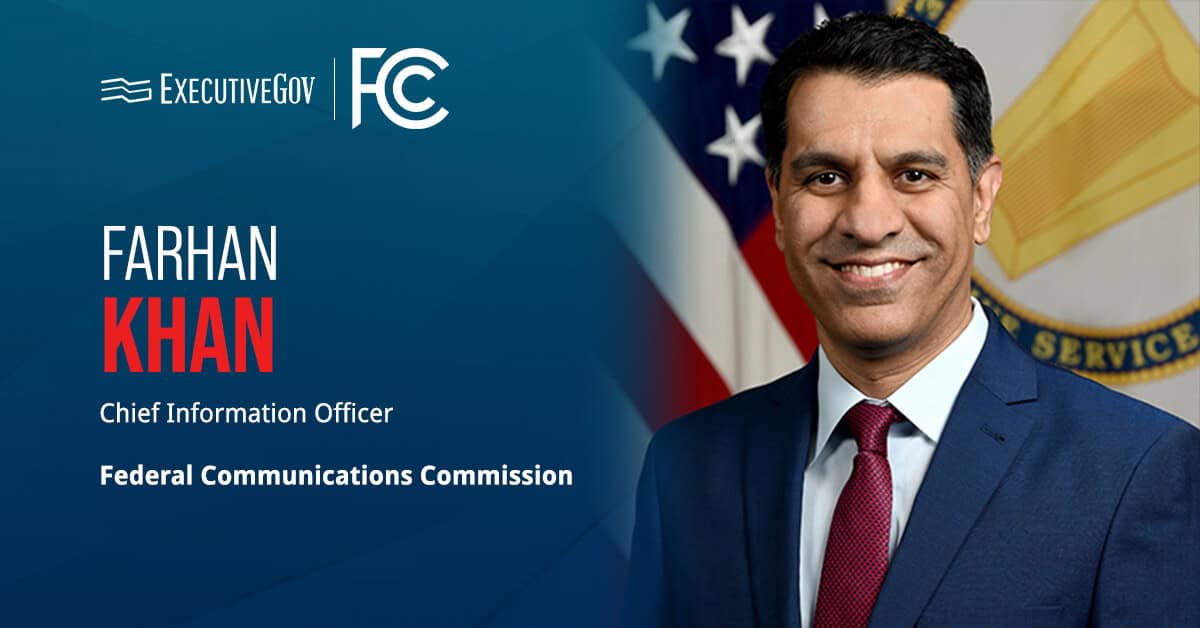
Farhan Khan Named FCC CIO
by Jane Edwards
Published on March 31, 2026
Farhan Khan. The former FDA official has been named CIO at the Federal Communications Commission.

The Federal Communications Commission has appointed Farhan Khan, a technology leader and former Food and Drug Administration official, as chief information officer.

Farhan Khan Named FCC CIO

As Khan steps into the FCC’s top IT role, federal leaders are sharpening their focus on modernization and secure digital infrastructure. Sign up today for the 2026 Digital Transformation Summit and hear directly from leaders shaping the future of federal technology.

FCC said Monday Khan will establish and oversee the commission’s technical vision, lead IT services and drive modernization efforts. He will also ensure information security across FCC systems to support the agency’s workforce and meet the needs of the telecommunications sector.

Table of Contents

  • What Did FCC Managing Director Dan Daly Say About Khan’s Appointment?
  • Who Is Farhan Khan?

What Did FCC Managing Director Dan Daly Say About Khan’s Appointment?

FCC Managing Director Dan Daly said Khan brings the experience needed to lead the agency’s IT organization.

“The FCC’s robust agenda requires a diligent information technology team led by someone with knowledge of all aspects of today’s technology landscape, but also an eye to the future needs of this industry and the Commission as a whole,” Daly stated.

“Farhan has extensive experience in the federal space and in managing large, complex teams. We look forward to his leadership as he applies this same expertise to his responsibilities at the Commission,” he added.

Who Is Farhan Khan?

Khan is an artificial intelligence and digital transformation executive who joined Swingtech as chief AI transformation officer in August 2025.

Before Swingtech, he was chief digital officer at FDA, where he led digital transformation initiatives, oversaw a $200 million budget and managed a team of more than 400 tech professionals. He also served as the agency’s chief technology officer from 2015 to 2017.

Khan also held IT leadership roles at the Federal Deposit Insurance Corporation, the Department of Transportation, the U.S. Army and the Department of Justice. In those roles, he led global IT operations and helped advance shared services models to facilitate application development, cloud migration, telecommunications and data center operations.

He holds a master’s degree in information systems from George Washington University.
Artificial Intelligence/DoD/News
Marine Corps Advances AI-Driven Battle Management in Dynamis Serial 005 Exercise
by Jane Edwards
Published on March 31, 2026
U.S. Marine Corps seal. USMC conducted the Dynamis Serial 005 exercise to advance AI-driven battle management capabilities.

The U.S. Marine Corps conducted “Dynamis Serial 005,” the fifth iteration of Project Dynamis, from March 3 to 20, across five sites in the U.S., including Fort Carson, Colorado, and Charleston, South Carolina.

Marine Corps Advances AI-Driven Battle Management in Dynamis Serial 005 Exercise

As the Marine Corps advances AI-enabled command and control through efforts like Project Dynamis, conversations around multidomain integration and decision advantage continue to gain urgency across the naval community. Register now for the 2026 Navy Summit and join the discussion about how the service is advancing digital modernization, autonomous systems and other naval capabilities.

USMC said Friday the exercise focused on artificial intelligence-enabled battle management command-and-control, or C2, workflows using a unified, multidomain data mesh designed to accelerate decision-making and close the sensor-to-shooter gap.

The service recently released a 56-page document outlining its strategy to advance AI and machine learning adoption to improve aviation readiness and decision-making processes.

Table of Contents

  • What Is Project Dynamis?
  • How Did Dynamis Serial 005 Advance Joint Fires Integration?
  • What Are the 4 Technological Pillars of Dynamis Serial 005?
  • What Are the Lessons Learned From SoSNIE?

What Is Project Dynamis?

Project Dynamis is a campaign of agile software development sprints that started in December. Marines worked with joint partners and software engineers in operational environments to refine digital orchestration capabilities.

Col. Arlon Smith, director of Project Dynamis, said the effort centers on rapidly iterating commercial technologies to deliver AI-driven decision advantage to warfighters at the tactical edge.

How Did Dynamis Serial 005 Advance Joint Fires Integration?

At Fort Carson, Marines from I Marine Expeditionary Force integrated with the Army’s 4th Infantry Division and the 10th Special Forces Group during the Ivy Sting 5 exercise, which included live fire, maneuver operations and synthetic long-range precision fires.

During one scenario, Special Forces transmitted targeting data from a commercial network across classification levels through Army systems to a Marine Corps weapons platform.

The Marine Corps said the exercise reduced airspace deconfliction times by up to 80 percent by digitally sharing High-Mobility Artillery Rocket System munition flight path data across Marine Corps, Army and Navy systems.

Lt. Col. Jeremy Graham, Project Dynamis series lead, said the effort advanced development of a data-centric kill web using AI and machine learning.

What Are the 4 Technological Pillars of Dynamis Serial 005?

The Marine Corps identified four primary components that enabled the exercise:

  • AI-powered decision support: Integration with the Army’s Next Generation C2 program, which uses software designed for AI-driven workflows to support operational decision-making.
  • Machine-to-machine targeting: Automated data flow from sensor to shooter across multiple domains and networks with reduced manual input and human oversight, improving speed and accuracy of targeting.
  • Maven Smart System: The Marine Corps’ enterprise AI-enabled C2 platform, which provided a common tactical picture by ingesting and fusing data from multiple sources, including in degraded communications environments.
  • Resilient mesh network: A secure, self-healing transport layer that allowed data to move across units and services without a single point of failure.

What Are the Lessons Learned From SoSNIE?

In parallel with Ivy Sting 5, a Marine Corps team participated in the Systems of Systems Naval Integration Experiment, or SoSNIE, at Naval Information Warfare Center Atlantic in Charleston. The team worked with industry partners to refine the digital architecture supporting cross-domain data integration and mission autonomy C2 capabilities.

“What we learned at SoSNIE is driving how we incorporate mission autonomy capabilities,” said Lt. Col. Ben Pimentel, lead planner for the SoSNIE portion of Dynamis Serial 005. “It also taught us how to architect information flow when operational conditions require on-premises solutions.”

The Marine Corps said the event also demonstrated the ability to transmit data from unclassified systems to higher-classification networks at machine speeds using a mix of cloud-based and on-premises platforms.

Executive Moves/Intelligence/News
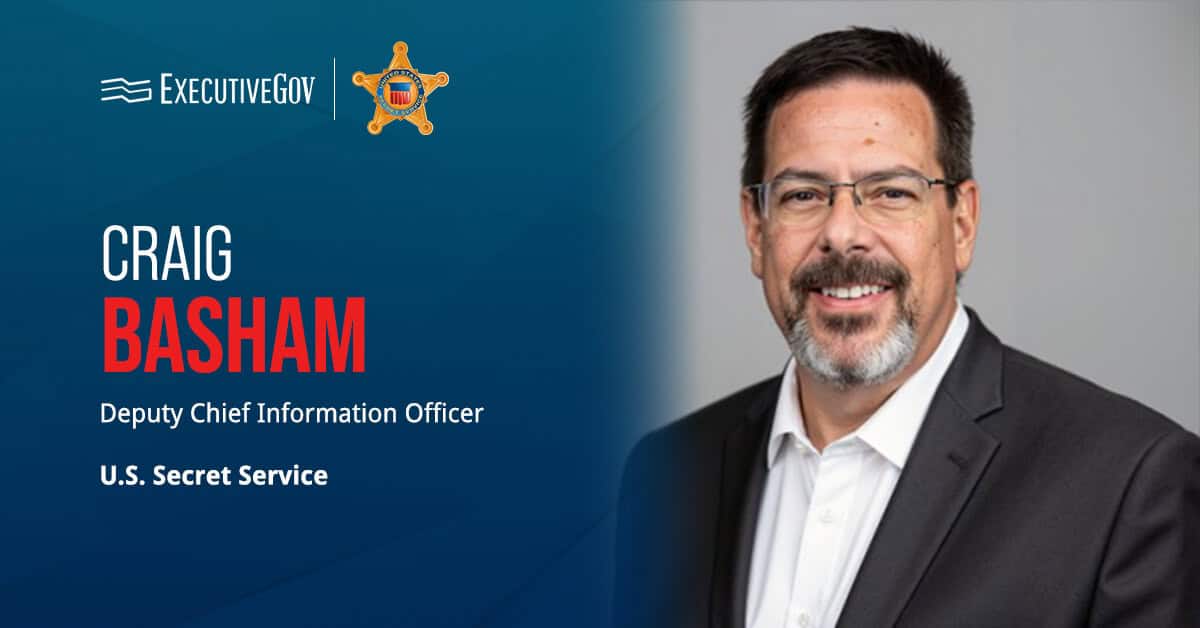
Former DHS Executive Craig Basham Appointed US Secret Service Deputy CIO
by Miles Jamison
Published on March 31, 2026
USSS Deputy CIO Craig Basham. Craig Basham to serve as the deputy chief informaion officer at the U.S. Secret Service.

The U.S. Secret Service has appointed veteran technology executive Craig Basham to serve as its new deputy chief information officer. Chris Cummiskey, CEO of Cummiskey Strategic Solutions and former Department of Homeland Security under secretary, announced the appointment Saturday on LinkedIn.

Former DHS Executive Craig Basham Appointed US Secret Service Deputy CIO

Sign up for the Potomac Officers Club’s 2026 Intel Summit on Sept. 24 to hear from senior intelligence leaders and industry experts on how data, AI, cyber capabilities and secure information-sharing are transforming intelligence operations.

Table of Contents

  • Who Is Craig Basham?
  • What Experience Does Craig Basham Bring?
  • Secret Service Expands Tech Leadership

Who Is Craig Basham?

Basham is an IT and cybersecurity leader with more than two decades of experience in federal and military service. He spent over five years at DHS, most recently serving as deputy executive director for IT operations. In this role, he oversaw a $654 million budget and led a team of more than 1,100 contractors providing secure IT services to over 12,000 personnel across more than 30 major sites in the National Capital Region.

What Experience Does Craig Basham Bring?

Before his stint at DHS, Basham spent over a decade at U.S. Customs and Border Protection, where he led the wireless systems program division and was involved with the U.S. Border Patrol and CBP’s Office of Information and Technology.

During his tenure at CBP, Basham led communications and infrastructure modernization efforts, overseeing more than 1,800 communications sites and managing an annual budget of roughly $130 million. He began his career in the U.S. Army as an IT specialist for U.S. European Command, supporting enterprise IT systems.

Secret Service Expands Tech Leadership

With Craig Basham joining as deputy CIO, the Secret Service is further strengthening its technology leadership team under Chief Operating Officer Chris Toms and Chief Information Officer Chris Kraft to advance its mission through IT, cybersecurity, artificial intelligence and other emerging capabilities.

Federal Civilian/Government Technology/News
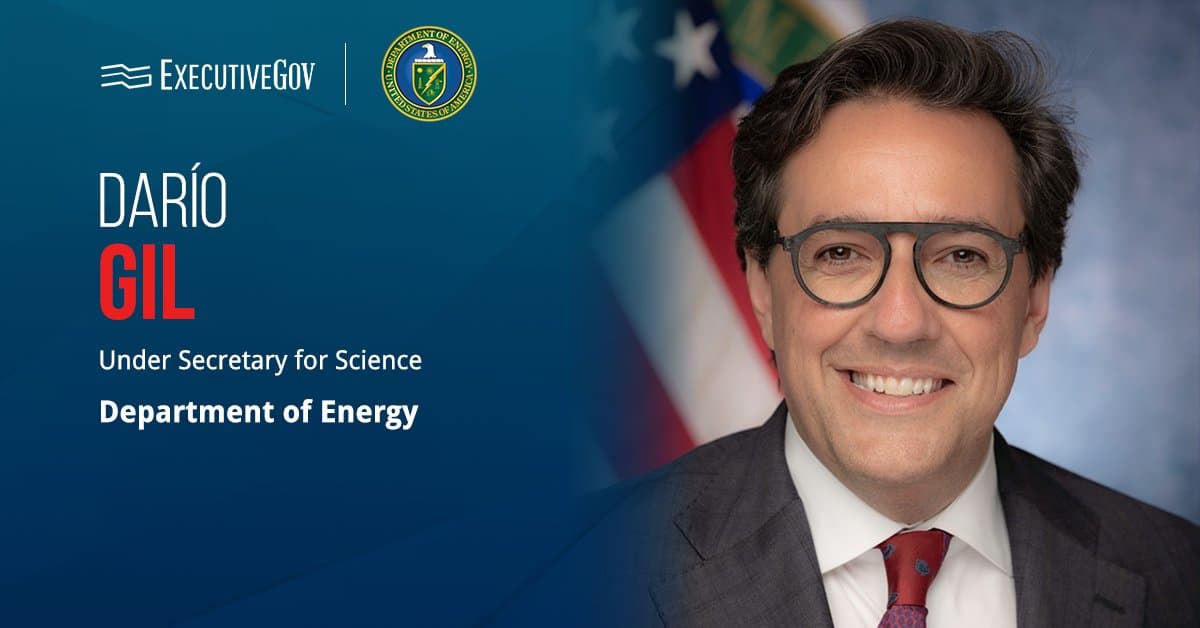
DOE Invests $320M in Quantum, Nuclear, Material Science Research
by Elodie Collins
Published on March 31, 2026
Dario Gil, under secretary for science at DOE. Gil said the investment will strengthen US technological leadership

The Department of Energy has awarded over $320 million in funding to support critical science and technology projects across various disciplines. The agency said Friday that 217 university and industry projects will receive funding over the next five years to expand scientific knowledge and address key challenges related to energy, national security and economic competitiveness.

DOE Invests $320M in Quantum, Nuclear, Material Science Research

Experts will discuss the risks of the accelerating development of quantum computing at the Potomac Officers Club’s 2026 Cyber Summit on May 21. Tickets are still available here.

Table of Contents

  • What Research Projects Will the DOE Funding Support?
  • What Other Investment Opportunities Does DOE Offer?

What Research Projects Will the DOE Funding Support?

The funded projects cover a broad range of science and technology areas:

  • Materials science and engineering: Focuses on developing advanced materials such as alloys, high-performance polymers and metal-organic frameworks for applications in energy storage, microelectronics and quantum information science.
  • Plasma and fusion science: Explores high-temperature plasma behavior to advance fusion energy.
  • Nuclear and particle physics: Investigates the fundamental structure of matter, including nuclear reactions, exotic nuclei and dark matter.
  • Chemical and molecular sciences: Examines chemistry and molecular interactions to improve chemical conversion efficiency.
  • Quantum information science and advanced computing: Drives innovations in quantum algorithms, quantum chaos theory and quantum entanglement.
  • Advanced sensors and nuclear technologies: Supports the development of sensors and other technologies for next-generation reactors and nuclear nonproliferation monitoring.
  • Scientific conferences and collaboration: Funds research gatherings that promote knowledge-sharing, interdisciplinary collaboration and professional development.

“The Department of Energy is the nation’s largest supporter of basic research in the physical sciences, and these investments will strengthen the nation’s scientific and technological leadership,” Dario Gil, under secretary for science at the DOE, stated. “The range and depth of scientific inquiry and discovery that these awards will make possible will provide dividends for America for years and decades to come.”

What Other Investment Opportunities Does DOE Offer?

The department recently launched a $352 million funding opportunity for Energy Frontier Research Centers, which support collaborative, multi-institutional research focused on fundamental questions in energy science and emerging technologies.

The agency also issued a $293 million Genesis Mission funding call to utilize artificial intelligence in addressing national challenges across areas such as advanced manufacturing, biotechnology and nuclear energy. 

In addition, DOE is investing in quantum innovation through initiatives such as the Advanced Research Projects Agency-Energy’s Quantum Computing for Computational Chemistry program. In early March, the agency announced the recipients of $37 million in funding to develop quantum algorithms for materials science, advanced batteries and industrial applications.

Digital Modernization/DoD/Executive Moves/Government Technology/News
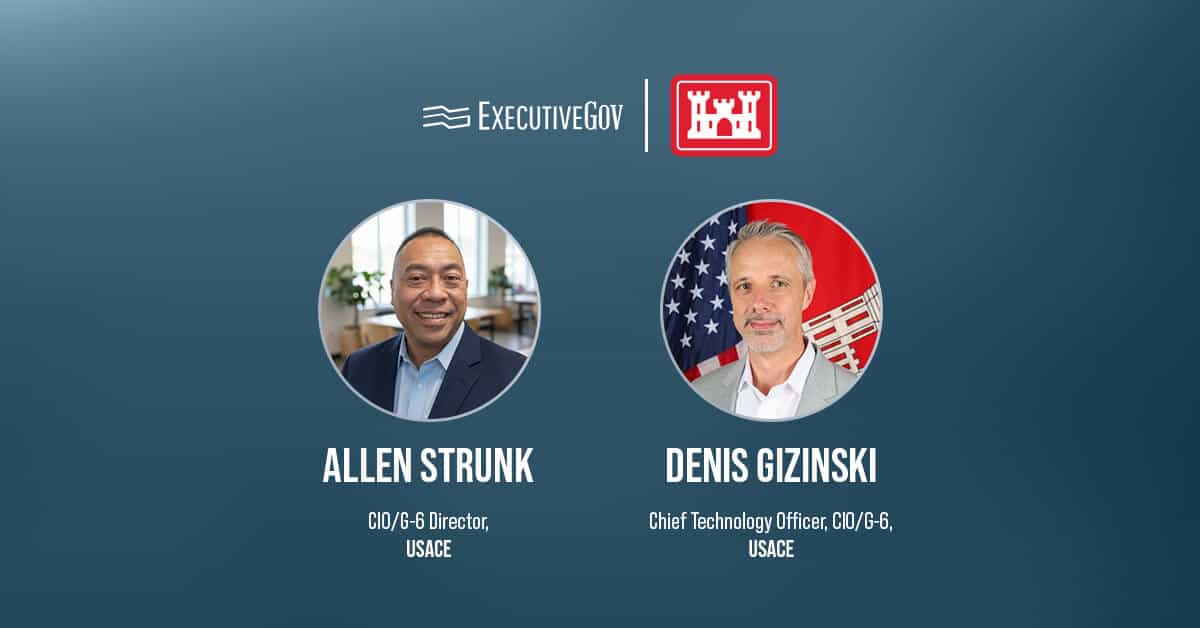
USACE CIO/G-6 Names Allen Strunk Director, Denis Gizinski CTO
by Kristen Smith
Published on March 31, 2026
Allen Strunk and Denis Gizinski. USACE CIO/G-6 named Allen Strunk and Denis Gizinski to senior IT roles.

The U.S. Army Corps of Engineers has appointed two senior technology leaders within its CIO/G-6 organization, naming Allen Strunk as director and Denis Gizinski as chief technology officer, to advance enterprise IT transformation and the integration of emerging technologies.

The appointments come amid efforts to modernize systems, expand cloud adoption, and align data and technology strategies across global operations, USACE said March 24.

USACE CIO/G-6 Names Allen Strunk Director, Denis Gizinski CTO

Register today for the 2026 Army Summit, hosted by the Potomac Officers Club on June 18, to hear Army officials and industry leaders discuss how the service is restructuring its approach to resources, contracting and technology modernization.

Table of Contents

  • Who Is Allen Strunk?
  • Who Is Denis Gizinski?

Who Is Allen Strunk?

Strunk will lead the USACE G-6 organization, overseeing a workforce of approximately 370 IT professionals who deliver enterprise technology services to support more than 37,000 personnel worldwide.

He brings over three decades of experience across military and civilian IT roles. Most recently, Strunk served as chief of information management for the USACE Europe District, where he led IT operations supporting U.S. European Command and U.S. Africa Command missions.

His prior roles include senior leadership positions in Army IT operations, governance and enterprise architecture, with responsibilities spanning large-scale network operations, cybersecurity and information assurance programs.

“Allen brings a wealth of IT knowledge and leadership experience that will contribute and enhance our G-6 organization, said Jason Barrett, chief information officer at USACE. “His expertise is critical as we modernize our systems to overcome future threats and enhance IT services globally.” 

In his new role, Strunk will focus on advancing cloud adoption, data strategy and enterprise architecture initiatives while driving modernization across USACE systems.

“I look forward to leading our exceptional team and leveraging cutting-edge technology to enhance mission capabilities, ensuring our divisions, districts and mission partners have the decisive information advantage they need to succeed in any environment,” Strunk said.

Who Is Denis Gizinski?

Gizinski joins USACE as chief technology officer after serving as chief information officer and deputy director G-6 for the U.S. Army Reserve.

In that role, he oversaw IT strategy, policy and governance for a global network supporting approximately 200,000 personnel across more than 1,000 locations, managing a large workforce and enterprise-scale IT budget.

His experience also includes leadership roles at U.S. Africa Command and Special Operations Command Africa, where he directed communications, computing infrastructure and enterprise IT services in complex operational environments.

As CTO, Gizinski will lead efforts to align technology strategy across the organization, with a focus on accelerating the adoption of artificial intelligence and developing future technology strategies.

“We will chart a clear path toward greater technology alignment across the broader Army and the DoW. This alignment will position us to accelerate the responsible adoption of artificial intelligence (AI), enabling us to reimagine how we manage, secure and leverage data—particularly the data distributed across USACE’s diverse automated information systems,” said Gizinski.

Artificial Intelligence/Cybersecurity/News
Can Object-Level Encryption Replace Traditional Cybersecurity Models?
by Gabriella DeCesare
Published on March 31, 2026
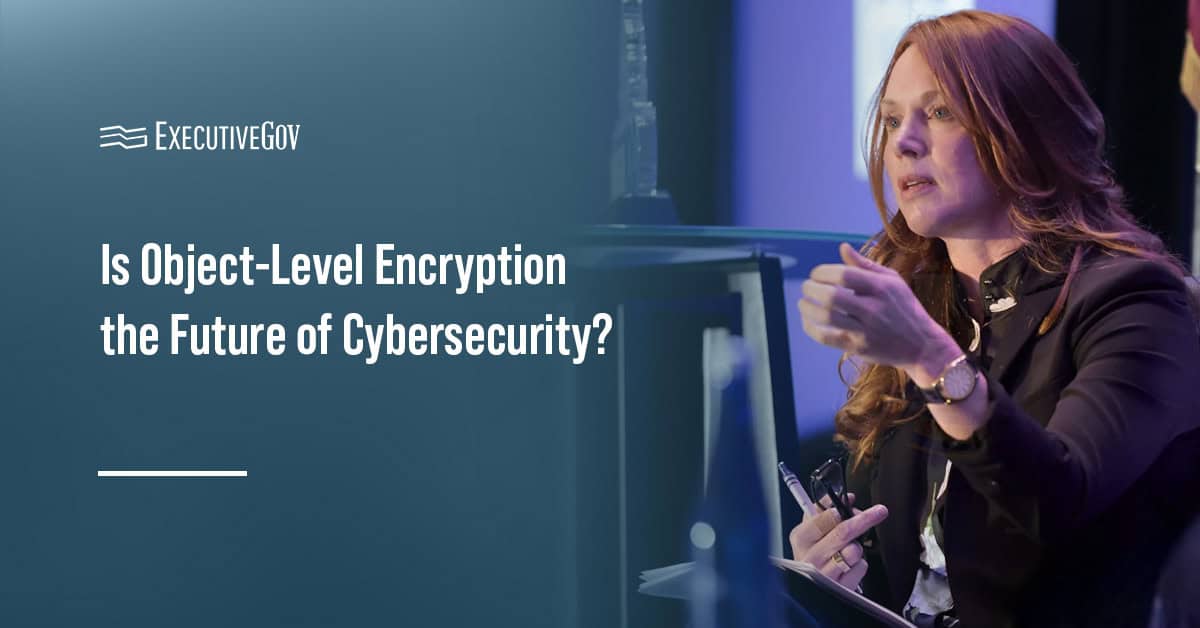
Angel Smith. Virtru's global head of public sector during panel discussion at the Potomac Officers Club's 2026 AI Summit

As AI is more prevalently used in high-security environments, cybersecurity can no longer rely on static defenses like application logins or network boundaries. Instead, the focus must shift toward securing the data itself. 

Current frameworks remain rooted in legacy thinking, where security models still rely on traditional perimeter security, even as use of AI increasingly poses access and security challenges, prompting a transformation. Traditional models are becoming obsolete as organizations prioritize data accessibility and AI-driven outcomes.

At Potomac Officers Club’s 2026 Artificial Intelligence Summit earlier this month, Angel Smith, president of global public sector at Virtru, led a forward-looking discussion on how cybersecurity must evolve in an era shaped by agentic AI and increasingly fluid data environments. In answering whether object-level encryption can replace traditional cybersecurity models, Smith suggested the shift is not only possible but increasingly necessary, as perimeter-based approaches alone are no longer sufficient in AI-driven environments.

Can Object-Level Encryption Replace Traditional Cybersecurity Models?To continue exploring these challenges and the path forward, join government and industry leaders at the 2026 Cyber Summit on May 21, where discussions will focus on cyber infrastructure, securely adopting AI and overcoming legacy barriers to innovation. Reserve your seat here. 

Table of Contents

  • Change From Traditional Perimeter Security to Object-Level Encryption
    • What Is Perimeter Security? 
    • What Is Object-Level Encryption? 
  • What Barriers Are Slowing the Shift to Data-Centric Security? 
  • Who Is Angel Smith?
  • Where Can GovCons Learn How Cybersecurity Is Evolving at Federal Agencies? 

Change From Traditional Perimeter Security to Object-Level Encryption

A central theme of Smith’s panel discussion at the Artificial Intelligence Summit was the transition away from perimeter-based security toward object-level encryption. This shift represents a paradigm change in how organizations protect sensitive information.

Using a vivid analogy, Smith explained: “you’ve got a castle and you’ve got the moat around the castle…you bust over that moat, you’re going to get access to everything in the castle.” This model—long the foundation of cybersecurity—assumes that threats can be kept out by reinforcing external boundaries.

However, Smith argued that this approach is increasingly ineffective in modern, interconnected environments. Instead, she proposed encrypting data at its core, rendering external defenses less critical: “if we were to think about the castle [in] terms of encrypting everything inside…who cares [about the moat, an analogy for perimeter security]? Come on in… It’s all encrypted.”

Object-level encryption could replace key functions of perimeter security by protecting data itself rather than relying on external defenses. This shift is described as a “game-changer,” but one that requires organizations to fundamentally change the way that they think about cybersecurity. 

What Is Perimeter Security? 

Perimeter security refers to the traditional cybersecurity model focused on protecting the boundaries of a network or system. This includes firewalls, access controls and segmented environments designed to keep unauthorized users out.

As described during the panel, perimeter security operates as a containment strategy. This approach often leads to siloed systems and limited data-sharing. 

While effective in earlier IT environments, perimeter security struggles in today’s landscape of interconnected systems and AI-driven workflows.

What Is Object-Level Encryption? 

Object-level encryption shifts the focus from protecting systems to protecting individual data elements. Instead of securing the perimeter, every piece of data gets encrypted and governed by access controls.

Smith described this approach as securing data “at the object level, no longer around the boundary level.”

This means encryption can be applied at granular levels, such as “the word document level” or even “the sensor field level.” Each data object carries its own permissions and attributes, ensuring that only authorized users can access it regardless of where the data resides.

The implications are significant: “clouds don’t matter anymore…On-prem doesn’t matter. You can move data, you can use AI because every single piece of information has attributes associated with it that only allows the right people to [access] it.” Smith explained. 

These capabilities position object-level encryption as a viable replacement for traditional models; by enabling secure data sharing across environments, object-level encryption methods support interoperability and AI integration. 

Angel Smith. Virtru president of global public sector spoke on cybersecurity models at Potomac Officers Club Summit.
Angel Smith (left) and SAIC’s Jay Meil (right) during panel discussion at the 2026 AI Summit. Photo: Executive Mosaic

What Barriers Are Slowing the Shift to Data-Centric Security? 

Transitioning to object-level encryption is not just a technical upgrade—it requires a cultural and operational transformation.

Panelists emphasized that the biggest barriers are not technological but institutional.

“Our policies are wrong, our perspectives are wrong,” Smith said, noting that organizations often make decisions “based off of fear and legacy and infrastructure.”

Interoperability also presents a major challenge, particularly in government and defense environments. The inability to seamlessly share data across systems and organizations remains a critical obstacle, with Smith pointing to persistent difficulties “trading information between squadrons…or…ground units.”

Ultimately, making the shift requires rethinking cybersecurity from the ground up—prioritizing data-centric security models, enabling secure data-sharing and aligning policy with emerging technological realities.

As the panel concluded, the future of cybersecurity will depend on whether organizations can overcome entrenched habits and embrace a model built for the AI-driven world.

Who Is Angel Smith?

Angel Smith is president of global public sector at Virtru, where she leads strategy and growth across government, defense and intelligence markets, with a focus on advancing data-centric security solutions. Prior to joining Virtru in 2026, she spent nearly a decade at Microsoft where she drove adoption of cloud, AI and data technologies across complex federal and international environments.

Smith also brings government and military experience, previously serving as a senior professional staff member on the House Permanent Select Committee on Intelligence, overseeing Department of War intelligence programs and supporting early cloud initiatives. Earlier in her career, she spent 23 years in the U.S. Marine Corps, rising from an enlisted electronics technician to a KC-130 pilot and detachment commander, shaping her perspective on national security and cybersecurity challenges.

Where Can GovCons Learn How Cybersecurity Is Evolving at Federal Agencies? 

To dive deeper into the evolving cybersecurity landscape, join the Potomac Officers Club’s 2026 Cyber Summit on May 21, where government and industry leaders will explore the latest strategies for securing networks in the age of AI. 

The event will feature expert discussions on zero trust, data-centric security, emerging threats and the technologies shaping the future of cyber defense, with insights from featured keynote speakers including Assistant Secretary for Cyber Policy at DOW Katherine Sutton. Don’t miss this opportunity to gain actionable insights and connect with key decision-makers driving innovation across the public and private sectors. Save your seat today!

Can Object-Level Encryption Replace Traditional Cybersecurity Models?

DoD/Government Technology/News
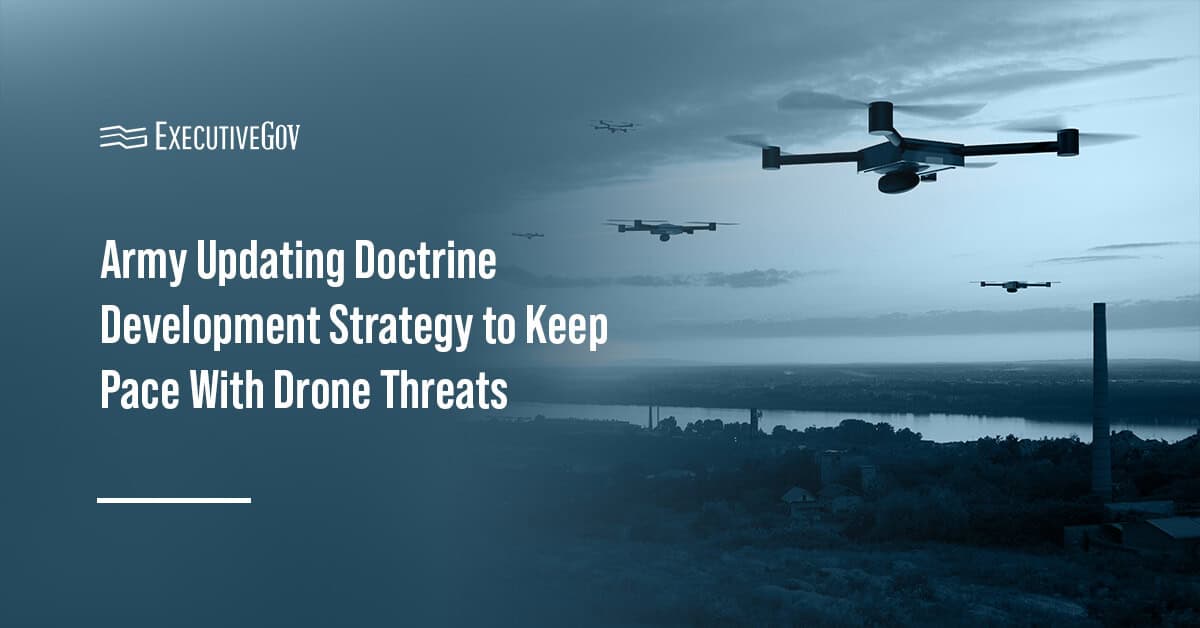
Army Updating Doctrine Development Strategy to Keep Pace With Drone Threats
by Elodie Collins
Published on March 31, 2026
Unmanned aerial systems. The Army is overhauling its operational doctrines to reflect widespread UAS use in recent conflicts

The U.S. Army has announced a force-wide overhaul of its operational doctrine to achieve drone dominance. The service said Monday that it will integrate real-world operational experience into doctrine updates and accelerate how tactics, techniques and procedures are developed and refined.

Army Updating Doctrine Development Strategy to Keep Pace With Drone Threats

Army and Pentagon leaders will discuss the capabilities American warfighters need to win against adversaries at the Potomac Officers Club’s 2026 Army Summit on June 18. Get your tickets today.

Table of Contents

  • How Is the Army Updating Doctrine for Drone Warfare?
  • What Is the Pentagon’s Drone Dominance Initiative?

How Is the Army Updating Doctrine for Drone Warfare?

The Army has reportedly already begun incorporating lessons from recent conflicts, including the war between Russia and Ukraine, into key publications. The service recently rolled out an update to Field Manual 3-0 that introduces new operational imperatives, such as protecting forces from constant observation and using sensors or small unmanned platforms to initiate contact.

The Army’s Combined Arms Doctrine Directorate works with the service’s centers of excellence to develop doctrines. For instance, the Maneuver Center of Excellence is finalizing new guidance on the tactical use of small drones, while the Fires Center of Excellence is updating doctrine to help units counter emerging drone threats, according to the Army.

“Most efforts this past year focused on fielding systems and learning to use them,” stated CADD Director Richard Creed. “As operational forces gain expertise, we can better determine what the doctrine should say.”

What Is the Pentagon’s Drone Dominance Initiative?

The Army’s doctrinal overhaul aligns with the Department of War’s broader push to achieve drone dominance through the rapid fielding and acquisition of low-cost unmanned systems and by strengthening the U.S. drone manufacturing base.

As part of the effort, the Pentagon launched the Drone Dominance Program to accelerate procurement of one-way attack drones, with plans to acquire more than 200,000 systems by 2027. The program uses phased evaluations, including the Gauntlet, where operators test vendor systems in real-world conditions.

In February, the department announced the 25 companies selected to participate in the Gauntlet. DOW expects to award approximately $150 million in prototype delivery orders following the evaluation stage.

Civilian/Cybersecurity/News
PNNL Deploys AI-Based MERU Cyber Defense Technology
by Miles Jamison
Published on March 31, 2026
PNNL logo. PNNL has deployed the AI-based Multimodal Entity Relationship Unification cybersecurity defense technology.

The Department of Energy’s Pacific Northwest National Laboratory has transitioned an artificial intelligence-based cybersecurity research effort into operational use to strengthen cyber defense.

PNNL Deploys AI-Based MERU Cyber Defense Technology

Register today for the Potomac Officers Club’s 2026 Cyber Summit on May 21 to join top government and industry leaders addressing escalating cyber threats, zero trust progress ahead of the 2027 deadline and the future of cybersecurity.

Table of Contents

  • How Does the MERU Technology Work?
  • What Impact Has MERU Shown?

How Does the MERU Technology Work?

PNNL said Thursday the new technology, dubbed Multimodal Entity Relationship Unification, or MERU, uses AI and graph theory to connect databases and train the system to extract key information while adapting to new data and environments. Developed by a team of PNNL researchers led by Chief Computer Scientist Mahantesh Halappanavar, MERU creates a “free-flowing stream of data” that connects global threat intelligence with a company’s specific computing setup.

It integrates up-to-date news about cyber attacks with databases such as the National Vulnerability Database, Common Weakness Enumeration, Common Attack Pattern Enumeration and Classification, and MITRE ATT&CK to provide a unified view of risks. This enables security teams to understand how attacks happen and help them identify and stop threats before they cause serious damage.

What Impact Has MERU Shown?

Early implementation by PNNL’s IT operations team has enabled rapid identification of high-priority threats and the creation of roadmaps to halt likely attacks. Joseph Aguayo, PNNL deputy chief information security officer, stated that the program breaks down massive amounts of threat intelligence into actionable insights. The capability is particularly vital for defending against zero-day attacks, where security teams must adapt defenses in real-time before official software patches become available.

DoD/Executive Moves/News
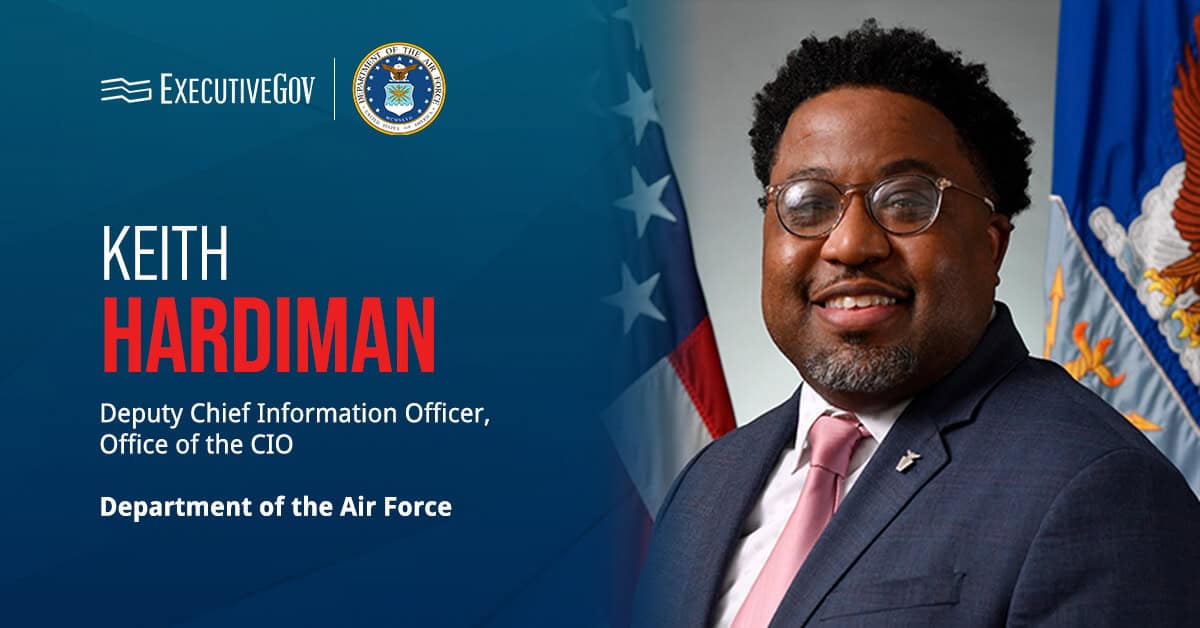
Keith Hardiman Named Air Force Deputy CIO
by Jane Edwards
Published on March 30, 2026
Keith Hardiman. The Department of the Air Force acting deputy CIO has been named to the role on a permanent basis.

Keith Hardiman, who has served as acting deputy chief information officer at the Department of the Air Force, has been appointed to the role on a permanent basis within the DAF’s Office of the CIO.

Keith Hardiman Named Air Force Deputy CIO

Sign up now for the 2026 Air and Space Summit on July 30 to learn how emerging technologies are helping the military sustain its advantage across air and space domains, and the strategies leaders are developing to address emerging challenges.

In a LinkedIn post announcing the appointment, the DAF Office of the CIO said Hardiman assumed the role of acting deputy CIO in July 2025.

Table of Contents

  • What Are Hardiman’s Accomplishments as Acting Deputy CIO?
  • Who Is Keith Hardiman?

What Are Hardiman’s Accomplishments as Acting Deputy CIO?

According to the post, Hardiman led the CIO team through complex challenges while advancing innovation and strengthening collaboration across the organization.

He has been credited with addressing challenges and contributing to organizational performance standards.

Who Is Keith Hardiman?

Hardiman previously served as acting director of enterprise IT within the DAF’s Office of the CIO. In this capacity, he led planning, management and governance for the department’s nearly $7 billion information and cybersecurity enterprise.

He has held other leadership roles, including director of information management within the Office of the Administrative Assistant to the Secretary of the Air Force; technical director and chief data officer for the Logistics CIO Support Division; and director of the 72nd ABW Communications Directorate.

The Langston University graduate holds a doctorate in applied aviation and aerospace from Oklahoma State University.

Executive Moves/News
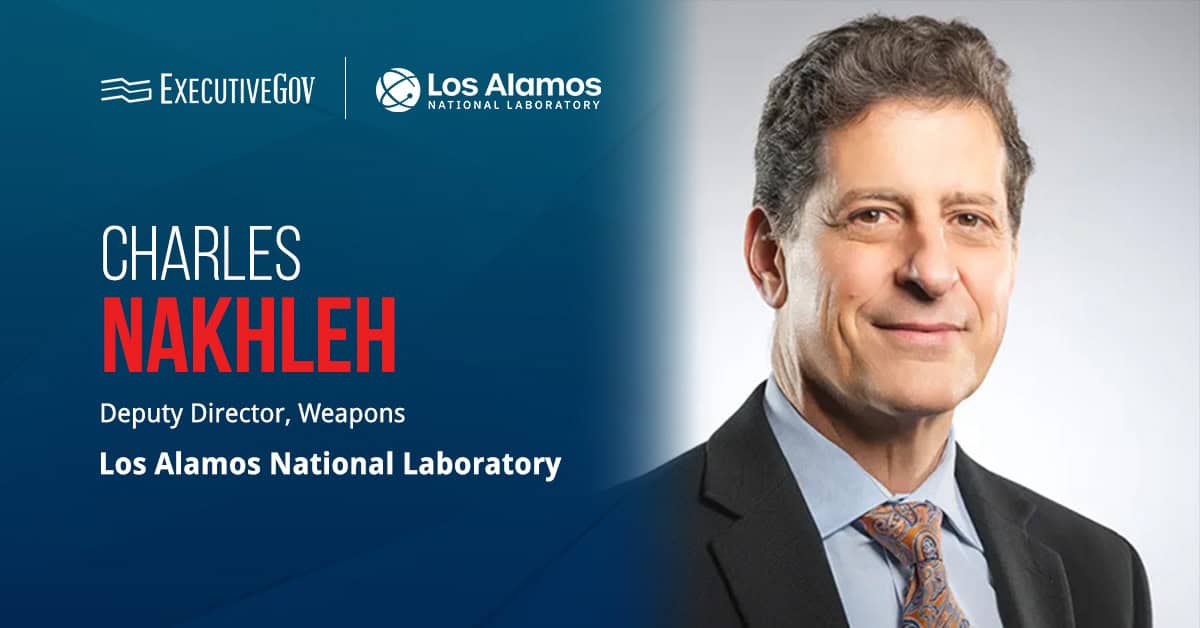
Charles Nakhleh to Lead as Deputy Laboratory Director for Weapons at LANL
by Elodie Collins
Published on March 30, 2026
Charles Nakhleh, incoming deputy director for weapons at LANL. Nakhleh will oversee work tied to NNSA weapons programs

Los Alamos National Laboratory has named Charles Nakhleh as deputy laboratory director for weapons, effective April 1. LANL said Thursday that Nakhleh will lead all laboratory programs and organizations associated with the National Nuclear Security Administration’s weapons programs, including four directorates: weapons physics, engineering, production and plutonium infrastructure.

He succeeds Robert Webster, who is retiring after more than four decades of service.

Table of Contents

  • Who Is Charles Nakhleh?
  • How Do National Laboratories Support US Weapons Programs?

Who Is Charles Nakhleh?

Nakhleh currently serves as associate laboratory director for LANL’s weapons physics directorate, where he oversees weapons physics and design, dynamic experimentation and multiphysics computational simulations.

Since joining the laboratory in 1996, he has held multiple roles of increasing scope and responsibility, including head of the X Theoretical Design division and executive officer for weapons programs. He also spent time at Sandia National Laboratories, where he oversaw target design and analysis for inertial confinement fusion and high-energy-density physics experiments.

In addition to his leadership roles, Nakhleh served in advisory roles across the nuclear security enterprise, including as a founding member of the NNSA’s Predictive Science Panel and as an adviser to the under secretary of energy for science on the Department of Energy’s National Ignition Campaign.

“Throughout his career, Charlie has exemplified the integrity, rigor and sense of purpose that define Los Alamos, and the Lab’s leadership team and I firmly believe he is the right person for the job,” LANL Director Thom Mason.

Nakhleh holds a doctorate in physics from Cornell University.

How Do National Laboratories Support US Weapons Programs?

National laboratories such as Los Alamos support weapons programs through research, testing, manufacturing and modernization efforts.

LANL designed five of the seven current weapons systems in the U.S. stockpile. The lab is also responsible for the maintenance and modernization of the B61 family of gravity bombs and the W76, W78, and W88 warheads.

Meanwhile, at Lawrence Livermore National Laboratory, researchers are testing whether U.S. nuclear warheads can infiltrate enemy missile defense systems using the National Ignition Facility, which simulates the extreme conditions weapons may encounter as they enter enemy territory.

LLNL is also supporting the development of the W87-1 warhead to replace the aging W78. W87-1 will be deployed on the Air Force’s Sentinel intercontinental ballistic missile system.

1 2 3 … 2,703 Next
News Briefing
I'm Interested In:
Wash100 Vote Now
Recent Posts
  • Farhan Khan Named FCC CIO
  • Marine Corps Advances AI-Driven Battle Management in Dynamis Serial 005 Exercise
  • Former DHS Executive Craig Basham Appointed US Secret Service Deputy CIO
  • DOE Invests $320M in Quantum, Nuclear, Material Science Research
About

ExecutiveGov, published by Executive Mosaic, is a site dedicated to the news and headlines in the federal government. ExecutiveGov serves as a news source for the hot topics and issues facing federal government departments and agencies such as Gov 2.0, cybersecurity policy, health IT, green IT and national security. We also aim to spotlight various federal government employees and interview key government executives whose impact resonates beyond their agency.

Read More >>

RSS ExecutiveBiz
  • FedTec, AiStrike Introduce FedRAMP-Ready Platform for AI-Driven Security Operations
  • Booz Allen to Support Air Force’s AEDC Hypersonic Test Improvement Project Under $82M Contract
  • Hanwha Defense USA, Hanwha Philly Shipyard Partner With VARD on Navy NGLS Contract
  • Evolver Secures CMMC Level 2 Certification to Strengthen Federal Cyber Posture
  • Amentum Relocates Hawaii Office to Boost USINDOPACOM Mission Support
  • Radiance Technologies Appoints Paul Lithgow as Chief Growth Officer
RSS GovConWire
  • Navy Selects Nine Contractors for $1.2B Training System Contract Modifications
  • RTX BBN Books $125M USTRANSCOM Modeling, Simulation Support IDIQ
  • Leidos Closes $2.4B ENTRUST Acquisition, Doubles Energy Infrastructure Market Footprint
  • Former Lockheed Martin Exec Jeff Schrader Joins Sierra Space as Chief Strategy Officer
  • NIH Issues RFP for Potential $3B Contract for Scientific, Technical Support Services
  • CyberArk’s Rahul Dubey on Treating AI Agents as Privileged Identities
Executive Gov

Copyright © 2025
Executive Mosaic
All Rights Reserved

  • Executive Mosaic
  • GovCon Wire
  • ExecutiveBiz
  • GovCon Exec Magazine
  • POC
  • Home
  • Acquisition & Procurement
  • Agencies
    • DoD
    • Intelligence
    • DHS
    • Civilian
    • Space
  • Cybersecurity
  • Technology
  • Executives
    • Profiles
    • Announcements
    • Awards
  • News
  • Articles
  • About
  • Wash100
  • Contact Us
    • Advertising
    • Submit your news
    • Jobs
Go toTop