Processing....

Executive Gov

Digital News Coverage of Government Contracting and Federal Policy Landscape
Sticky Logo
  • Home
  • Acquisition & Procurement
  • Agencies
    • DoD
    • Intelligence
    • DHS
    • Civilian
    • Space
  • Cybersecurity
  • Technology
  • Executives
    • Profiles
    • Announcements
    • Awards
  • News
  • Articles
  • About
  • Wash100
  • Contact Us
    • Advertising
    • Submit your news
    • Jobs
Logo
Cybersecurity/News
CISA Issues Guide to Advance Secure OT Communication
by Miles Jamison
Published on February 11, 2026
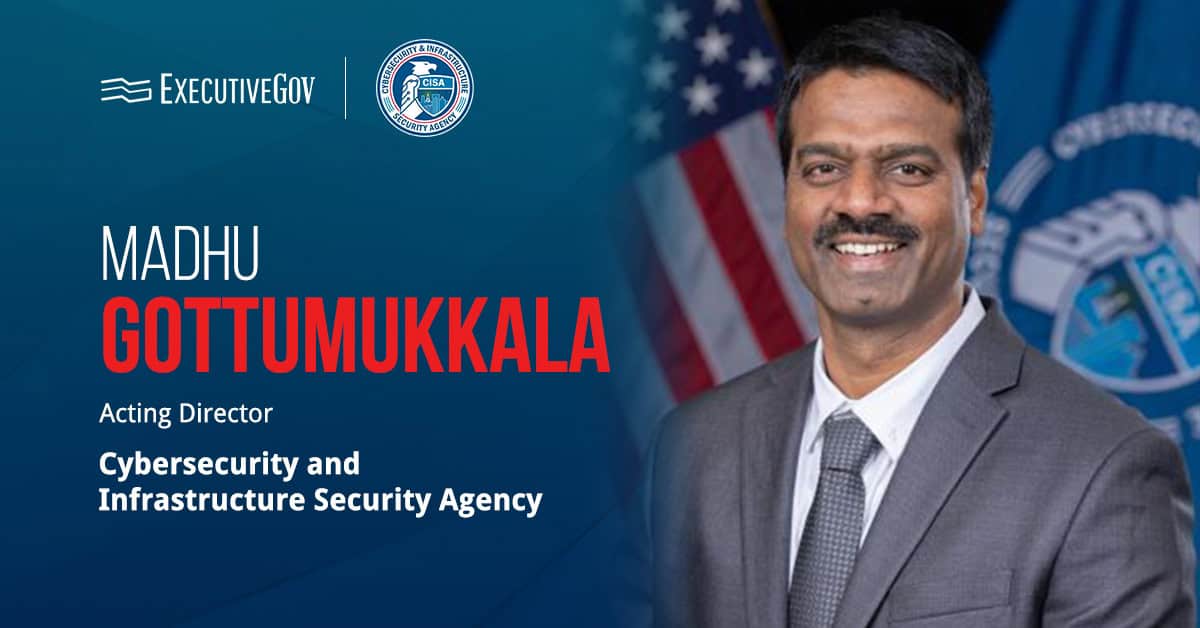
CISA's Madhu Gottumukkala. DISA released a new guide to advance the adoption of secure operational technology communications.

The Cybersecurity and Infrastructure Security Agency has released a new guide aimed at helping critical infrastructure operators adopt more secure operational technology, or OT, communications and reduce barriers to implementation.

CISA Issues Guide to Advance Secure OT Communication

As agencies like CISA advance cybersecurity initiatives, Potomac Officers Club’s 2026 Cyber Summit on May 21 will bring together government and industry leaders to assess progress and chart the path forward. Secure your seat today.

Table of Contents

  • What Is the Focus of CISA’s New Guide?
  • What Actions Does CISA Recommend?
  • Why Is Secure OT Communication a Priority?
  • Related Federal OT Cybersecurity Efforts

What Is the Focus of CISA’s New Guide?

The agency said Wednesday the guide, titled Barriers to Secure OT Communications: Why Johnny Can’t Authenticate, outlines challenges preventing widespread adoption of secure industrial protocols. Developed through interviews with stakeholders across water, transportation, chemical, energy and food sectors, the document examines why many operators continue using legacy protocols that lack authentication and message integrity protections.

What Actions Does CISA Recommend?

The guidance outlines practical steps to overcome procurement, deployment and sustainment challenges, as well as latency and bandwidth constraints, inspection limitations caused by encryption and interoperability issues with legacy systems. It encourages prioritizing secure communication features when acquiring new equipment and calls on manufacturers to reduce usability friction in product design. The document builds on CISA’s prior “Secure by Demand” guidance and aims to support long-term enhancements in OT cybersecurity practices.

According to CISA Acting Director Madhu Gottumukkala, adopting secure communications in OT environments is a long-term effort that involves complexity, cost and risk.

“Over the past year, CISA conducted customer-led research to create this secure communication guide. CISA encourages asset owners and operators, system integrators, service providers, and OT manufacturers to review this guide and collaborate together to implement secure communication,” said Gottumukkala, who spoke at Potomac Officers Club’s 2025 Homeland Security Summit in the fall.

Why Is Secure OT Communication a Priority?

Insecure communication allows threat actors to impersonate devices or alter messages in transit to OT devices. Adoption of secure versions of industrial protocols, which have been available for more than 20 years, has been limited due to technical, operational and cost-related barriers within the control systems community.

Related Federal OT Cybersecurity Efforts

CISA’s guidance follows a series of recent OT security initiatives, including joint Secure Connectivity Principles issued with the UK’s National Cyber Security Centre, the National Institute of Standards and Technology’s draft update to Guide to Operational Technology (OT) Security and the Department of War’s new Zero Trust for Operational Technology guidance.

Healthcare IT/News
VA to Restart Oracle-Cerner EHR Rollout With 2026 Regional Go-Lives
by Kristen Smith
Published on February 11, 2026
VA logo. VA unveiled plans to deploy its Oracle-Cerner EHR at 13 sites in 2026.

The Department of Veterans Affairs is preparing to restart deployments of its new Oracle-Cerner electronic health record in April, when four Michigan facilities — Detroit, Saginaw, Ann Arbor and Battle Creek — go live. 

The move will mark the end of a three-year pause aimed at resolving system outages, performance issues and patient safety concerns, Federal News Network reported Tuesday.

Other planned deployments are scheduled for Ohio and Kentucky sites in June, Indiana facilities in August, and medical centers in Cleveland, Ohio, and Anchorage, Alaska, in October.

VA halted new deployments in April 2023 to stabilize sites already operating on the system. According to VA Deputy Secretary Paul Lawrence, facilities currently using the new EHR are returning to pre-deployment productivity levels, with some already meeting that benchmark.

VA to Restart Oracle-Cerner EHR Rollout With 2026 Regional Go-Lives

Join the Potomac Officers Club’s 2025 Healthcare Summit this Thursday, Feb. 12, 2026, to gain insights from VHA, DHA and CMS leaders. Don’t miss this deep dive into enterprise modernization, interoperability and the future of federal digital health.

Table of Contents

  • What Is Different About the Upcoming Oracle-Cerner EHR Rollout?
  • How Are Lawmakers and Watchdogs Responding to the EHR Rollout?
  • How Does the EHR Rollout Relate to VA’s AI and Modernization Strategy?

What Is Different About the Upcoming Oracle-Cerner EHR Rollout?

Unlike earlier deployments, VA plans to implement the system in geographic waves, moving region by region rather than launching at isolated facilities nationwide. Lawrence said the “market approach” avoids having neighboring sites operate on different record systems.

He shared that the department is increasing staffing and deploying vendor support teams to upcoming go-live locations to accelerate operational recovery.

How Are Lawmakers and Watchdogs Responding to the EHR Rollout?

The reboot comes amid continued scrutiny. Lawmakers have cited the program’s rising lifecycle cost — estimated at roughly $37 billion — and raised concerns about whether past technical and safety issues have been fully addressed.

VA’s Office of Inspector General has documented hundreds of major performance incidents since launch, while a 2025 Government Accountability Office survey found low user confidence and lingering patient safety concerns among staff at early-adopter sites.

According to Lawrence, the department has addressed root causes tied to prior deployments, including workflow standardization and training gaps, expressing confidence that the 2026 schedule will move forward as planned.

How Does the EHR Rollout Relate to VA’s AI and Modernization Strategy?

The EHR restart aligns with VA’s broader modernization push. The department recently announced a $4.8 billion fiscal year 2026 investment in healthcare infrastructure, including $1 billion for EHR modernization.

VA’s latest AI inventory also highlights initiatives tied to EHR optimization, including a pre-deployment clinical AI agent intended to reduce documentation burdens and support workflow efficiency. VA’s AI strategy, released in October, states that early AI use cases will inform how advanced capabilities are integrated into the modernized record system.

Full EHR deployment across 170 sites is currently projected to conclude as early as 2031.

Acquisition & Procurement/DoD/Executive Moves/News
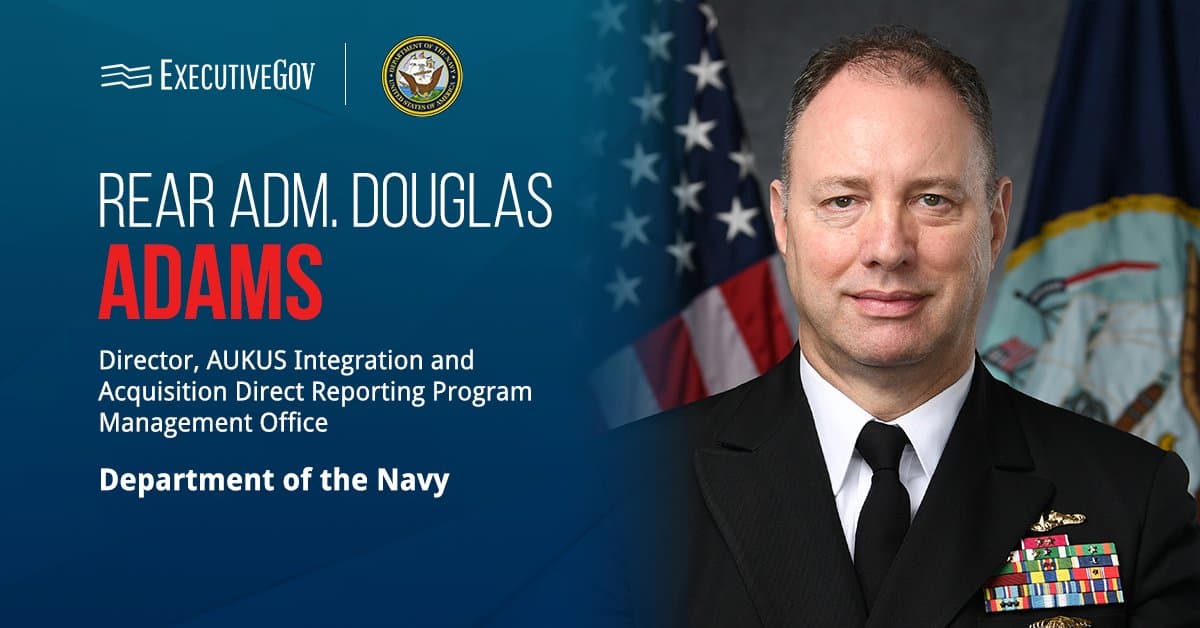
Rear Adm. Douglas Adams Takes Helm of AUKUS Integration & Acquisition Office
by Jane Edwards
Published on February 10, 2026
Douglas Adams. The U.S. Navy rear admiral assumed leadership of the AUKUS Integration and Acquisition program office.

Rear Adm. Douglas Adams took on the role of director of the AUKUS Integration and Acquisition Direct Reporting Program Management Office, or AUKUS I&A, within the Department of the Navy.

Rear Adm. Douglas Adams Takes Helm of AUKUS Integration & Acquisition Office

The latest appointment comes as the Navy continues to navigate evolving undersea priorities and strengthen defense collaboration with international partners. Those broader themes of maritime strategy and partnership will remain top of mind across the defense community ahead of the Potomac Officers Club’s 2026 Navy Summit. Register now for the Aug. 27 event!

Naval Sea Systems Command said Monday Adams succeeds Rear Adm. Richard Seif, who previously served as director of AUKUS I&A, and will continue serving concurrently as program executive officer for undersea warfare systems. 

Seif has been confirmed for promotion to vice admiral and will assume leadership of Submarine Force Atlantic and Allied Submarine Command in Norfolk, Virginia.

Table of Contents

  • Who Is Rear Adm. Douglas Adams?
  • What Does the AUKUS I&A Program Office Do?
  • How Are Lawmakers & Innovators Advancing AUKUS Capabilities?

Who Is Rear Adm. Douglas Adams?

Adams has been serving in the Navy since 1987. As PEO for undersea warfare systems, he oversees the research, development, acquisition, transition and sustainment of undersea weapons, combat systems, countermeasures, training and sensor systems.

He served as commander of USS Rhode Island (Blue) (SSBN 740) from October 2010 to March 2013.

Adams has held multiple senior acquisition and program management roles across the Navy’s undersea and maritime portfolio. His assignments include service in the Virginia-class submarine program office (PMS 450), major program manager for undersea systems (IWS 5) and deputy PEO for undersea warfare systems.

What Does the AUKUS I&A Program Office Do?

AUKUS Integration and Acquisition is a U.S. Navy program office responsible for coordinating the delivery of the U.S. contribution to the first pillar of the trilateral alliance among Australia, the U.K. and the U.S.

AUKUS Pillar I is focused on helping Australia acquire nuclear-powered attack submarines while reinforcing nuclear stewardship and nonproliferation standards.

The program office integrates the Navy’s technical, programmatic and industrial efforts in support of strategic mission requirements. It also serves as a primary coordination point for aligning submarine operations, training, workforce development, nuclear stewardship and trilateral basing initiatives with AUKUS partners.

How Are Lawmakers & Innovators Advancing AUKUS Capabilities?

Congress and defense innovation leaders have advanced legislative and technological initiatives under the AUKUS framework. 

In June 2025, House lawmakers proposed the AUKUS Reform for Military Optimization and Review Act, a bipartisan bill intended to accelerate and strengthen review processes for transfers, exports and activities involving advanced technologies and defense services.

Meanwhile, the Defense Innovation Unit launched the AUKUS Maritime Innovation Challenge 2025 to seek commercial platforms designed to improve undersea command, control and communications.

The DIU solicitation followed the conclusion and announcement of winners in the inaugural AUKUS Electronic Warfare Challenge in September 2024. 

Acquisition & Procurement/Intelligence/News
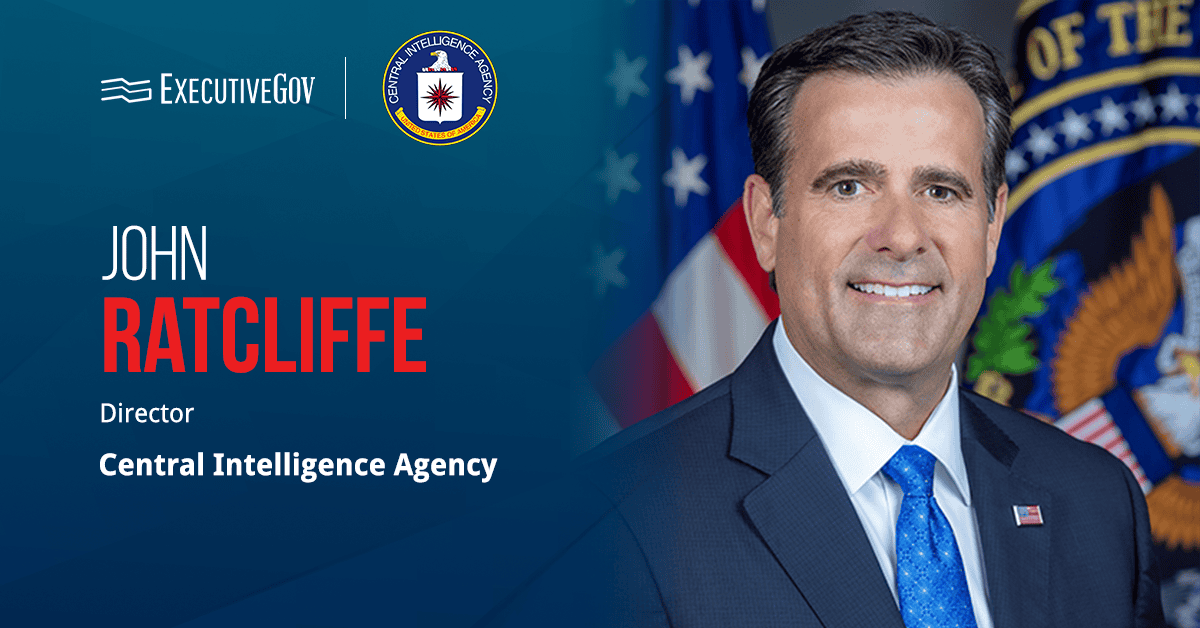
CIA Unveils Acquisition Framework
by Jane Edwards
Published on February 10, 2026
John Ratcliffe. The CIA director commented on the launch of the agency's acquisition framework.

The CIA has launched an acquisition framework designed to accelerate collaboration with U.S. technology companies and rapidly bring new capabilities into operational use.

CIA Unveils Acquisition Framework

As federal intelligence agencies continue to adjust how they engage with industry, these developments are shaping broader conversations across the GovCon landscape. Save your seat at the Potomac Officers Club’s 2026 Intel Summit on Sept. 24, and join government and industry leaders as they examine priorities and trends affecting the intelligence community.

Table of Contents

  • What Is the Scope of the CIA Acquisition Framework?
  • Who Is Leading the CIA’s Acquisition Reform Efforts?
  • What Did CIA Leaders Say About the Acquisition Framework?

What Is the Scope of the CIA Acquisition Framework?

The CIA said Monday the new acquisition framework is designed to accelerate and streamline how the agency works with U.S. commercial partners by reducing internal process timelines and clarifying acquisition pathways. 

The framework will enable the agency to leverage its existing authorities, centralized vendor vetting and IT authorization process to acquire capabilities, speed up onboarding of tech prototypes and meet urgent mission requirements through core systems modernization.

Who Is Leading the CIA’s Acquisition Reform Efforts?

Efstathia Fragogiannis is leading the agency’s acquisition reforms, a CIA official confirmed to Federal News Network. 

Fragogiannis joined the agency in November as chief procurement executive and previously served as director of contracts and senior procurement executive at the Defense Advanced Research Projects Agency, according to the report.

What Did CIA Leaders Say About the Acquisition Framework?

CIA Director John Ratcliffe said the agency is optimizing how it works with the private sector to meet evolving mission demands.

“CIA’s rapidly evolving mission demands a radical shift towards a culture of speed, agility, and innovation. By leveraging the best technological solutions available today, the CIA will be better equipped to meet the intelligence challenges of tomorrow,” added Ratcliffe, a previous Wash100 awardee.

In a post on X, CIA Deputy Director Michael Ellis said the agency is seeking partners with cutting-edge capabilities to support its most urgent mission needs.

“This framework will enable CIA to rapidly onboard breakthrough technology prototypes,” Ellis noted.

Artificial Intelligence/DoD/News
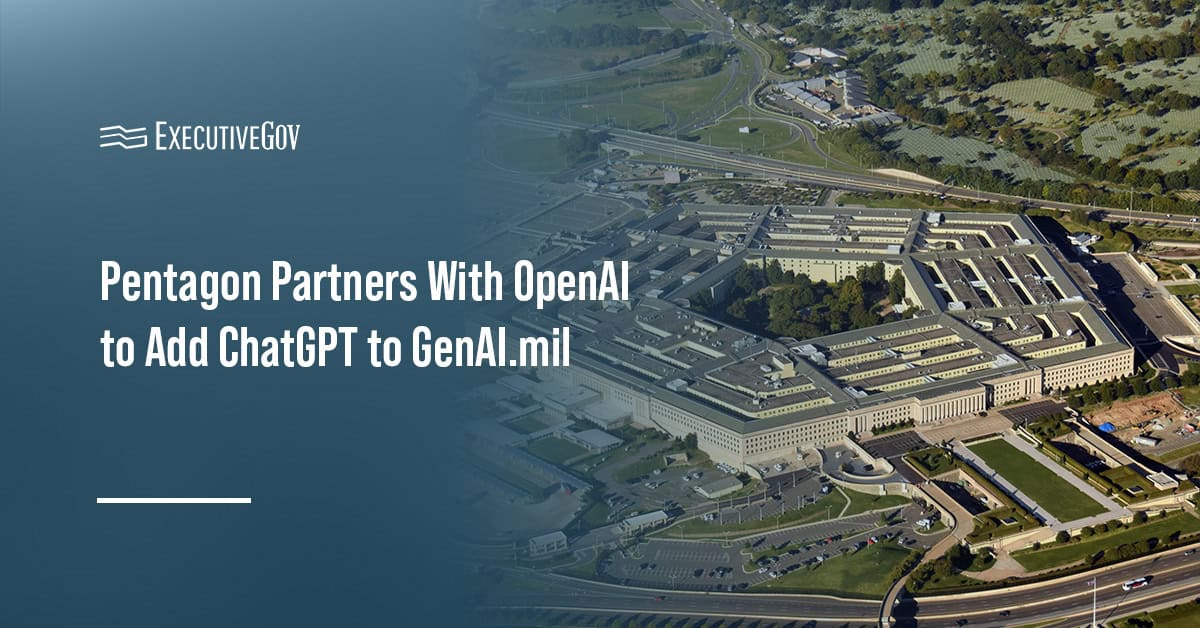
Pentagon Partners With OpenAI to Add ChatGPT to GenAI.mil
by Jane Edwards
Published on February 10, 2026
Pentagon. The War Department of War partnered with OpenAI to integrate ChatGPT into GenAI.mil.

The Department of War has partnered with OpenAI to integrate ChatGPT into its enterprise artificial intelligence platform, GenAI.mil, as part of a push to expand access to large language models, or LLMs, for personnel across the department.

Pentagon Partners With OpenAI to Add ChatGPT to GenAI.mil

The War Department’s move to expand enterprise AI access through GenAI.mil underscores the growing role of artificial intelligence across the federal landscape. That broader momentum will be reflected at the Potomac Officers Club’s 2026 Artificial Intelligence Summit on March 18. Register now to take part in the conversation at this OpenAI-backed event.

DOW said Monday the partnership will make OpenAI’s advanced LLMs available to the department’s approximately 3 million personnel through the GenAI.mil environment.

The partnership follows the rapid adoption of GenAI.mil since its launch. DOW said the platform has surpassed 1 million unique users across military services in its first two months of operation.

Table of Contents

  • What Does ChatGPT Offer to the Department of War?
  • What Is GenAI.mil?

What Does ChatGPT Offer to the Department of War?

According to DOW, ChatGPT will support mission execution and readiness by enabling personnel to use AI tools in their daily workflows.

OpenAI said some of the daily tasks of service members that ChatGPT is designed to support include summarizing and analyzing policy and guidance documents; drafting and reviewing procurement and contracting materials; generating internal reports and compliance checklists; and assisting with research, planning and other mission support and administrative workflows.

The company noted that it will field a custom version of ChatGPT on GenAI.mil that is approved for DOW’s unclassified work.

What Is GenAI.mil?

Launched in December, GenAI.mil is DOW’s enterprise AI platform designed to provide a unified environment for mission-ready AI capabilities.

The platform initially rolled out with Google’s Gemini for Government as one of its first frontier AI tools and later expanded to include xAI for Government.

The Pentagon said the recent efforts align with the White House’s AI Action Plan and DOW’s AI Acceleration Strategy.

Artificial Intelligence/Healthcare IT/News
VA Lists Suicide Prevention, EHR Applications in AI Inventory
by Kristen Smith
Published on February 10, 2026
VA logo. VA’s 2025 AI inventory includes suicide prevention and EHR use cases.

The Department of Veterans Affairs is expanding its use of artificial intelligence while simultaneously retiring dozens of earlier efforts, signaling a more targeted approach as the agency aligns AI adoption with suicide prevention priorities and electronic health record modernization.

VA Lists Suicide Prevention, EHR Applications in AI Inventory

VA’s evolving AI strategy mirrors broader federal healthcare modernization discussions at the Potomac Officers Club’s 2025 Healthcare Summit on Thursday. Register now to hear leaders from the Veterans Health Administration, Defense Health Agency and Federal EHR Modernization Office speak about how AI, data and digital platforms can improve patient safety, clinical workflows and enterprise health systems.

Table of Contents

  • How Is VA Applying AI to Suicide Prevention?
  • How Does VA Address AI Risks?
  • What Role Does AI Play in EHR Modernization?
  • How Does AI Adoption Fit Into VA’s Broader Modernization Push?

How Is VA Applying AI to Suicide Prevention?

VA’s 2025 AI use case inventory, released in January, includes continued use of the Recovery Engagement and Coordination for Health–Veteran Enhanced Treatment, or REACH VET, program, Nextgov/FCW reported Friday. 

First deployed in 2017, the predictive model identifies veterans in the highest tier of suicide risk to support targeted outreach and early intervention. VA released an updated version of the model last year to incorporate additional risk factors, including military sexual trauma.

VA also disclosed a new pre-deployment effort focused on analyzing Veterans Crisis Line call data. The initiative will evaluate acoustic and linguistic indicators to help identify imminent suicide risk and assess the effectiveness of crisis interventions.

How Does VA Address AI Risks?

Oversight of patient-facing AI remains a focal point as VA expands adoption. In a report released last month, the VA Office of Inspector General warned that the Veterans Health Administration lacks a formal mechanism to identify and resolve risks associated with generative AI in clinical settings. The watchdog raised concerns about patient safety in the absence of standardized risk management processes.

Responding to the report, VA told Nextgov/FCW that AI tools are used strictly as support systems and that clinical decisions remain the responsibility of VA staff. 

What Role Does AI Play in EHR Modernization?

The inventory also highlights how VA is positioning AI to support its electronic health record modernization effort.

The VA will restart its federal EHR rollout at 13 facilities, ending a hiatus that began in 2023. The program had been sidelined to resolve persistent usability issues and enhance patient safety protocols. VA’s AI strategy, released in October, states that early AI use cases will inform how the technology is eventually integrated into the new EHR platform.

The inventory includes five AI initiatives led by the Office of Electronic Health Record Modernization, including a pre-deployment effort involving a clinical AI agent designed to reduce administrative burden by assisting with documentation and workflow management during patient visits. 

How Does AI Adoption Fit Into VA’s Broader Modernization Push?

VA’s AI adoption is unfolding alongside major investments in healthcare infrastructure. The department recently announced plans to invest $4.8 billion in fiscal year 2026 to modernize and repair medical facilities nationwide. Of that total, $1 billion is allocated to EHR modernization.

Artificial Intelligence/News
DOE to Drive AI-Powered Scientific Discovery With Genesis Mission Consortium
by Miles Jamison
Published on February 10, 2026
DOE seal. The Department of Energy has launched the Genesis Mission Consortium to advance AI-driven scientific research.

The Department of Energy has launched the Genesis Mission Consortium, a public-private partnership focused on applying artificial intelligence to scientific research, national security and energy-related technologies.

As AI rapidly transforms government and defense, the Potomac Officers Club’s 2026 Artificial Intelligence Summit on March 18 convenes top practitioners to share strategies, use cases and what’s next for operational AI. Book your seat today!

Table of Contents

  • What Is the Genesis Mission Consortium?
  • How Will the Consortium Operate?
  • Prior DOE Genesis Mission Initiatives

What Is the Genesis Mission Consortium?

The department said Monday the consortium supports its Genesis Mission initiative by bringing together the department, national laboratories, private-sector companies and academic institutions to coordinate technical expertise and resources. The effort, which will be administered by TechWerx, aligns with executive orders issued by President Donald Trump addressing artificial intelligence development and related regulatory barriers.

How Will the Consortium Operate?

The consortium is structured to function as a centralized collaboration hub. It will help identify and form partnerships, promote funding opportunities, support agreement execution and track project outcomes. Member-driven working groups will focus on key technical areas, including AI model development and validation, data standards and integration, high-performance computing and cloud infrastructure, and robotics and automation. These groups are intended to streamline industry and academic engagement in joint development efforts.

DOE Under Secretary for Science Dario Gil, director of the Genesis Mission, stated the partnership creates a “powerful engine for innovation” to drive breakthroughs across various disciplines.

Prior DOE Genesis Mission Initiatives

The consortium builds on earlier Genesis Mission initiatives already underway, including a request for information issued in January seeking input from public and private-sector organizations on technical challenges and workforce needs related to the application of AI in science and engineering. In December, the department disclosed plans to invest more than $320 million to accelerate development of the mission’s AI capabilities.

DoD/News
Perennial Autonomy Lands JIATF-401 Agreement for Kinetic Counter-sUAS Capability
by Miles Jamison
Published on February 10, 2026
Bumblebee Quadcopter. The JIATF-401 awarded Perennial Autonomy an agreement to deliver its Bumblebee V2 counter-drone system.

Perennial Autonomy has received a $5.2 million agreement from the Joint Interagency Task Force 401, or JIATF-401, to deliver its Bumblebee V2 counter-drone system.

Perennial Autonomy Lands JIATF-401 Agreement for Kinetic Counter-sUAS Capability

Stay informed on Army priorities and planned initiatives supporting the service’s 2030 objectives at the Potomac Officers Club’s 2026 Army Summit on June 18. The event will include panel discussions and networking with senior government and GovCon leaders. Register now!

The U.S. Army said Friday the agreement, awarded on Jan. 30, aims to equip U.S. forces with an affordable, low-collateral kinetic interceptor. Deliveries are expected to start in March.

Table of Contents

  • What Is Perennial Autonomy’s Bumblebee V2?
  • How Will the Counter-Drone System Be Evaluated?

What Is Perennial Autonomy’s Bumblebee V2?

The Bumblebee V2 is a first-person-view multirotor drone engineered for physical interception and neutralization of illicit small unmanned aircraft systems, or sUAS, in domestic and overseas environments. The system defeats threats through direct aerial collision, disabling both aircraft, while employing a kinetic approach to limit collateral damage.

“The Bumblebee V2 provides a cost-effective, reliable interceptor that can neutralize threats without endangering our own forces or surrounding infrastructure. On the modern battlefield, where drones are a constant threat, having a low-collateral kinetic option is not just an advantage, it is increasingly becoming essential for protecting our forces,” said Brig. Gen. Matthew Ross, director of JIATF-401.

How Will the Counter-Drone System Be Evaluated?

The Army’s Global Response Force will conduct an operational assessment of the Bumblebee V2 in support of the newly established Lieutenant General Gavin Joint Innovation Outpost. The evaluation is intended to determine the system’s suitability for rapidly deployable units conducting high-risk missions worldwide. The effort aligns with the outpost’s focus on accelerating the transition of emerging technologies to operational forces.

Cybersecurity/News
FTC Details Ransomware Threat, Tech Support Scams in Annual Cyber Report
by Elodie Collins
Published on February 10, 2026
Federal Trade Commission logo. The FTC published its 2025 Ransomware Report

The Federal Trade Commission has reported that ransomware and other malware-based attacks represent only 2.23 percent of all fraud complaints submitted to the agency.

In the 2025 Ransomware Report published Friday, the FTC shared that, between July 2023 and June 2025, tech support scams were among the most reported fraud types.

About 1 percent of the 42,972 reports the FTC received that allegedly originate from China are ransomware. The majority of the complaints are related to online shopping fraud.

Complaints tied to Russia, Iran and North Korea are relatively rare, with the three countries accounting for only 0.05 percent of all fraud reports the FTC received from 2023 to 2025.

FTC Details Ransomware Threat, Tech Support Scams in Annual Cyber Report

Malicious actors targeting American businesses and systems is one of the top concerns of Potomac Officers Club’s 2026 Cyber Summit on May 21. Gain insights directly from cyber officials from across the public and private sectors at the GovCon event. Get your tickets today.

Table of Contents

  • What Is FTC Doing to Counter Ransomware, Other Cyber-Related Fraud?
  • Why Did the FTC Publish the Report?

What Is FTC Doing to Counter Ransomware, Other Cyber-Related Fraud?

According to the FTC, it has made over 90 enforcement actions related to data security, including in cases that involve malicious actors located in China or Russia. For instance, in 2024, the agency brought action against Marriott International and its subsidiary Starwood Hotels & Resorts Worldwide for data breaches tied to malicious actors with links to the Chinese government.

To safeguard American consumers against cyber fraud, the FTC has collaborated with foreign counterparts to end scams from abroad. The agency sued Restoro Cyprus Limited and Reimage Cyprus Limited for allegedly duping consumers into purchasing computer repair services they do not need.

Additionally, the FTC runs education campaigns to warn the public about ransomware, tech support scams and other cyberattacks.

Why Did the FTC Publish the Report?

The FTC’s Ransomware Report is mandated under the Reporting Attacks from Nations Selected for Oversight and Monitoring Web Attacks and Ransomware from Enemies Act, or RANSOMWARE Act.

The Ransomware Report provides Congress with information on agency actions to fight against ransomware and other cyberattacks.

DoD/National Security/News
Executive Order Establishes US Arms Transfer Strategy
by Jane Edwards
Published on February 9, 2026
White House. President Trump signed an executive order establishing the America First Arms Transfer Strategy.

President Donald Trump has signed an executive order to establish and implement a strategy designed to ensure that future arms sales prioritize U.S. interests by using foreign purchases and capital to build U.S production and capacity and strengthen the U.S. defense industrial base.

Table of Contents

  • What Are the Objectives of the America First Arms Transfer Strategy?
  • What Are the EO’s Directives to Federal Leaders?

What Are the Objectives of the America First Arms Transfer Strategy?

According to a White House fact sheet published Friday, the America First Arms Transfer Strategy aims to use U.S. arms transfers as a mechanism to bolster foreign policy and the domestic defense industrial base. 

The strategy seeks to expand production capacity for weapons systems most relevant to the National Security Strategy; support domestic reindustrialization and improve the resilience of the U.S. defense industrial base; prioritize transfers to allies and partners that invest in their own defense capabilities and hold strategic geographic importance; and strengthen critical supply chains.

What Are the EO’s Directives to Federal Leaders?

The executive order directs senior federal officials to implement the America First Arms Transfer Strategy through coordinated planning and oversight across key departments. 

Under the EO, the secretaries of war, state and commerce must create a sales catalog of prioritized systems and platforms that support the strategy’s goals; improve advocacy efforts for U.S. arms transfers in line with the strategy’s objectives; publish quarterly performance metrics on defense sales case execution; and identify efficiencies in the enhanced end use monitoring criteria, congressional notification process and the third-party transfer process.

The order also calls for the establishment of the Promoting American Military Sales Task Force, to be chaired by the assistant to the president for national security affairs, to oversee implementation and report quarterly on progress and performance metrics. 

In November, War Secretary Pete Hegseth, a 2026 Wash100 awardee, issued new guidance aimed at unifying its arms transfer and security cooperation enterprise to strengthen burden-sharing with allies and partners and enhance the U.S. defense industrial base.

Previous 1 … 40 41 42 43 44 … 2,719 Next
News Briefing
I'm Interested In:
Recent Posts
  • Leonel Garciga Steps Down as Army CIO
  • CAISI Signs Frontier AI Testing Agreements With 3 Companies
  • New ARPA-H Program Aims to Accelerate Biomedical Research With AI
  • Army, Defense Firms Launch ‘Right to Integrate’ Hackathon Initiative
About

ExecutiveGov, published by Executive Mosaic, is a site dedicated to the news and headlines in the federal government. ExecutiveGov serves as a news source for the hot topics and issues facing federal government departments and agencies such as Gov 2.0, cybersecurity policy, health IT, green IT and national security. We also aim to spotlight various federal government employees and interview key government executives whose impact resonates beyond their agency.

Read More >>

RSS ExecutiveBiz
  • Exiger VP Dan Kunze on the Interconnection of Emerging Technologies, Energy & Space
  • LMI’s RAPTR Platform Earns DOW Tradewinds ‘Awardable’ Status
  • Patrick Roddy Joins Sodexo as COO for Facility Management, Government Services
  • Peraton Labs Secures NSF Award for Low-Latency XR Medical Collaboration Research
  • Nokia Federal, Lockheed Martin Launch Modular 5G Capability for Defense Platforms
  • LogicMonitor, IBM, Red Hat Collaborate to Automate IT Operations
RSS GovConWire
  • Intel Taps Alex Katouzian to Lead Client Computing & Physical AI; Pushkar Ranade Named CTO
  • Anduril Books $100M Space Force Contract Modification for SDA Mesh Networking Work
  • ICE Plans Shared EHR Platform BPA Exceeding $100M
  • Leidos Reports $4.4B Q1 FY26 Revenue Driven by Strong Demand Across Key Markets
  • Sarah Campbell Named Future Technologies COO
  • SAP NS2 Appoints Retired Army Gen. Gus Perna as EVP & Strategic Customer Officer
Executive Gov

Copyright © 2025
Executive Mosaic
All Rights Reserved

  • Executive Mosaic
  • GovCon Wire
  • ExecutiveBiz
  • GovCon Exec Magazine
  • POC
  • Home
  • Acquisition & Procurement
  • Agencies
    • DoD
    • Intelligence
    • DHS
    • Civilian
    • Space
  • Cybersecurity
  • Technology
  • Executives
    • Profiles
    • Announcements
    • Awards
  • News
  • Articles
  • About
  • Wash100
  • Contact Us
    • Advertising
    • Submit your news
    • Jobs
Go toTop