

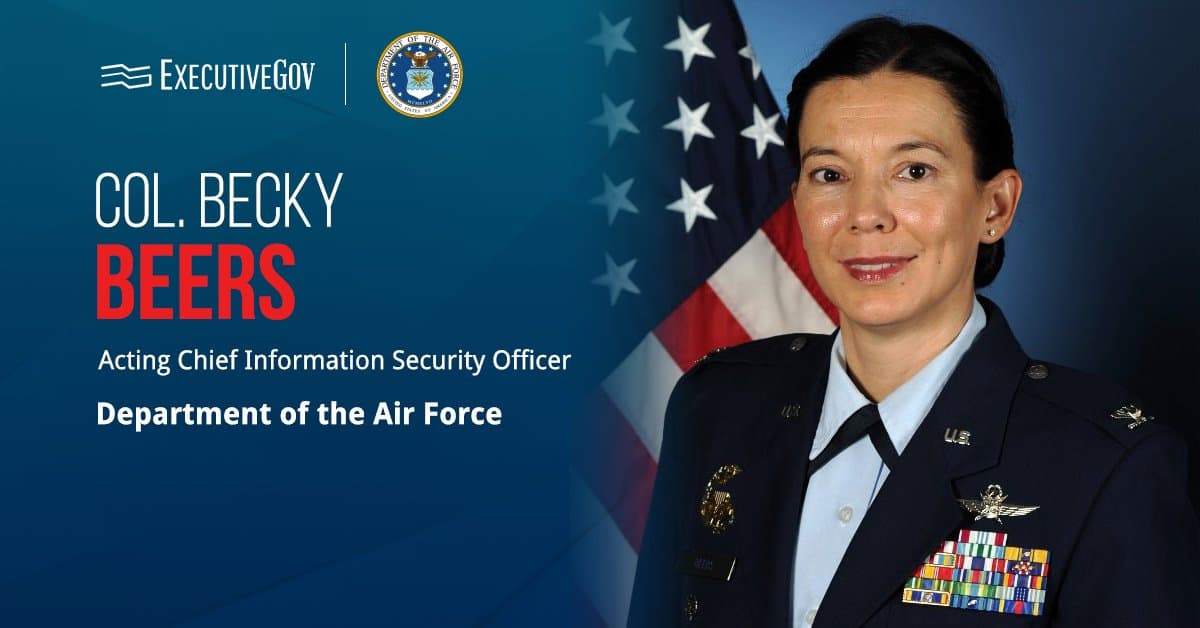
Col. Becky Beers has been named acting chief information security officer at the Department of the Air Force.
In a LinkedIn post, Beers said she will serve as acting CISO within the Office of the DAF Chief Information Officer.

Attend the Potomac Officers Club’s 2026 Air and Space Summit on July 30 to hear sessions exploring how advanced technologies can help maintain an edge in the air and space domains and the strategies leaders are developing to address emerging challenges. Sign up now to save your seat.
Table of Contents
Who Is Col. Becky Beers?
Beers is a U.S. Air Force officer with experience spanning cyber operations, enterprise IT and command leadership roles.
According to her LinkedIn profile, she most recently served as deputy director of enterprise IT within the Air Force.
She also served as deputy CISO within the Office of the DAF CIO, where she supported cybersecurity governance, risk management and compliance efforts across the enterprise.
Beers has held assignments across multiple Air Force and joint organizations focused on cyber operations and IT initiatives supporting military missions. Her previous roles include commander of the 61st Air Base Group at Los Angeles Air Force Base; chief of the cyberspace operations division within 16th Air Force A3; and commander of the 75th Intelligence Squadron at Joint Base San Antonio in Texas.
The University of Southern California graduate received her commission through the Air Force Reserve Officer Training Corps. She holds a master’s degree in strategic intelligence from the National Intelligence University.
What IT & Cybersecurity Initiatives Has the DAF CIO Office Launched?
The Office of the DAF CIO has introduced several initiatives to strengthen cybersecurity and modernize its IT environment. These include guidance on software-as-a-service procurement and usage; the “Network of the Future” strategy to strengthen network resilience and ensure network security; and the “cyber cake” framework, a layered cybersecurity model that integrates zero trust, supply chain risk management and cyber resilience practices.
Related Articles

The Department of the Treasury has named 19 individuals with experience across government and the private sector to senior positions spanning economic policy, legislative affairs, operations and public affairs. Secretary of the Treasury Scott Bessent made the announcement on Tuesday. Who Are the Appointed Senior Leaders for Treasury? Austin Browning, deputy chief of staff for operations Aynsley Moore, chief of operational strategy Brandon Mayhew, deputy executive secretary Charlie Bolton, deputy assistant secretary for macroeconomics Christina Skinner, deputy assistant secretary for the Financial Stability Oversight Council Don Snyder, deputy assistant secretary for energy, strategic initiatives and tax administration Elliott Yoshio Hulse,
The Department of War’s Office of the Chief Information Officer has launched the Cyber Registered Apprenticeship Program, or Cyber RAP, as part of efforts to strengthen its cybersecurity workforce and support national security missions. The latest DOW initiative underscores the growing demand for skilled cyber professionals across the federal landscape. Join the 2026 Cyber Summit on May 21 to hear defense officials and industry leaders discuss AI in cyber defense, post-quantum cryptography, cybersecurity compliance, zero trust and more. Register now! The DOW OCIO said Tuesday Cyber RAP, which will launch as a pilot in the summer of 2026, is designed
The Defense Logistics Agency Weapons Support has introduced the Rapid Sustainment Initiative, or RSI, a contracting approach designed to address gaps in sustainment planning for new weapon systems. DLA announced the initiative in a Friday post to their website. What Challenge Is the Rapid Sustainment Initiative Addressing? Sustainment planning often began at initial operating capability, or Milestone C, creating a reactive environment throughout the acquisition lifecycle that triggered delays and parts shortages. U.S. Army Brig. Gen. Beth Behn warned that insufficient sustainment planning can result in readiness issues years after fielding. How Does RSI Work? The initiative shifts DLA engagement to