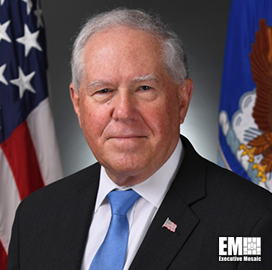
Frank Kendall: Air Force’s Plan to Buy 1,763 F-35s Remains Unchanged
Frank Kendall, secretary of the Air Force and a three-time Wash100 Award winner, said the service still sticks to its...


Frank Kendall, secretary of the Air Force and a three-time Wash100 Award winner, said the service still sticks to its...
The FBI said it considers establishing a consolidated cyber campus in the suburbs of Washington, D.C., to support its mission...
The National Science Foundation has released a document outlining its four strategic goals and objectives – empower, discover, impact and...
The Government Accountability Office has found that the number of sole-source contracts over $22 million that the Department of Defense...
The National Institutes of Health Information Technology Acquisition and Assessment Center (NITAAC) has secured 801 Certification that enables it to...
Air Combat Command has announced the formation of a new organization at Davis-Monthan Air Force Base in Arizona to advance...
The U.S. and the European Commission have announced a new framework that seeks to reestablish a legal process for transfers...
The National Security Institute at George Mason University’s Antonin Scalia Law School has announced the appointment to its advisory board...
Sen. Rob Portman, R-Ohio, the ranking member of the Senate Homeland Security and Governmental Affairs Committee, has released a report...
The Securities and Exchange Commission (SEC) is soliciting comments on proposed rules to improve and standardize disclosures by public companies...