Executive Gov
  • Home
  • Acquisition & Procurement
  • Agencies
    • DoD
    • Intelligence
    • DHS
    • Civilian
    • Space
  • Cybersecurity
  • Technology
  • Awards
  • News
  • About
  • Wash100
  • Contact Us
    • Advertising
    • Submit your news
No Result
View All Result
Executive Gov
  • Home
  • Acquisition & Procurement
  • Agencies
    • DoD
    • Intelligence
    • DHS
    • Civilian
    • Space
  • Cybersecurity
  • Technology
  • Awards
  • News
  • About
  • Wash100
  • Contact Us
    • Advertising
    • Submit your news
No Result
View All Result
Executive Gov
No Result
View All Result
Home Articles

Air Force IT Outsourcing: How It Works and Why It’s Essential

by Annie Tyler
July 1, 2024
in Articles
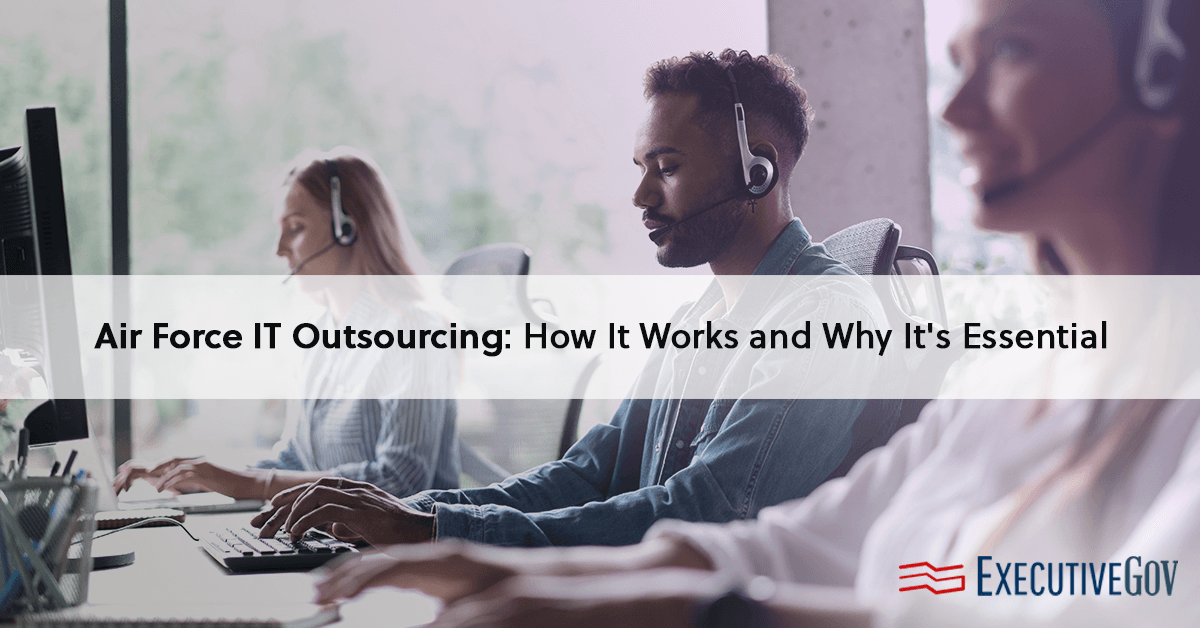
Three IT professionals working with an overlay of the text “Air Force IT Outsourcing: How It Works and Why It's Essential”

Photo by OPOLJA/ Shutterstock

The Department of the Air Force (DAF) is undergoing a technological shift as part of its long-standing modernization initiative. In its recent information technology strategy, the Air Force is accelerating cloud adoption and improving portfolio management of its digital assets. 

Table of Contents

    • You might also like
    • Genesis Mission’s Unique Contracting Model Spurs Industry Contributions
    • Air Force Col. John Ohlund Seeking a Few Good Contractors for AI Data Tagging
    • How the Air Force’s Family of Affordable Mass Missile Is Transforming Defense Acquisition
  • What Is Air Force IT Outsourcing?
  • How Does Air Force IT Outsourcing Work?
  • EITaaS: Advancing Air Force IT Capabilities
  • Top Reasons Why the Air Force Outsources IT Services
    • Cost-Effectiveness
    • Access to Expertise and Advanced Technologies
    • Focus on Core Missions
  • Frequently Asked Questions
    • Why Are IT Professionals Crucial for Supporting Air Force Operations?
    • What Are the Common IT Roles Within the Air Force?

You might also like

Genesis Mission’s Unique Contracting Model Spurs Industry Contributions

Air Force Col. John Ohlund Seeking a Few Good Contractors for AI Data Tagging

How the Air Force’s Family of Affordable Mass Missile Is Transforming Defense Acquisition

Supporting these advancements, the Air Force is outsourcing nearly all routine IT operations to contractors and external partners. This move allows the DAF to build dedicated cybersecurity mission teams for its more mission-critical digital concerns. 

Learn more about Air Force IT outsourcing and its crucial role in supporting the DAF’s technology and operations.


What Is Air Force IT Outsourcing?

IT outsourcing means hiring external IT experts to manage the Air Force’s information technology services and operations. This strategy enables the DAF to maximize external expertise, resources and capabilities to meet its internal IT needs.


How Does Air Force IT Outsourcing Work?

The IT outsourcing process in the Air Force involves crucial steps:

  1. The Air Force assesses its IT requirements and identifies its outsourcing objectives.
  2. The Air Force outlines the scope of the outsourcing project and develops contract requirements based on its assessment.
  3. The DAF then issues requests for proposals, inviting potential vendors to submit proposals that meet its needs.
  4. Once it receives the proposals, the Air Force evaluates them based on the vendors’ capabilities, experience, proposed solutions and cost-effectiveness.
  5. After selecting the most suitable vendor, the Air Force awards the contract.


EITaaS: Advancing Air Force IT Capabilities

The Enterprise Information Technology as a Service (EITaaS) is one of the Department of the Air Force’s key initiatives to boost its IT capabilities. It is a program designed to utilize commercial services and best practices to deliver standardized, innovative and flexible IT services in the Air Force.

In August 2022, the Air Force awarded the Wave 1 EITaaS contract, valued at $5.7 billion, to an industry team led by CACI. The contract yielded great results, such as: 

  • Adoption of top-tier commercial technology
  • Improved mission readiness
  • Resilient IT and data operations
  • Enhanced IT service quality

Moreover, Wave 1 focuses on three main areas:

  • IT service management, operations management and asset management
  • Enterprise service desk and local field services
  • End-user devices and device management

In June 2024, the Air Force posted a new request for information for Base Infrastructure Modernization, the next phase of the EITaaS. It aims to modernize the wired and wireless Non-Secure Internet Protocol Router and Secure Internet Protocol Router Base Area Network at global Air Force bases.


Top Reasons Why the Air Force Outsources IT Services

Military surveillance team in a command center room
Photo by Gorodenkoff/Shutterstock

Air Force Lieutenant General Robert Skinner is a strong advocate of outsourcing IT services to commercial vendors to lower expenditures.

“I’m a big proponent of commercial IT as a service,” Skinner stated at the Rocky Mountain Cyberspace Symposium. “We have to be careful as we kind of move forward with this. … I think we really need to get after this in a more holistic look and a faster pace,” he added.

In line with Skinner’s perspective, outsourcing IT services offers numerous benefits that enhance operational efficiency and mission readiness. Here are the top reasons why the Air Force opts for IT outsourcing:


Cost-Effectiveness

Outsourcing IT support can lead to substantial cost savings for the Air Force in the long run. Partnering with a managed service provider avoids costly technology upgrades and the need to hire additional IT staff. 

With these savings, the Air Force can allocate its financial resources toward more vital areas. 


Access to Expertise and Advanced Technologies

The Air Force turns to outsourcing to acquire highly specialized skills and knowledge sets, which may not be available internally. Outsourcing guarantees that the DAF remains at pace, if not ahead of the curve, in technological advancements.


Focus on Core Missions

By entrusting IT responsibilities to contractors, the Air Force can focus on its primary mission areas for defense, surveillance and national security. Consequently, the Air Force can allocate its internal resources toward more mission-critical operations.


Frequently Asked Questions


Why Are IT Professionals Crucial for Supporting Air Force Operations?

IT professionals are among the most in-demand within the federal government, and understandably so. They provide advanced capabilities, systems, solutions and technologies critical for modernizing military functions. 

Below are the top reasons why IT professionals are crucial for Air Force operations:

  • IT professionals provide the Air Force with secure communication networks to coordinate missions and share intelligence.
  • IT experts protect the Air Force’s networks, platforms, systems and data from cyber threats.
  • They oversee network operations, troubleshoot problems and integrate new technologies within the Air Force’s infrastructure.
  • They regulate the next generation of AI, machine learning and advanced computing, allowing airmen to pinpoint threats autonomously.


What Are the Common IT Roles Within the Air Force?

Common IT roles within the Air Force include:

  • Cyber warfare operations personnel
  • Knowledge operations management personnel
  • IT security specialist
  • Systems software analyst
  • Client systems specialist
  • Cyber transport systems specialist
  • Cyber warfare operations officer
Stay connected via Google News
Follow us for the latest travel updates and guides.
Add as preferred source on Google
Share5Tweet19

Recommended For You

Genesis Mission’s Unique Contracting Model Spurs Industry Contributions

by Pat Host
July 23, 2026
Research. The Dept. of Energy AI research effort Genesis Mission has an unprecedented acquisition strategy.

The Genesis Mission has industry making contributions instead of winning contractsIt leverages a unique acquisition model including a portion similar to AFWERXHear directly from top federal officials about...

Read moreDetails

Air Force Col. John Ohlund Seeking a Few Good Contractors for AI Data Tagging

by Pat Host
July 22, 2026
Col. John Ohlund. The ABMS CFT lead told ExecutiveGov the USAF has business opportunities in using AI to tag its ABMS data.

The USAF has business for industry in using AI to tag the service’s data, said Col. John OhlundThe service is entering a transition period for its Advanced Battle...

Read moreDetails

How the Air Force’s Family of Affordable Mass Missile Is Transforming Defense Acquisition

by Pat Host
July 21, 2026
Missiles. The Family of Affordable Mass Munitions is an Air Force program designed to produce cheap, standoff cruise missiles

The Pentagon is on a munitions shopping spree to replenish depleted stocksFAMM will be a low-cost, standoff cruise missile designed for long-range massLearn about scaling essential munitions programs...

Read moreDetails

What Hung Cao's N2/N6 Reorganization Means for Navy Information Warfare Contracts

by Gabriella DeCesare
July 22, 2026
Hung Cao. The acting secretary of the Navy is spearheading a service reorganization with impacts for contractors.

The Navy has split its longstanding N2/N6 organization into three new directorates overseeing intelligence, enterprise IT policy and information warfare resource sponsorship. Find out what the restructuring means...

Read moreDetails

What SBIR/STTR Reauthorization Means for AFRL Contracts

by Pat Host
July 1, 2026
Robert Antypas. AFRL is back to awarding research contracts after SBIR/STTR reauthorization in March.

AFRL is back to awarding SBIR contracts to industry after a six-month lapse following the reauthorization of the SBIR/STTR programs. The lab will continue using that model of...

Read moreDetails
Sign Up For Our Newsletter
Subscribe to our mailing list to receives daily updates direct to your inbox!
Invalid email address
Your privacy is guranteed.
Thanks for subscribing!

Sponsors

About ExecutiveGov

ExecutiveGov, published by Executive Mosaic, is a site dedicated to the news and headlines in the federal government. ExecutiveGov serves as a news source for the hot topics and issues facing federal government departments and agencies such as Gov 2.0, cybersecurity policy, health IT, green IT and national security. We also aim to spotlight various federal government employees and interview key government executives whose impact resonates beyond their agency.

CATEGORIES

  • Acquisition & Procurement
  • Announcements
  • Articles
  • Artificial Intelligence
  • Awards
  • Big Data & Analytics News
  • C4ISR
  • Civilian
  • Cloud
  • Contract Awards
  • Cybersecurity
  • Defense And Intelligence
  • Defense Security Cooperation
  • DHS
  • Digital Assets
  • Digital Modernization
  • DoD
  • Events
  • Executive Moves
  • Executive Spotlights
  • Federal Civilian
  • Financial Reports
  • Foreign Military Sales
  • General News
  • GovCon Expert
  • Government Cloud
  • Government Technology
  • GSA
  • Healthcare IT
  • Industry News
  • Intelligence
  • Legislation
  • M&A Activity
  • National Security
  • News
  • Policy Updates
  • Press Releases
  • Profiles
  • Space
  • Videos
  • Wash100
Sign Up For Our Newsletter
Subscribe to our mailing list to receives daily updates direct to your inbox!
Invalid email address
Your privacy is guranteed.
Thanks for subscribing!

Copyright 2026 Executive Mosaic. All Rights Reserved. Site Archive

No Result
View All Result
  • Home
  • Acquisition & Procurement
  • Agencies
    • DoD
    • Intelligence
    • DHS
    • Civilian
    • Space
  • Cybersecurity
  • Technology
  • Awards
  • News
  • About
  • Wash100
  • Contact Us
    • Advertising
    • Submit your news

Copyright 2026 Executive Mosaic. All Rights Reserved. Site Archive

Get your free GovCon news!

Get your latest GovCon news and insights. Become a VIP and subscribe to the GovConWire Daily News.

Invalid email address
We promise not to spam you. You can unsubscribe at any time.
Thanks for subscribing!