- NPS has installed the AI supercomputer under a research partnership with NVIDIA
- The system will support research in weather modeling, cybersecurity and disaster response
- The 2026 Navy Summit will explore AI, digital engineering and more
The Naval Postgraduate School has launched the NVIDIA DGX GB300 artificial intelligence supercomputer at its campus in Monterey, California, to support defense-focused education and research.

As the Navy continues to expand its investment in artificial intelligence and advanced computing, government and industry leaders will gather at the Potomac Officers Club’s 2026 Navy Summit on Aug. 27 to discuss AI and digital engineering, autonomous systems, network modernization, shipbuilding and other priorities shaping the future maritime force. Sign up now!
NPS said Wednesday Jensen Huang, founder and CEO of NVIDIA; U.S. Navy Adm. Samuel Paparo, commander of U.S. Indo-Pacific Command; and NPS President Ann Rondeau, a retired Navy vice admiral, attended a ribbon-cutting ceremony to officially launch the system, which supports collaborative AI research established through a cooperative research and development agreement signed by NPS and NVIDIA in December 2024.
What Is NVIDIA DGX GB300?
DGX GB300 is an AI supercomputer that pairs 36 NVIDIA Grace central processing units with 72 NVIDIA Blackwell Ultra graphics processing units, enabling NPS to process large workloads. The system is the first DGX GB300 deployed in the U.S. military and operates within the school’s existing power and water infrastructure.
The supercomputer supports several use cases, including weather modeling, cybersecurity, oceanic and operations research, disaster resilience and response planning. The NPS Foundation received the system as a donation from NVIDIA and funded research projects that call for its compute and memory capacity. Vertiv, DDN and VAST Data contributed storage, infrastructure and technical expertise to accelerate deployment.
What Did NPS, USINDOPACOM & NVIDIA Officials Say About the AI Supercomputer?
Rondeau said the partnership with NVIDIA brings together AI capability, faculty expertise and student research to advance education and accelerate solutions to defense challenges.
“Enduring advantage has never depended on technology alone, it depends on leaders with the intellect, wisdom and judgment first to deter conflict and, when necessary, fight decisively,” she said.
NPS Chief Information Officer Trenton Hancock said the school will manage demand carefully as the system comes online, and that the capability’s value lies in enabling researchers to explore complex problems that mirror operational fleet challenges.
“The real value is accelerating the transformation of data into operationally relevant effects, reducing the time required to learn, adapt and make better decisions in support of naval forces,” he noted.
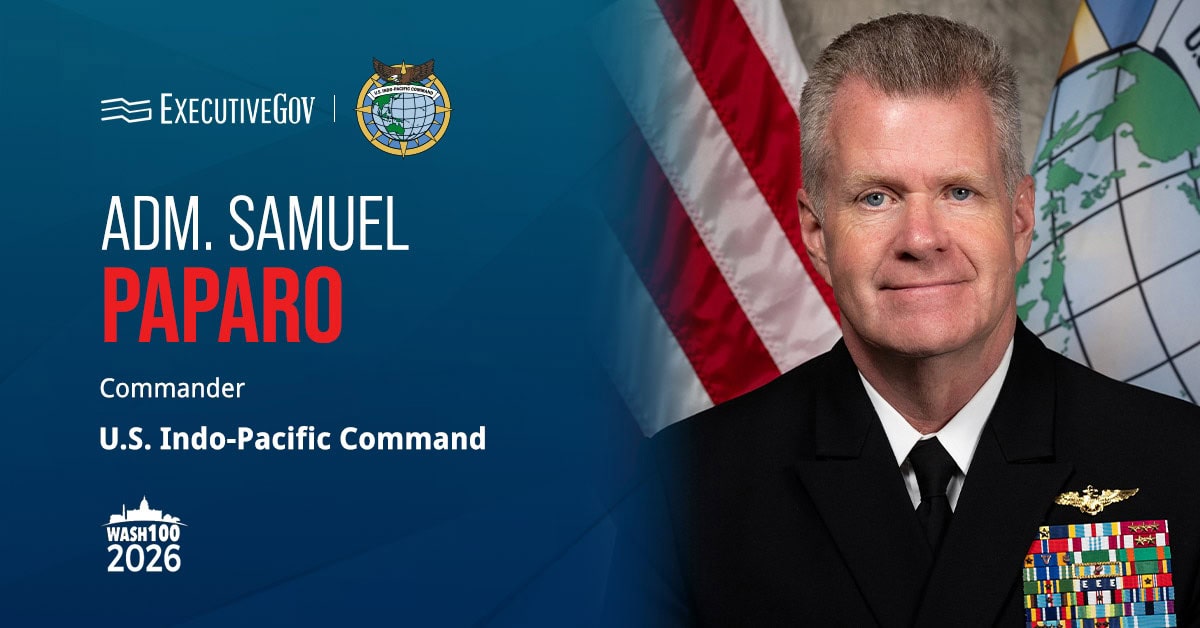
Paparo, a 2026 Wash100 awardee, said achieving decision superiority requires leveraging data, compute, and human-machine integration to observe, assess, decide, learn and adjust faster than any adversary.
“As we connect these capabilities across space, sensors and networks, our operational advantage does not merely grow by addition, it compounds to deliver overwhelming joint effects,” the USINDOPACOM chief added.
Huang said AI will serve as the backbone of U.S. defense and that the system will let service members train on and build with advanced AI tools.
“By supporting the Naval Postgraduate School and placing one of the world’s most advanced AI supercomputers in the hands of the men and women who defend our Nation, we are empowering them to train on it, build with it, and lead America’s fighting force with the decisive advantages our Sailors, Marines and Joint Force deserve,” the NVIDIA chief executive added.