Processing....

Logo

Digital News Coverage of Government Contracting and Federal Policy Landscape
Sticky Logo
  • Home
  • Acquisition & Procurement
  • Agencies
    • DoD
    • Intelligence
    • DHS
    • Civilian
    • Space
  • Cybersecurity
  • Technology
  • Executives
    • Profiles
    • Announcements
    • Awards
  • News
  • Articles
  • About
  • Wash100
  • Contact Us
    • Advertising
    • Submit your news
    • Jobs
Logo
DoD/News
Senate Confirms Marc Andersen as Assistant Secretary of the Army for Financial Management, Comptroller
by Elodie Collins
Published on October 9, 2025
Logo of the U.S. Army. Marc Andersen will serve as the Army's assistant secretary for financial management and comptroller

The Senate has confirmed Marc Andersen as the new assistant secretary of the Army for financial management and comptroller. According to Congress records, Andersen, who was nominated to the role by President Donald Trump, secured the role in a 51-47 vote from legislators on Tuesday. 

He replaces Caral Spangler, who held the position from August 2021 through December 2024. 

Andersen was nominated to be an Army assistant secretary in March. At the time, he said in a LinkedIn post that soldiers and their families “embody the very best of America” and, if confirmed, he will ensure that the “organization that serves them reflects that same excellence.”

Who Is Marc Andersen?

Andersen brings to the role extensive leadership experience in the public and private sectors. He served as a senior partner emeritus at EY,  a consulting, assurance, tax and transaction services provider, for over 22 years. 

He also founded his own advisory services firm, called Andersen Advisory, where he also serves as a managing member. 

According to his LinkedIn profile, he also serves as a venture partner at IronGate Capital Advisors, a senior adviser for Tesla Government, a senior strategic adviser for Infuse and board of advisers chairman at vTech.

Executive Moves/News
Senate Confirms Jack Dever & Chris Fox to Key ODNI Roles
by Miles Jamison
Published on October 9, 2025
ODNI seal. The U.S. Senate confirmed Jack Dever as general counsel and Chris Fox as intelligence community inspector general.

The U.S. Senate has confirmed Jack Dever as general counsel and Chris Fox as intelligence community inspector general at the Office of the Director of National Intelligence, ODNI announced Wednesday.

Table of Contents

  • Who Is Jack Dever?
  • Who Is Chris Fox?

Who Is Jack Dever?

In his new role, Dever will provide legal guidance to the ODNI and the broader intelligence community. He was CEO of Lockhaven Solutions, a cybersecurity consulting firm. The cybersecurity expert held leadership roles at General Electric, Wells Fargo and UBS. 

Dever also served as assistant general counsel at the FBI and assistant U.S. attorney. His military service included stints as a signals intelligence Korean linguist and Judge Advocate General officer.

“His proven leadership—spanning military service and distinguished roles across the government and private sector—makes him an asset to our mission at ODNI. He will serve with the highest standards of integrity, strengthening the security of our country and upholding the Constitution,” said Director of National Intelligence Tulsi Gabbard.

Who Is Chris Fox?

Fox will oversee independent reviews across the intelligence community, advancing transparency, accountability and operational efficiency while identifying fraud, waste and mismanagement.

Fox previously worked at Six Technologies and Matrix International and was a specialized skills and covert action officer at the CIA’s directorate of operations. He also had stints at the Department of Justice’s National Security Division and the Department of Homeland Security’s Center for Risk and Economic Analysis of Terrorism Events. Early in his career, Fox served as a special warfare airman and joint terminal attack controller for the U.S. Air Force.

“With nearly two decades of experience in national security spanning military service, intelligence operations, legal practice and entrepreneurship, Chris steps into this role with the integrity, fortitude and commitment to country needed to serve as inspector general for the intelligence community,” said Gabbard.

Cybersecurity/DoD/News
Army Activates 2nd Theater Information Advantage Detachment
by Jane Edwards
Published on October 9, 2025
U.S. Army logo. The Army activated the second TIAD, marking a key step in its approach to information warfare.

The U.S. Army has activated the second Theater Information Advantage Detachment, or TIAD, as part of efforts to provide commanders with capabilities to support Army operations across the broader information environment, DVIDS reported.

The Army Cyber Command TIAD led by Col. John Agnello was activated during a ceremony held Friday at Fort Gordon in Georgia.

“This TIAD is built on the shoulders of soldiers who bring not only technical mastery, but the courage to challenge, the creativity to adapt, and the conviction to lead. I’m honored to command a team that doesn’t just execute the mission; they embody it. They are the Army’s advantage in the information fight, and a key reason we’re positioned to succeed,” said Agnello, the second TIAD commander.

ARCYBER TIAD

The ARCYBER TIAD is one of three planned detachments tailored to three geographic commands: Indo-Pacific, Europe and ARCYBER itself. Each TIAD integrates into a unified team several disciplines, including cyber operations, electronic warfare, civil affairs, psychological operations and public affairs.

In October 2024, the Army first announced plans to establish three detachments to counter information adversaries.

The ARCYBER TIAD achieved initial operating capability with its activation. The unit will continue to refine its integration across information, cyber and influence disciplines as it advances toward full operating capability.

“Today, with the activation of this TIAD, we carry that legacy forward—into the information domain, where influence is decisive and truth must be defended. This is not just a new unit; it’s the next chapter in how the Army fights and wins,” said Lt. Gen. Maria Barrett, commander of ARCYBER.

Acquisition & Procurement/Contract Awards/DoD/News
Radiance-Louisiana Tech Team Secures DARPA Contract for MICA Program
by Jane Edwards
Published on October 9, 2025
Contract award. The team of Radiance Technologies and LA Tech secured a DARPA contract for the MICA program.

The Defense Advanced Research Projects Agency has awarded the team of Radiance Technologies and Louisiana Tech University a contract to perform work on the Microsystem Induced CAtalysis, or MICA, program.

Radiance said Wednesday it will work with LA Tech to model microsystems that can precisely control protein function.

Table of Contents

  • Developing Novel Simulation Platform AMPERE
  • What Is DARPA’s MICA Program?

Developing Novel Simulation Platform AMPERE

As part of the MICA program, Radiance and the university will develop a novel simulation platform, called AMPERE, that combines machine learning with multiscale physical modeling.

AMPERE, which is short for Adaptive Multi-Physics Engine for Reaction Engineering, will help predict the behavior of biomolecular catalysts under microsystem stimulation.

“This program addresses a critical need to bridge molecular-scale biological control with scalable microsystem design,” said Andrew Gardner, principal investigator for MICA at Radiance. “AMPERE will enable the co-design of molecules and microsystems with high precision, advancing secure therapeutics, resilient biomanufacturing, and beyond.”

LA Tech will bring its capabilities in computational biology and nanotechnology to support interface modeling and catalyst fabrication as part of the program.

“Together, we’re developing tools and methods to direct molecular function. As a researcher and educator, these projects provide valuable opportunities for students in both the lab and the classroom,” said Tom Bishop, MICA co-investigator and professor at LA Tech.

What Is DARPA’s MICA Program?

According to Radiance, the MICA program aims to explore how microsystems can harness electromagnetic fields, heat and fluid motion to guide chemical reactions at the molecular level.

DARPA stated that the program aims to address challenges in predicting how molecular catalysts behave when incorporated into microsystem surfaces and how their activity can be controlled in complex environments.

According to the agency, the program could lead to advances in medical therapeutics, materials synthesis and environmental remediation, among other areas.

DHS/News
DHS Launches Lab to Test Next-Gen 911 System Compatibility
by Kristen Smith
Published on October 9, 2025
Department of Homeland Security logo. DHS opens a new laboratory to test Next-Gen 911 system interoperability.

The Department of Homeland Security’s Science and Technology Directorate has established a new laboratory to ensure Next Generation 911 systems work seamlessly across jurisdictions and technology providers, Federal News Network reported. The initiative aims to prevent communication breakdowns as states and localities transition from analog infrastructure to modern, internet protocol-based emergency networks.

DHS Launches Lab to Test Next-Gen 911 System Compatibility

On Nov. 12, Potomac Officers Club’s 2025 Homeland Security Summit will unite top leaders from government, industry and law enforcement to address the country’s most urgent security challenges, from AI integration to border innovation and supply chain resilience. Register now to gain exclusive insights from DHS, CISA and homeland security experts shaping America’s defense strategy.

Table of Contents

  • Ensuring Interoperability Before Deployment
  • 5G and 6G Technologies

Ensuring Interoperability Before Deployment

The new lab allows vendors to remotely test their NG911 technologies for interoperability before rollout. The facility builds on DHS’ existing public safety radio testing program and uses open-source tools that vendors can download, run and analyze to confirm their systems meet compatibility standards.

“What we don’t want to do is have an interoperability chasm upon deployment,” said Sridhar Kowdley, technology manager for S&T’s communications and networking technology center. “We want to solve those issues during the [research and development] and the implementation point.”

The lab recently demonstrated a 911 video call. The next-generation system is expected to be faster and more resilient, enabling voice, photos, videos and text messages to reach call centers over a digital network. Kowdley said more test cases are planned before a formal certification process begins.

Kowdley noted that the transition to NG911 involves significant integration challenges, including connections to computer-aided dispatch systems and next-generation core services. The laboratory’s early efforts, he said, are focused on reducing technical barriers and identifying potential data and interoperability gaps before deployment.

5G and 6G Technologies

DHS S&T is exploring how 5G wireless networks can enhance emergency response through faster data transfer, artificial intelligence and Internet of Things capabilities. The directorate is assessing secure, cost-effective ways to apply 5G across diverse DHS operations, from border security to airport management.

S&T is also participating in early discussions around sixth-generation standards. “Generally, 6G is developed for consumers,” Kowdley said. “It’s not driven for homeland security applications or Department of Defense. So all of the federal agencies are getting together to work on 6G.”

Acquisition & Procurement/DoD/News
MDA Issues Sources Sought Notice for Advanced Object Classification 1.1 Software Upgrade
by Miles Jamison
Published on October 9, 2025
MDA seal. The Missile Defense Agency issued a sources sought notice for the AOC 1.1 software upgrade.

The Missile Defense Agency has released a sources sought notice for the development of the Advanced Object Classification, or AOC, 1.1 software upgrade.

According to the notice published on SAM.gov Friday, the planned software upgrade is designed for upgraded early warning radars, or UEWR. Responses will be accepted until Oct. 17.

Advanced Object Classification 1.1 Software Upgrade

The AOC 1.1 upgrade is intended to bolster the accuracy of classifying objects during the midcourse phase of ballistic missile flight. It builds upon the performance of the previously fielded AOC 1.0 version by incorporating further algorithm and interface control document-driven enhancements identified during testing and fielding.

The agency aims to introduce a flat-file classification database to enhance the AOC 1.1 software. This new capability is expected to enable the system to be rapidly reconfigured to counter emerging threats without necessitating software recompilation or a return to the original developer for modifications. This will streamline the speed at which UEWRs can adapt.

The existing AOC architecture utilizes 37 algorithms and machine learning to boost object classification accuracy and overall classification results, respectively. It does not require changes to the radar hardware or the ground-based midcourse defense fire control interface.

Artificial Intelligence/Government Technology/News
USPTO AI Pilot Program Seeks to Streamline Patent Applications
by Arthur McMiler
Published on October 9, 2025
John Squires headshot. The USPTO director elaborated on the AI-based pilot program for streamlining patent applications.

The U.S. Patent and Trademark Office has unveiled a test program called ASAP!, short for Artificial Intelligence Search Automated Pilot, aimed at enhancing the quality, speed and efficiency of patent applications.

Table of Contents

  • Patent Applications’ Issues Alert
  • Other AI Pilots to Follow

Patent Applications’ Issues Alert

The pilot program will provide applicants with an AI-Assisted Search Results Notice, or ASRN, listing top 10 potential previous art issues that requires their attention, USPTO said Wednesday. It added that the ASRN is designed to help applicants decide on early actions such as filing amendments, submitting supporting evidence, requesting deferrals or seeking fee refunds.

USPTO will use the pilot’s results to assess pre-examination search outcomes, evaluate ASRN scalability and guide future initiatives to further streamline patent applications. Patent applicants who want to join ASAP! have to file a petition to participate in the pilot program and pay its fee.

Other AI Pilots to Follow

According to John Squires, under secretary of commerce for intellectual property and USPTO director, ASAP! is the inaugural release in a wave of other planned AI pilots to help both patent examiners and applicants. “Quality starts at filing—and our enterprising examiners have developed a cadre of new tools that re-imagine workflows and attack thorny chokepoints that constrain productivity, throughput, and ultimately quality for new applicants,” Squires noted.

USPTO is investing significantly to harness AI in its functions. In August 2024, the agency awarded Accenture Federal Services a $75 million contract to implement AI capabilities for improving patent reviewing processes.

Civilian/News
Gustav Chiarello Confirmed as HHS Assistant Secretary for Financial Resources
by Jane Edwards
Published on October 8, 2025
Gustav Chiarello. The former FTC attorney was confirmed by the Senate as HHS assistant secretary for financial resources.

The Senate on Tuesday voted 51-47 to confirm Gustav Chiarello, former Federal Trade Commission attorney, as assistant secretary for financial resources at the Department of Health and Human Services.

President Donald Trump nominated Chiarello for the assistant secretary role at HHS in February.

Gustav Chiarello Confirmed as HHS Assistant Secretary for Financial Resources

Connect with top industry and government leaders at the Potomac Officers Club’s 2025 Healthcare Summit on Dec. 4! Explore the latest health innovations, policy developments and emerging trends transforming the field. Don’t miss this premier GovCon networking event—reserve your spot today! 

Who Is Gustav Chiarello?

Chiarello most recently was senior special counsel to the House Judiciary Committee. He served on the Subcommittee on the Administrative State, Regulatory Reform and Antitrust chaired by Rep. Scott Fitzgerald, R-Wis.

During the first Trump administration, he served as an attorney adviser to Acting FTC Chairman Maureen Ohlhausen.

The antitrust and competition policy lawyer worked in private practice earlier in his career.

The Catholic University of America economics graduate has a master’s degree in public policy from Georgetown University and a law degree from George Mason University.

Acquisition & Procurement/Civilian/News
FAR Council Issues Changes to 8 Parts of Acquisition Regulation
by Jane Edwards
Published on October 8, 2025
Government contracting. The FAR Council released model deviation text for FAR Parts 15, 16, 22, 23, 25, 32, 42 and 53.

The Federal Acquisition Regulatory Council has released new model deviation text for eight parts of the FAR as part of the Revolutionary FAR Overhaul, or RFO, initiative.

In April, President Donald Trump signed an executive order directing his administration to amend the Federal Acquisition Regulation to streamline the federal procurement process and eliminate barriers to doing business with the government.

The FAR Council issued new text for Part 15 – Contracting by Negotiation; Part 16 – Types of Contracts; Part 22 – Application of Labor Laws to Government Acquisitions; and Part 23 – Sustainable Acquisition, Material Safety and Pollution Prevention; Part 25 – Foreign Acquisition; Part 32 – Contract Financing; Part 42 – Contract Administration and Audit Services; and Part 53 – Forms.

These eight parts are open for feedback until Nov. 3.

The council has yet to issue implementation support for Parts 22, 23, 32 and 53.

Table of Contents

  • Contracting by Negotiation
  • Types of Contracts

Contracting by Negotiation

The text of FAR Part 15 concerning contracting by negotiation has been revised for greater clarity. The part now comes with updated rules of engagement, redefined competitive range and five subparts: presolicitation and solicitation; evaluation and award; postaward; contract pricing; and unsolicited proposals.

Part 15 continues to be primarily used for establishing negotiated contracts when using a request for proposals.

A section that addresses the types of negotiated acquisitions has been updated to modernize the language throughout. The two paragraphs in this section are now titled “Noncompetitive Acquisitions” and “Competitive Acquisitions.”

A section concerning issuing solicitations has been removed due to repetitive information found in other FAR parts.

Types of Contracts

FAR Part 16 has been updated to clarify complicated policies and procedures for selecting contract type and provide the acquisition workforce with new flexibilities and tools to support the guiding principles for the FAR system.

Key improvements to Part 16 include innovative contract types, significant task and delivery order procedure simplification, on-and-off ramps and blanket purchase agreements.

A subpart concerning contract type selection has been restructured to consolidate policies, stress documentation and provide contracting officers with greater flexibility.

The council has updated a subpart on incentive contracts to consolidate all incentive-related policies and contract type descriptions into a single subpart and revised a subpart on indefinite-delivery contracts to clearly outline the types of task and delivery order contracts for acquisition professionals and how to use them.

Artificial Intelligence/DoD/News
Army Implementing Automation, System Modernization to Cut Routine Work
by Kristen Smith
Published on October 8, 2025
Leonel Garciga. The Army CIO discussed new automation and modernization initiatives.

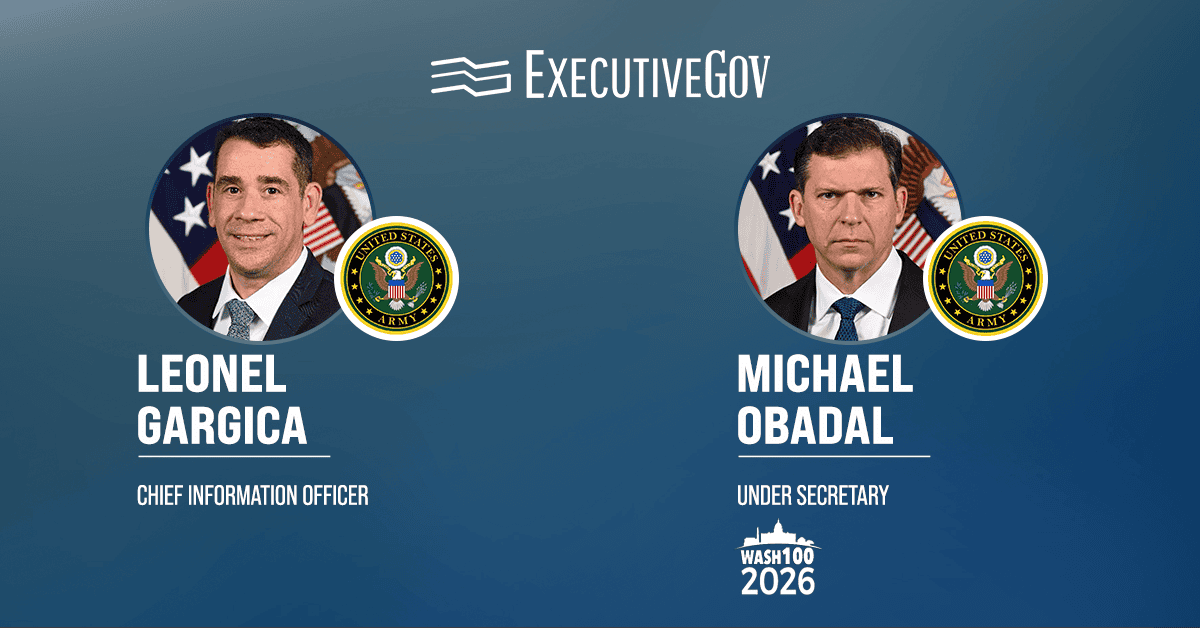
The U.S. Army is advancing a broad automation effort aimed at reducing low-value administrative tasks and freeing soldiers and civilian employees to focus on higher-priority missions, Federal News Network reported. Army Chief Information Officer Leonel Garciga, a two-time Wash100 Award recipient, said on the Ask the CIO podcast that the service has identified roughly 300 potential areas where automation and artificial intelligence could simplify workflows and ease the cognitive burden on its workforce.

The initiative began after Under Secretary of the Army Mike Obadal issued a memo directing all major commands and program offices to identify opportunities for process automation and AI integration. Feedback from across the service produced more than 300 submissions, which Garciga’s office has been reviewing to determine which projects would yield the greatest benefit. Because resources are limited, Garciga said the CIO team evaluated proposals using three main criteria: impact on soldiers and civilians, scalability across the Army and cost-effectiveness. Of the 300 ideas, five projects were selected for initial development.

Some proposals revealed unexpected efficiencies. “We found some efficiencies inadvertently as we worked through the process,” Garciga said. “I think we had a good triage mechanism, which was really focused on soldiers and on where we can make the most impact as quickly as possible.”

Table of Contents

  • Early Priorities: Personnel Records and Training
  • Business Systems Reform and Data Challenges
  • Streamlining Systems and Reducing Technical Debt

Early Priorities: Personnel Records and Training

The Army’s initial focus is on what Garciga calls “administrivia” — routine or repetitive tasks that consume time without adding significant value. Early pilot efforts include using AI to streamline the review of personnel records and applying automation to enhance cross-training programs for both soldiers and civilians.

“Let’s put AI against it to really reduce that cognitive burden,” Garciga said, noting that the aim is to improve response times for personnel inquiries and ensure service members are “in the right place and where they need to be in their lifecycle from a training perspective.”

Business Systems Reform and Data Challenges

In line with AI integration, the Army is advancing business process reengineering to modernize how its business systems operate. Garciga said the effort helps the service understand where modernization challenges stem from, whether data quality, process inefficiencies or technology gaps.

“We’ve been really focused on looking at those areas where we really believe that we can have the most impact directly to soldiers or civilian workforce,” he said. “A lot of times we find that there’s a lot of problems we want to apply AI to, and it’s like, ‘Hey, this is really a data problem.’”

Streamlining Systems and Reducing Technical Debt

The Army’s redefinition of business systems is part of a wider initiative to modernize and consolidate its digital infrastructure. The goal is to merge or retire nearly 100 separate business systems within the next year, an effort led by a cross-Army team working closely with program offices and functional stakeholders.

Central to this work is the creation of a no-code, low-code center of excellence, designed to bring greater consistency and cybersecurity to system development across the service. By reducing duplication and integrating oversight, the Army aims to cut maintenance costs and eliminate “technical debt” built up from legacy systems.

Garciga said the modernization push is focused on improving access to data and tools for both soldiers and civilian personnel. Efforts now underway are intended to accelerate enterprise system convergence, shorten delivery timelines and deliver more efficient digital capabilities to users across the force.

Previous 1 … 33 34 35 36 37 … 2,658 Next
News Briefing
I'm Interested In:
Recent Posts
  • CISA, NIST Release Draft Report on Identity Token Cyberthreats for Public Comment
  • War Department to Provide xAI for Government Capabilities via GenAI.mil
  • HHS Proposes HTI-5 Rule to Cut Health IT Burden, Advance AI-Enabled Interoperability
  • NIST Invests $20M to Establish AI Centers for Manufacturing, Critical Infrastructure Security
About

ExecutiveGov, published by Executive Mosaic, is a site dedicated to the news and headlines in the federal government. ExecutiveGov serves as a news source for the hot topics and issues facing federal government departments and agencies such as Gov 2.0, cybersecurity policy, health IT, green IT and national security. We also aim to spotlight various federal government employees and interview key government executives whose impact resonates beyond their agency.

Read More >>

RSS ExecutiveBiz
  • DecisionPoint–Agile Defense JV Added to GSA’s Polaris SDVOSB GWAC
  • Parsons Expands Role on DARPA Blackjack With $30M SDA Contract Novation
  • Zscaler’s Federal CTO Discusses Zero Trust Implementation for OT, IoT
  • RTX Secures $842M Army Contract for Fire Units Production
  • Carahsoft to Bring Tom Sawyer Software’s Graph AI Tech to Government Clients
  • Lockheed, MANTECH Partner on AI-Based Aircraft Sustainment
RSS GovConWire
  • Teledyne Promotes JihFen Lei to Senior Vice President
  • AFRL Launches $10B Multiple Award Contract for R&D Services
  • ULA Names John Elbon Interim CEO Following Tory Bruno’s Departure
  • Aquia Brings Back Co-Founder David Maskeroni as CEO
  • Lockheed Books $3.6B Navy Contract Modification for F-35 Logistics Support
  • CACI Strikes $2.6B All-Cash Deal for ARKA Group
Footer Logo

Copyright © 2025
Executive Mosaic
All Rights Reserved

  • Executive Mosaic
  • GovCon Wire
  • ExecutiveBiz
  • GovCon Exec Magazine
  • POC
  • Home
  • Acquisition & Procurement
  • Agencies
    • DoD
    • Intelligence
    • DHS
    • Civilian
    • Space
  • Cybersecurity
  • Technology
  • Executives
    • Profiles
    • Announcements
    • Awards
  • News
  • Articles
  • About
  • Wash100
  • Contact Us
    • Advertising
    • Submit your news
    • Jobs
Go toTop