- RIMPAC 2026 served as a testbed for advanced naval capabilities
- The exercise culminated with the sinking of decommissioned U.S. ships
- Acting Navy Secretary Hung Cao and other military leaders will keynote the 2026 Navy Summit on Aug. 27
The Rim of the Pacific, or RIMPAC, 2026 brought together 31 nations and about 30,000 personnel for the latest iteration of the world’s largest combined and joint maritime exercise. Hosted by the U.S. Pacific Fleet in Hawaii, the event served as a testbed for advanced naval capabilities, with 40 experimentation initiatives conducted throughout the five-week event, offering a glimpse into how future battles at sea will be fought.

Hear Acting Navy Secretary Hung Cao, a 2026 Wash100 winner, talk about his vision for the Navy at the 2026 Navy Summit on Aug. 27. The Navy’s top civilian leader is joining the summit’s lineup of keynote speakers, which also includes the service’s I-boss Vice Adm. Michael Vernazza and Marine Corps Deputy Commandant for Information Lt. Gen. Joseph Matos. Sign up today to secure your spot!
What Is RIMPAC?
RIMPAC 2026 marked the 30th iteration of the exercise, with the theme, Partners: Integrated and Prepared, to highlight the vital need to strengthen collective defense and safeguard maritime security across the Indo-Pacific.
“No single nation can ensure security in the Pacific alone,” stated Vice Adm. Jeff Jablon, deputy commander of the U.S. Pacific Fleet and commander of the RIMPAC 2026 Combined Task Force.
“The work participating nations do at RIMPAC builds the combined and joint ability to deter conflict and supports all nations in exercising their sovereign rights and freedoms in the maritime domain,” Jablon said.
The biennial exercise included five submarines, 32 surface ships and 206 aircraft. It was conducted in three phases:
- In-port phase: Involved planning for upcoming operations, establishing multi-national command structures, and conducting expert exchanges, cultural activities and sporting events.
- At-sea phase: Covered multi-domain training across anti-submarine warfare, integrated air and missile defense, combat logistics, and other key tactical areas.
- Free-play: Provided an unscripted scenario, where opposing forces test and react to one another to assess maritime capabilities.
RIMPAC 2026 began June 24 and concluded July 31.
What Naval Capabilities Were Demonstrated at RIMPAC 2026?
Unmanned Vessels
RIMPAC is a vital proving ground for the Navy to evaluate uncrewed surface vehicles, or USVs, and unmanned underwater vehicles, also known as UUVs, in realistic operational conditions.
Previous editions of the military exercise showcased autonomous platforms. In 2024, Anduril Industries deployed its extra-large autonomous undersea vehicle, Ghost Shark. Swiftships’ Nomad and Leidos’ Ranger, Sea Hunter and Seahawk joined maritime experimentations in 2022.
Rear Adm. Suzanne M. Bailey, deputy commander of the U.S. 3rd Fleet, described RIMPAC as the “primary laboratory” for operationalizing new platforms and concepts, according to Breaking Defense.
“With our partner nations, we’re learning together on how to combine manned and unmanned platforms into a single, cohesive and formidable fighting and defensive force,” she added.
This year’s exercises featured Surveyor, a 20-meter USV built by Saildrone. The USV can fire four AGM-179 Joint Air-to-Ground Missiles, or JAGM.
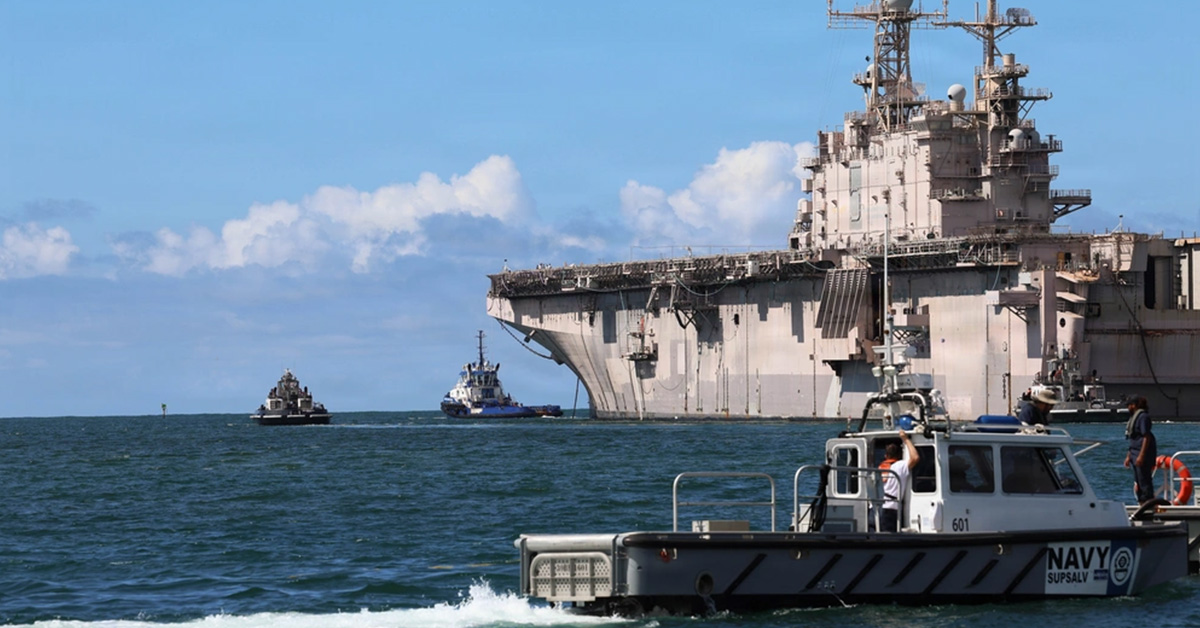
BlackSea Technologies’ Global Autonomous Reconnaissance Craft drone also had its first live-fire test at RIMPAC, The War Zone reported. The drone, under the command of Unmanned Surface Vessel Division 32, was employed to attack the former USS Peleliu, a decommissioned Tarawa-class amphibious assault ship, in a sinking exercise, also known as SINKEX.
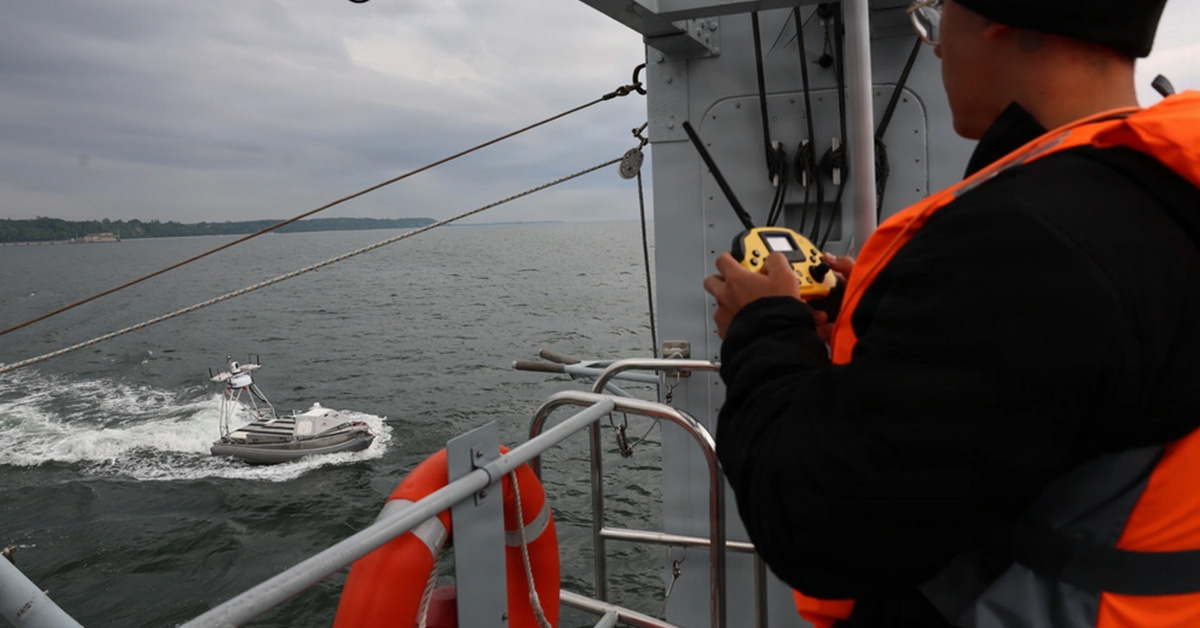
USVs from HavocAI, Leidos and Splash Industries also joined RIMPAC 2026, according to Naval News.
The Future of UUV & USV Navy-Industry Partnership panel at the 2026 Navy Summit on Aug. 27 will chart the evolution of UUVs and USVs, identify challenges in collaborating with the Navy, and explore applications of unmanned platforms in the Golden Fleet and AUKUS. The discussion will feature retired Rear Adm. Anthony Lengerich, former vice commander of the Naval Sea Systems Command and current vice president of naval programs at Thales Defense & Security, and other government and industry experts. Get your tickets today!
C-UAS/Air Defense
RIMPAC 2026 also prioritized counter-unmanned aerial system and air defense operations. The Navy’s Arleigh Burke-class guided missile destroyers USS Paul Hamilton and USS Carl M. Levin teamed up with the Philippines’ BRP Miguel Malvar guided-missile frigate and Singapore’s Formidable-class stealth frigate RSS Steadfast for defensive counter-air and raid exercises.
Meanwhile, the Naval Postgraduate School, or NPS, and the Naval Information Warfare Center Pacific fielded spectral imaging sensors and 3D-printed rockets at Schofield Barracks in Honolulu to detect and defeat unmanned aircraft, Army Recognition reported. The sensors are designed to identify signatures of unmanned platforms, while the rockets will neutralize the threats.
Advanced Manufacturing
Advanced manufacturing to replace broken components at sea is another capability that the U.S. Navy is building to operate across the vast distances of the Pacific theater, and at RIMPAC 2026, the service put those distributed logistics concepts to the test.
NPS’ Consortium for Advanced Manufacturing Research and Education, or CAMRE, and Fleetwerx, an innovation hub, piloted a “trifecta of advanced manufacturing, autonomous systems and artificial intelligence” to deliver parts, Defense One said.
The technologies enable commanders to digitally submit a request for parts to the nearest qualified manufacturer, which will produce and deliver the required components.
“Very simply, this is Uber for manufacturing delivered at the speed of Amazon, for the highest quality of parts, and we have the opportunity to do it in the most contested of environments,” Marine Lt. Col. Michael Radigan, advanced manufacturing and repair operations subject matter expert at CAMRE, shared.
Researchers evaluated a technology for manufacturing metal powder aboard a Canadian ship during RIMPAC. NPS also participated in C-UAS experimentation by coordinating additively manufactured drones, some of which were produced on ships while in transit to Hawaii.
Additionally, the demonstration included digitally crewed surface vessels to deliver parts to U.S. or partner-nation ships.
Submarine Hunter
Beyond surface and air defense operations, RIMPAC 2026 also provided a stage for testing Lockheed Martin’s SensorMAX, an AI-powered sonar analysis platform, for subsurface threat detection. SensorMAX is designed to ingest and process the acoustic data collected from a network of sensors and uses AI and machine learning to identify targets.
During the exercise, two MH-60R helicopters dropped sonobuoys that captured subsurface acoustic data that was then transmitted to SensorMAX. Lockheed said the system can serve as the Navy’s AI portable sonar expert, allowing aircrew to simultaneously monitor data from up to eight sonobuoy surveillance feeds.
Anti-Ship Capabilities
The multi-national exercise culminated with the sinking of the former USS Peleliu and the decommissioned guided-missile cruiser USS Mobile Bay. All participating nations showcased their anti-ship capabilities during the exercise.
The U.S. military fired two UGM-84 Harpoons, an encapsulated anti-ship missile system introduced in 1977, from the Los Angeles-class submarine USS Columbia during the exercise. Meanwhile, an F/A-18F Super Hornet fighter jet launched an AGM-158C Long-Range Anti-Ship Missile at the targets.
American submarines deployed additional harpoons during the exercise.
On the shore, soldiers from the 1st Battalion, 623rd Field Artillery Regiment, Kentucky Army National Guard coordinated joint strike operations with Japanese ground forces. The American battalion operated the M142 High Mobility Artillery Rocket System, while Japanese troops fired Type 12 surface-to-ship missile systems.
Helicopters from the U.S. Army, the U.S. Navy and the Royal New Zealand Navy also participated in the sinking exercise.
Decision-makers from across the Navy will share insights on the service’s most critical initiatives, including integrating commercial capabilities into maritime operations centers, partnering with industry to build UUVs and USVs, advancing Project Overmatch, and accelerating shipbuilding through the Golden Fleet initiative at the 2026 Navy Summit on Aug. 27. Do not miss this chance to engage with the leaders forging the next era of naval dominance. Register here!