
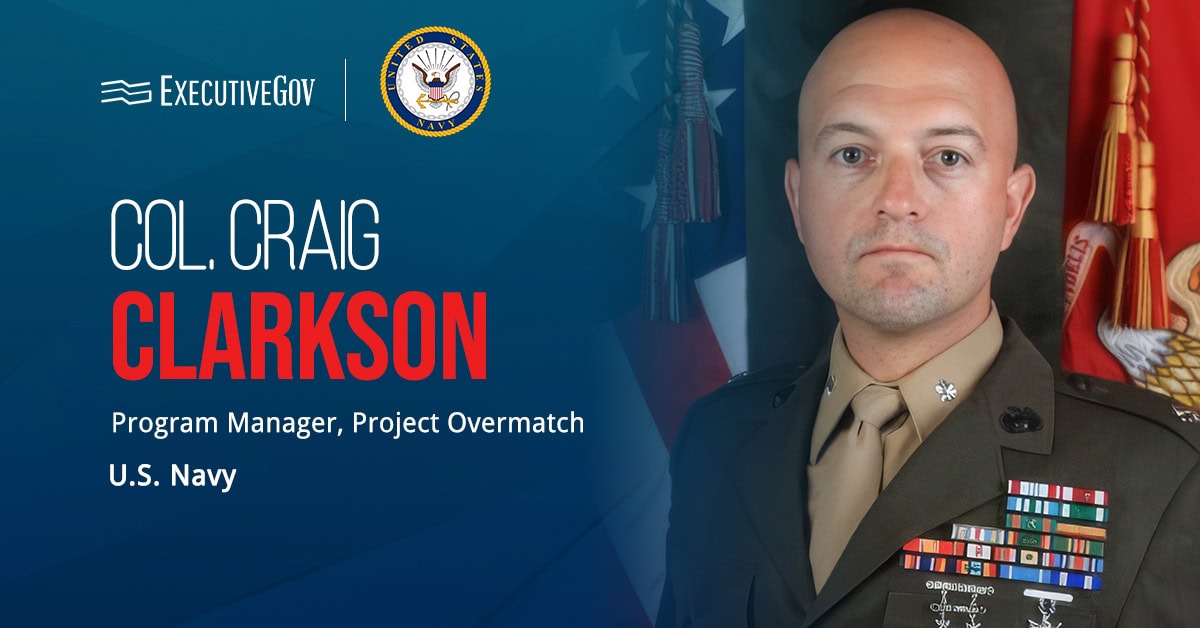
- New leadership: Col. Craig Clarkson took over Project Overmatch in June after four years leading MCTSSA and Project Dynamis.
- A fast-follower philosophy: Clarkson favors integrating existing systems over building new ones from scratch.
- Catch him live: Clarkson speaks on a Project Overmatch panel at the nearly sold-out 2026 Navy Summit this Thursday, Aug. 27. Register today!
Col. Craig Clarkson doesn’t come to Project Overmatch as an outsider learning the mission from scratch. He arrives as someone who spent the last four years running a parallel version of it for the Marine Corps — and that background is likely to shape how he leads the Navy’s flagship command-and-control modernization effort at a moment when the 2026 Navy Summit has made Overmatch’s next chapter a headline topic of conversation. Attendees at this Thursday’s summit will get to hear that thinking firsthand, as Clarkson takes the stage for a dedicated panel on Project Overmatch, CJADC2 and network-centric warfighting.
Clarkson became Project Overmatch’s program manager in June, taking over during a change of command and retirement ceremony at Naval Base Point Loma that closed out Capt. Remil J. Capili’s four-year tenure. Under Capili, Overmatch grew into a rapid acquisition program office credited with modernizing the Navy’s command-and-control systems and data architectures, operationalizing artificial intelligence across the fleet, and standing up a modern software development and operations pipeline.
“Project Overmatch led the way for the Navy in using novel acquisition approaches to deliver real, advanced capability to the fleet,” Vice Adm. Seiko Okano, principal military deputy of the assistant secretary of the Navy for research, development and acquisition, said during the ceremony.

Who Is Craig Clarkson?
Before taking the Overmatch job, Clarkson spent four years as commanding officer of Marine Corps Tactical Systems Support Activity, or MCTSSA, where he also served as the Marine Corps’ deputy direct report program manager for Project Dynamis — the Corps’ contribution to the Pentagon’s Combined Joint All-Domain Command and Control vision. That effort tasked Clarkson with a specific, resource-constrained problem: how does a service with a fraction of the Navy’s or Army’s acquisition budget still deliver joint, interoperable C2 capability on a relevant timeline?
His answer was consistent across public appearances throughout Dynamis’ run. Rather than building new software architectures from the ground up, Clarkson told National Defense Magazine that his approach was to take “that tapestry of existing program of record stuff” already fielded across the Marine Corps and re-engineer it into small form-factor systems — hardware stacks compact enough to fit in a carry-on suitcase — that Marines could deploy in degraded, contested environments. Speaking with Breaking Defense around the same period, Clarkson described the work at MCTSSA as taking existing programs of record and moving that software off monolithic systems and onto small form-factor servers that are “already joint and interoperable to some degree today.”
That philosophy produced results. Under Clarkson’s leadership, MCTSSA ran a series of monthlong software sprints called Dynamis “serials” that connected battle management nodes across the joint force and tested data fidelity across classification levels. During one exercise alongside the Army’s 4th Infantry Division, Marines reportedly cut airspace deconfliction times by as much as 80 percent using AI-enabled data-sharing.
Clarkson has also been candid about why a service under the Navy’s own acquisition umbrella needed a separate lane in the first place, saying flatly that “the Navy gets very hyper-focused on Navy” and that the tactical level for a destroyer looks nothing like the tactical level for a small Marine unit operating with organic sensors on a remote atoll.
Speaking with USNI News about the origins of the small form-factor concept, Clarkson explained that the goal was to “take all the software that matters in the aircraft C2 system, harvest the software out of a lot of programs and converge that software on small form factor systems,” then get that capability directly into Marines’ hands for real-world feedback.
That’s the perspective now steering the organization he once needed a workaround for.
Hear from Clarkson and other high-profile Navy leaders at the 2026 Navy Summit, from Potomac Officers Club, this Thursday, Aug. 27!
What Does Clarkson Bring to Project Overmatch?
Clarkson’s resume spans more than two decades of acquisition and operational leadership, from combat engineer platoon commander through squadron command, with deployments across Europe, Africa, Latin America, Asia and the Middle East. On the acquisition side, he’s held program management roles at Marine Corps Systems Command and Marine Corps Forces Cyberspace Command, and he’s a certified DAWIA Level III program manager alongside credentials in Lean Six Sigma Black Belt, the Scaled Agile Framework and ITIL v4. He also holds three master’s degrees — in logistics and supply chain management, military studies, and national resource strategy — earned at Marine Corps University and the National Defense University’s Eisenhower School.
It’s a career built at the intersection of frontline logistics and acquisition bureaucracy — exactly the combination Overmatch’s next phase may need as it works to translate rapid prototyping into program-of-record decisions across the fleet.

Where Can You Hear From Clarkson Directly?
Clarkson will discuss Project Overmatch, CJADC2 and network-centric warfighting during a dedicated panel at the 2026 Navy Summit, Potomac Officers Club’s premier gathering for Navy and Marine Corps acquisition leaders, taking place this Thursday, Aug. 27, at the Falls Church Marriott Fairview Park. He’ll be joined by Google Public Sector Field CTO Amina Al Sherif, Legion Intelligence Vice President of Mission Engineering Dr. Nick Weir, Department of the Navy Marine Corps Technology Officer Jeffrey Proudfoot and DON Advanced Wireless Technologies IPT Director Bill Sellers, with the session moderated by Legion Intelligence’s Col. (Ret.) Mark Campbell.
This marks one of Clarkson’s first major public appearances since taking over Overmatch — and with the 2026 Navy Summit just days away, seats for this session are filling quickly. If understanding where Navy and Marine Corps command-and-control modernization is headed next matters to your work, this is the panel to be in the room for.
Registration for the 2026 Navy Summit remains open, but not for long — save your seat now before Thursday’s doors close.