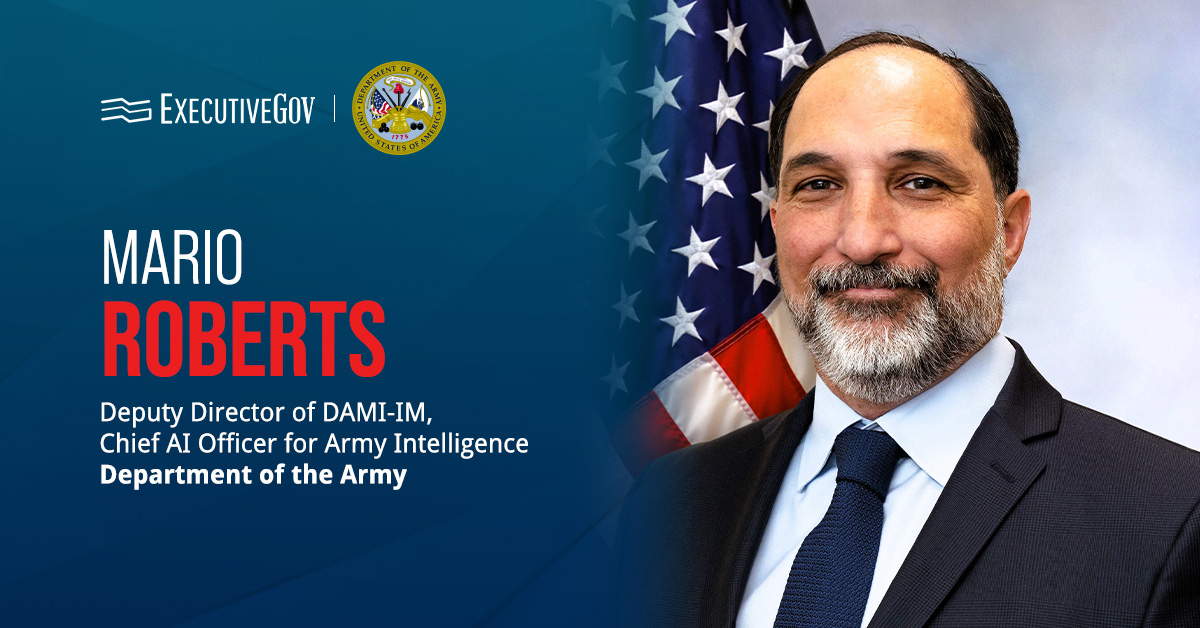
- Mario Roberts said the Army is undergoing a turbulent transition period as it adopts AI
- Deploying AI at the tactical edge requires a different approach than enterprise AI
- Roberts joins military and industry experts at one of the AI panels at the 2026 Intel Summit on Sept. 24
In line with department-wide and executive mandates, the U.S. Army is accelerating the adoption of artificial intelligence, but Mario Roberts, chief AI officer for Army Intelligence, does not think the current workforce fully understands how to employ the technology effectively yet.
In an interview with FedScoop, Roberts explained that the Army is undergoing a transition period he described as turbulent and “a little bit messy” as the service expands its use of AI.

Roberts will share more insights about the challenges of deploying AI for military intelligence during the Agentic AI Across Mission and Enterprise: From Pilot to Production at the Decision Edge panel at the 2026 Intel Summit on Sept. 24. The panel will explore the requirements and risks associated with deploying agentic AI at the edge and how the technology can compress decision cycles. Sign up today to be part of the conversation!
What AI Skills Does the Army Need?
The Army CAIO pointed specifically to the back-end work that makes deployed models function as intended: managing data centers, fine-tuning and training models, and deploying and scaling the technology across an ecosystem. Roberts said the skillset does not yet exist in the Army workforce. He also pointed out that reskilling and retraining do not build expertise.
“It takes time to cultivate and develop [a] workforce to where you know you have a full understanding of how AI operates and works today,” he stated.
The IT, cyber, and network skillsets that people have been accustomed to over the past decades are not being pushed away, he clarified, but they are being overshadowed by the demands of AI and the need to leverage the technology in the workforce.
Roberts noted that, nowadays, everyone wants to move quickly and integrate AI into workflows, even without a clear understanding of how things will operate, which can lead to mistakes. He was candid that the Army recently deployed AI using an approach that the service later realized was not appropriate for that specific model. However, missteps should not prevent efforts to deploy AI.
“Without moving quickly, […] without employing AI models, without embracing or scaling AI to the formations, you’re not going to learn and grow,” he stated.
Roberts has a proven track record of building a workforce to meet the requirements of an emerging capability. He previously served as Army cybersecurity chief for the Office of the Deputy Chief of Staff, Intelligence (G2), and was responsible for preparing service personnel for cloud migration.
He revealed in a 2018 interview with Defense One that the Army did not have a military occupational specialty for cloud computing. To address the gap, he said he sent out IT staff for training and certifications to understand how platforms like Microsoft Azure work.
How Do Enterprise and Tactical Edge AI Deployments Differ?
The Army is undertaking the challenge of deploying AI not just in offices and garrisons but also at the tactical edge to support commanders and warfighters.
He explained that applying AI to meet operational needs requires a fundamentally different approach than deploying it for staff-like functions, such as finance, resourcing and even policy writing. According to the official, it is much faster to take an AI out of the box, scale it and get a return on investment for staff functions than at the tactical edge, where it has to learn imagery, translation and other critical capabilities.
“Here in garrison, I can deploy [AI] in the cloud very quickly [and] scale very quickly, not an issue,” Roberts said. “As you start to work your way down on the operational [level], down the echelons, it becomes a challenge. The things I deploy today in the cloud, I can’t deploy at the edge.”
How Is the Army Deploying AI for Intelligence?
One AI-powered capability that the Army is pursuing is the Tactical Intelligence Targeting Access Node, or TITAN, an intelligence, surveillance and reconnaissance ground station. TITAN uses AI and machine learning to rapidly process sensor data, supporting targeting and situational awareness.
The program, managed by the Capability Program Executive for Intelligence and Spectrum Warfare, recently moved to the production phase. The Army awarded Palantir Technologies and Anduril Industries delivery orders valued at a total of $192 million for the procurement and integration of eight initial production systems of TITAN Advanced and TITAN Basic variants. The systems are scheduled to be delivered over the next 18 months.
What Is Mario Roberts’ Role at DAMI-IM?
In addition to his role as CAIO, Roberts serves as deputy director of the Department of the Army Military Intelligence – Information Management, or DAMI-IM, Directorate.
DAMI-IM, which operates within the Army Department’s headquarters, is responsible for providing IT, information management and information assurance systems in support of Army intelligence efforts. The directorate also ensures that Army G-2 personnel have the appropriate levels of information assurance awareness, training and certification.
Where to Hear About AI Use for Military Intelligence
The Potomac Officers Club’s 2026 Intel Summit on Sept. 24 is the prime destination to hear more about how the military is leveraging AI to support intelligence missions. Leaders from the War Department will be present to discuss plans and future initiatives to deploy AI within the enterprise and at the tactical edge.
Maj. Gen. Brian Sidari, deputy chief of space operations for intelligence at the Space Force, will deliver a keynote speech at the event. Other DOW leaders at the event include:
- Erik Blasch, program officer at the Air Force Office of Scientific Research
- Maj. Gen. Mark Cunningham, director of intelligence at the U.S. Marine Corps
- Stephen Pierce, director of Naval Intelligence Activity N3
This is a rare opportunity to engage with military intelligence leaders and gain insights about upcoming AI initiatives at DOW! Get your tickets before it’s too late!