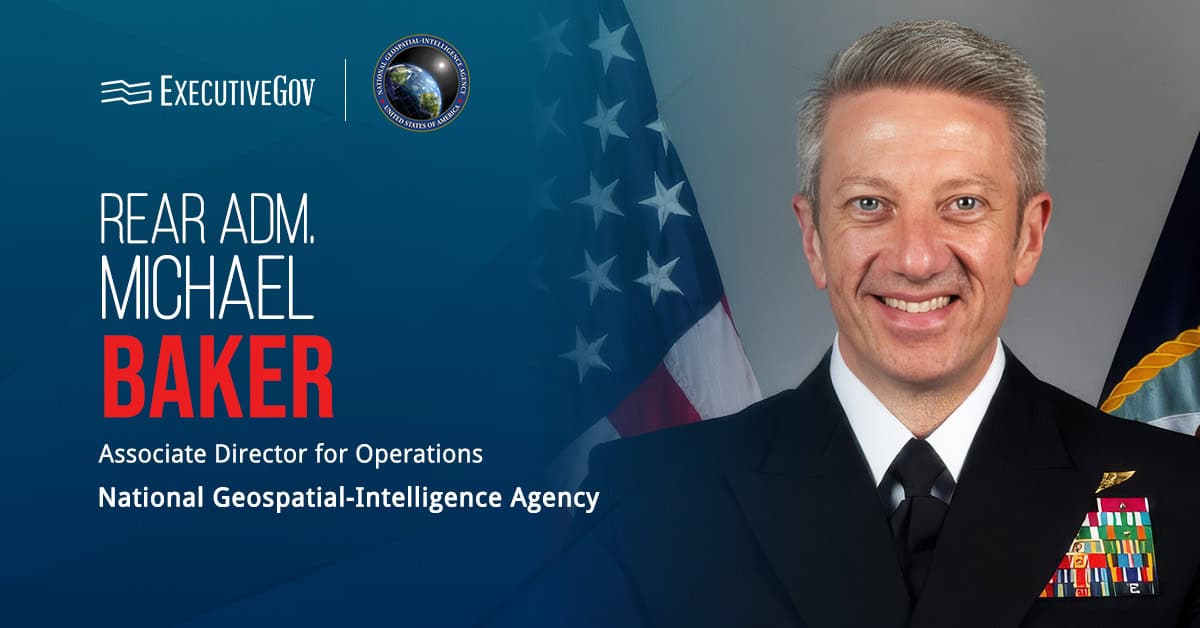
- NGA has required AI proficiency and expanded training across its workforce
- Rear Adm. Michael Baker has outlined AI agent applications in training and intelligence workflows
- The 2026 Intel Summit will explore AI, cyber and data modernization
Navy Rear Adm. Michael Baker, associate director for operations at the National Geospatial-Intelligence Agency, said every new hire has been required to demonstrate artificial intelligence and data management capability, and that the requirement also applies to current employees across NGA, Nextgov/FCW reported Wednesday.

As intelligence agencies accelerate AI adoption in geospatial intelligence and enterprise systems, government and industry leaders will also gather at the Potomac Officers Club’s 2026 Intel Summit on Sept. 24. The event will focus on data, AI, cyber capabilities and secure information-sharing as agencies modernize while operating under tighter fiscal constraints. Reserve your spot now!
“Every single old hire has to go through AI training and data management so that all of us are operating inside of the reality of what this ecosystem is,” Baker said Tuesday at the Defense One Tech Summit.
What Did Navy Rear Adm. Michael Baker Say About AI Agents?
Baker noted that AI agents are already being used in his workflow and could evolve into tools that support training and decision-making.
“And a real ideal is, in the future, that agent is also helping to train me,” Baker said. “We’re working together as we go back and forth to think through a problem.”
He said AI agents could eventually support strategic planning and intelligence risk assessment while emphasizing the need to balance innovation with security and operational stability.
How Does the AI Skills Requirement Align With NGA’s Efforts to Advance AI?
NGA’s workforcewide AI skills requirement aligns with broader agency initiatives to advance AI adoption.
In 2025, NGA announced efforts to establish AI standards to manage an expected surge in space-based sensor data and implemented a standardized disclosure for AI-generated intelligence products.
The agency initiated efforts to advance the rollout of generative AI to support geospatial data analysis and deliver accurate intelligence to decision-makers.