
- The U.S. Army, Navy and Space Force have tested a rapid deployment, low-signature emitter called Hammer of the Gods at Project Convergence Capstone 6
- The experiment focused on positioning, navigation, and timing capabilities of the maritime emitter variant
- The test marks the first time Hammer of the Gods was tested at sea
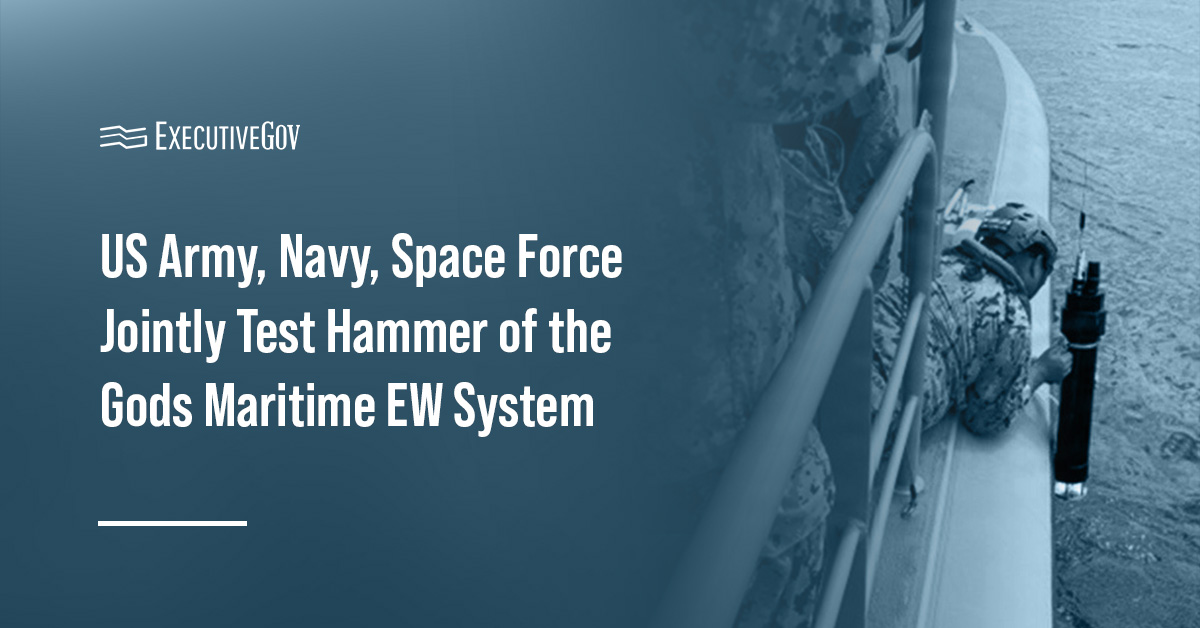
The U.S. Army, Navy and Space Force have conducted joint experimentation with an electronic warfare platform known as Hammer of the Gods, according to a Defense Visual Information Distribution Service article published on Friday.
Hammer of the Gods, a deployable, low-signature emitter, was tested during Project Convergence Capstone 6 at Fort Irwin, California, marking the technology’s first at-sea evaluation.

Connect with U.S. Army and Space Force officials at the 2026 Air and Space Summit on July 30. Experts will discuss programs such as Collaborative Combat Aircraft and space situational awareness. Grab the last few seats here!
What Is Hammer of the Gods?
Hammer of the Gods is an electronic warfare system built for rapid deployment, combining an expanded range of command-and-control and operational functions while keeping its electromagnetic footprint low. The platform is designed to project effects across multiple domains in military operations. While land-based configurations of the system have appeared in exercises over the past two years, the maritime variant was introduced for the first time in mid-July 2026 as part of PC-C6.
What Was the Focus of the Hammer of the Gods Experimentation?
A central focus of the PC-C6 experiment was positioning, navigation, and timing, the set of capabilities that allow forces to navigate, synchronize communications and guide precision weapons. Lt. Col. Darrin Hall, chief of modeling, simulation and integration for U.S. Space Forces Pacific, emphasized that protecting PNT functions is critical to modern combat effectiveness.
“Counter-PNT effects enhances lethality by impacting the backbone for pinpoint targeting via long range artillery, guided missiles, and cruise munitions. Without PNT data, modern weapon precision drops sharply, resulting in delayed missions, missed objectives, or severe collateral damage,” Hall explained.
The demonstration was made possible through support from U.S. Space Forces Pacific and Naval Base San Diego, which worked together to integrate the maritime system into the broader capstone event.