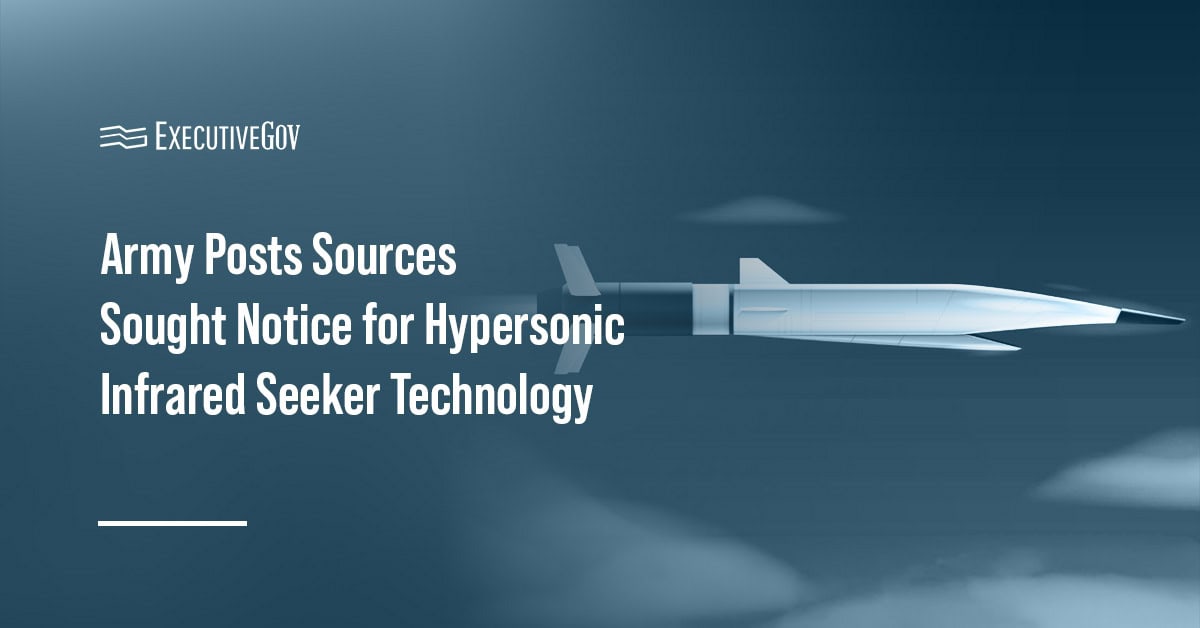
- The Army has posted a sources sought notice HITS-TO to find partners maturing hypersonic infrared seekers
- No funding is available; respondents must finance their part of the collaboration
- Technical capability statements are due by 4 p.m. ET on Sept. 30.
The U.S. Army is gathering industry insight on hypersonic infrared target sensing technology under an effort called the Hypersonic Infrared Target Sensing – Transition Opportunity, or HITS-TO.
According to the notice posted Thursday, the Army’s ACC-APG Durham office is conducting the effort as a sources sought notice rather than a funded solicitation. This means no funding is available. The service is evaluating capabilities from industry, national laboratories, university-affiliated research centers and federally funded research and development centers that could help place an infrared seeker on a hypersonic weapon.
The effort builds on progress Department of War laboratories have made maturing five hypersonic infrared sensing task areas to a technology and manufacturing readiness level of 3 to 4, though the labs lack the capacity to advance the innovations toward manufacturable systems on their own. The DoW has separately sought prototype sensors for tracking ballistic and hypersonic threats, reflecting a broader departmental push to close gaps in hypersonic sensing technology.
How Can Industry Respond to the HITS-TO Sources Sought Notice?
Interested parties must submit a Technical Capability Summary Statement of no more than six pages addressing one of four technical objectives: imaging and tracking systems, optical materials, test and evaluation or modeling and simulation.
Submissions must be in PDF format following the naming convention HITS-TO#SS[Company Name] and emailed to hits_rfi@army.mil, or transmitted through DoD SAFE for material containing controlled unclassified information. Responses are due no later than 4 p.m. EDT on Sept. 30, 2026.
What Security and Financial Requirements Apply to Interested Partners?
Respondents must verify their ability to handle controlled unclassified information in accordance with NIST SP 800-171 using a current DD Form 2345, state their facility clearance level and confirm that key personnel hold the clearances required for technical discussions.
Only entities capable of performing controlled unclassified or classified work will be considered, and prospective partners must demonstrate their ability to finance their share of the collaboration through internal resources, external sponsorship or jointly developed proposals because the notice does not provide government funding.
What Happens After a Capability Statement Is Selected?
Qualified respondents will be invited to participate in more detailed discussions after signing a nondisclosure agreement, which could lead to a Cooperative Research and Development Agreement. Under 15 U.S.C. § 3710a, a CRADA allows a federal laboratory to share personnel, facilities or intellectual property with a nonfederal partner without transferring funds.
The Army has used similar arrangements before, including a recent CRADA between its research laboratory and Greystones Group to advance AI-enabled data tools, and officials have said such partnerships could eventually lead to funded contracts.