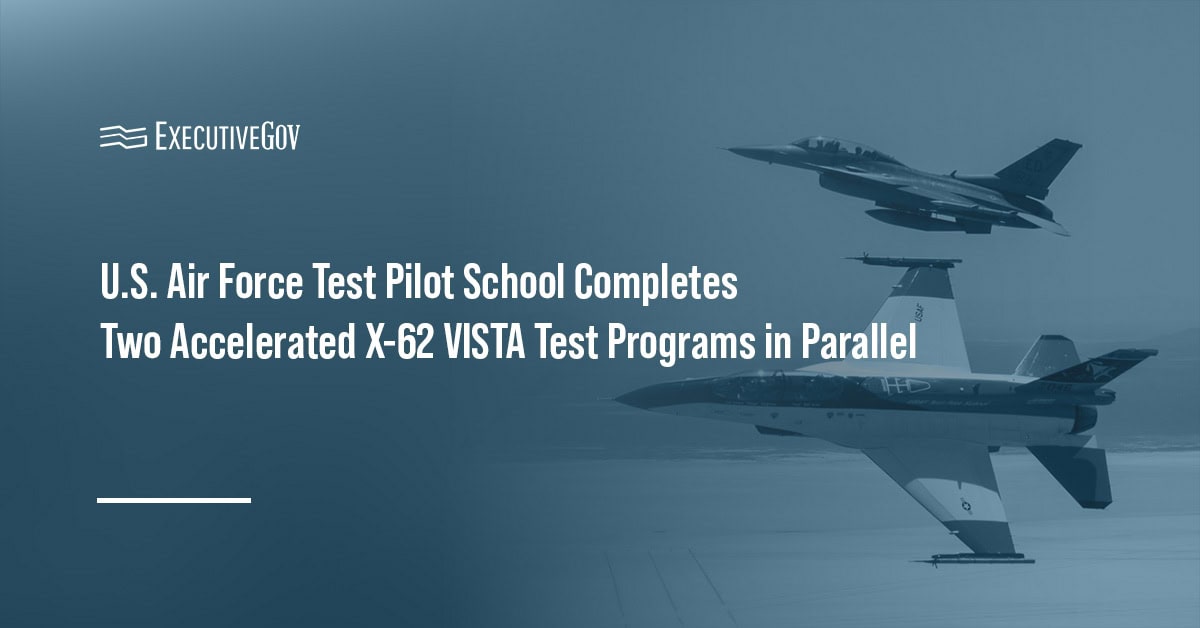
- The U.S. Air Force Test Pilot School has demonstrated the capability of the X-62 VISTA aircraft in the integration of AI in autonomous military technologies
- Two flight test campaigns for the aircraft were completed the Test Resource Management Center’s Mission Systems Upgrades initiative
- One program tested AI-driven sensor-to-vehicle control while the other focused on testing enhanced safety protocols
The Edwards Air Force Base announced Tuesday that the U.S. Air Force Test Pilot School’s Research Division has wrapped up two accelerated flight test campaigns using the X-62 VISTA aircraft, running the efforts in parallel throughout April 2026 even as the platform undergoes planned system upgrades.
The two programs, dubbed HAVE HEAT and HAVE HOLIDAYS, were carried out under the Test Resource Management Center’s X-62 Mission Systems Upgrades initiative and are aimed at speeding the safe integration of artificial intelligence and autonomy technologies for military use.
What Was Demonstrated in the HAVE HEAT and HAVE HOLIDAYS Programs?
The HAVE HEAT program made use of Lockheed Martin’s Infrared Search and Track Legion Pod to show that artificial intelligence agents could process live infrared sensor feeds and use that data to direct the X-62 VISTA to autonomously intercept an airborne target in real time.
Lt. Col. Joshua Strafaccia, dean of faculty for research at the Air Force Test Pilot School, said the program marks a step forward in avionics capability tied to integrated, AI-driven control of multiple sensors and aircraft for mission autonomy.
“This bridges a capability gap and positions us to test advanced autonomy faster,” Strafaccia said.
Running alongside HAVE HEAT, the HAVE HOLIDAYS effort focused on integrating and evaluating a broad set of modular technologies within the X-62’s Enterprise Open Mission System Architecture computer. The work included incorporating a non-prime, third-party autonomous agent onto the aircraft, testing enhanced safety protocols designed to keep autonomous systems from exceeding operator-defined limits.
All ground testing for both programs, conducted by a combined team of military, government and contractor engineers, was completed within three months. According to Edwards Air Force Base, executing HAVE HEAT and HAVE HOLIDAYS simultaneously under compressed timelines demonstrates the X-62 VISTA’s capacity for rapid experimentation and reflects the school’s ability to sustain a high tempo of technology evaluation.
What’s Next for the X-62 Vista Under the Mission Systems Upgrades Initiative?
The next phase of the Mission Systems Upgrades program will focus on the integration of the RTX PhantomStrike radar for additional sensor and computing capacity as well as supporting modern network data communications to the X-62 VISTA. Once complete, the upgrades are expected to position the aircraft as a foundational platform supporting the Air Force’s top-priority programs.
“X-62 is continued proof that an agile, dedicated team can rapidly advance Department of War initiatives through intentional collaboration,” said Col. Maryann Karlen, commandant of the Air Force Test Pilot School. “Accomplishing these significant milestones is a direct reflection of the adaptability and warfighter focus personified by all members of the school,” she said.