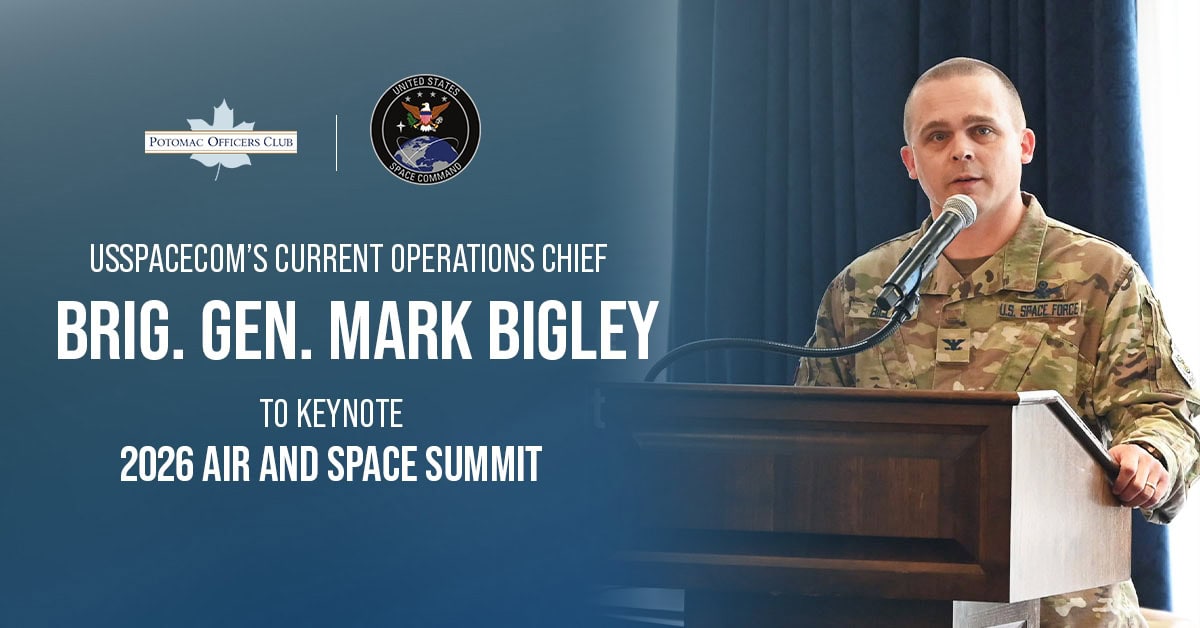
- Brig. Gen. Mark Bigley, present chief of USSPACECOM’s Current Operations Division and former Space Delta 9 commander, will keynote the 2026 Air and Space Summit on July 30
- Bigley’s career spans space warfare and space situational awareness, making him best-suited to talk about orbital threats, the great power competition and space capabilities
- Register today to hear from Bigley and other leaders from the Air Force, the Space Force and NASA
Space Force Brig. Gen. Mark Bigley, chief of the Current Operations Division of the U.S. Space Command, will deliver the mid-afternoon keynote at the Potomac Officers Club’s 2026 Air and Space Summit on July 30.
He will join an esteemed lineup of keynote speakers set to headline the summit, including:
- Tom Ainsworth, acting assistant secretary of the Air Force for space acquisition and integration
- Matt Anderson, deputy administrator at NASA
- Anthony Baity, assistant deputy chief of staff for logistics, engineering and force protection at the Air Force
- Gen. John Lamontagne, vice chief of staff of the Air Force
- Dr. Eliahu Niewood, director of studies and analysis and director of the Integrated Capabilities Office at the Air Force

The 2026 Air and Space Summit is an essential forum where leaders from the Air and Space Forces, NASA and other agencies will sit down with industry innovators to discuss the challenges that warfighters face in an increasingly high-tech, multi-domain battlefield. As space grows more consequential as a warfighting domain, with adversaries advancing counterspace capabilities, senior officials from the Air Force and the Space Force will join the summit to share insights into the warfighting strategies and capabilities needed to maintain America’s advantage in orbit. Get your tickets for this highly anticipated event today!
Who Is Mark Bigley?
Before his current role, Bigley served as the second-ever commander of Space Delta 9, the Space Force’s component for deterring and defeating orbital threats. He succeeded Col. Casey Beard, who now serves as deputy commander of the Space Force’s Combat Forces Command.
In the role, he led three active duty squadrons and one operational detachment at Schriever Space Force Base in Colorado.
Bigley also previously commanded the 1st Space Operations Squadron, which provides space situational awareness support. The squadron operates the Operationally Responsive Space 5, a constellation for monitoring satellites in geosynchronous orbit, and the Geosynchronous Space Situational Awareness Program.
Earlier in his career, he served as a combat crew commander for the U.S. Air Force’s 741st Missile Squadron.
What Has Mark Bigley’s Career Focused On?
Space Warfare
Bigley is an expert in space warfare, with a career built around protecting and defending U.S. assets in orbit. From leading Space Delta 9 to his current role at USSPACECOM, he has firsthand insight into how the U.S. detects, tracks and counters adversarial space activity.
His career reflects the broader shift within the U.S. military toward treating orbit as a warfighting domain that requires constant vigilance and rapid response.
Lt. Gen. Douglas Schiess, who is nominated to be the next chief of space operations at the Space Force, said during his confirmation via MilitaryTimes that space would be at the forefront of a major conflict with adversaries.
Orbital Asset Defense
Bigley has previously spoken about the threats in orbit, warning that the Space Force must be ready to respond to adversarial activities that may disrupt the delivery of critical space-based services. He noted, in an interview with Defense One in 2023, that Russia and China have demonstrated technologies that can destroy U.S. and allied assets in orbit.
For instance, Russia tested a hit-to-kill anti-satellite system in 2021, creating thousands of pieces of orbital debris.
“And disruption is just at the low end. At the high end, a war that extends into space would be damaging to the way that the United States uses space and the way the rest of the world relies on space,” he warned.
Space Situational Awareness
In the same interview, he emphasized the importance of space domain awareness and of gaining a full picture of other nations’ activities and capabilities in orbit that may threaten U.S. space assets and operations.
“As we’ve seen them demonstrate those capabilities, [that] has given us some insight into what those countries’ systems are capable of and understanding how we may have to protect and defend against those in the future,” Bigley stated.
Reflecting the importance of monitoring activities in space, the Space Force has allocated $1.37 billion toward space domain awareness research and development in its fiscal 2027 budget request.
What Will Mark Bigley Discuss in His 2026 Air and Space Summit Keynote?
Bigley’s keynote at the 2026 Air and Space Summit will provide GovCons with insights into space as an increasingly contested domain. Drawing from his experience leading USSPACECOM’s Current Operations Division and Space Delta 9, he is expected to address:
- Great power competition in orbit: Great power competition has extended into the space domain, with rival nations increasingly developing capabilities designed to track, target and disable satellites that support military and civilian operations.
- Space domain awareness as a force multiplier: The importance of technologies that enable the joint force to distinguish between routine operations and potential threats and give commanders information needed to respond quickly.
- Delivery of space capabilities: The U.S. Space Command’s responsibility for delivering space capabilities to joint and combined forces while protecting and defending the space domain
- Budget and investment priorities: Commentary about the Space Force’s FY27 budget request and how the funding may impact USSPACECOM’s mission
Bigley’s firsthand experience commanding units tasked with satellite defense and space domain awareness positions him to speak candidly about where current systems fall short and where industry can step in. His keynote may reveal specific capability gaps, positioning attendees to be better prepared to respond to the U.S. military’s near-term and long-term requirements.
The event will also convene the leading innovators from the space industry. Representatives from Amazon Web Services, AT&T, Exiger, Intel Government Technologies, Kepler Communications, Nightwing, OMNI, Planet Labs, SAIC, SES Space & Defense, Ultra I&C and Vantor will join panels on the Golden Dome initiative, accelerating sensor-to-decision timelines and capability delivery, NASA’s transition to commercial relay infrastructure, deploying AI/ML on the tactical edge, and more!
Sign up today to engage with and gain insights from the top voices in the air and space domains!