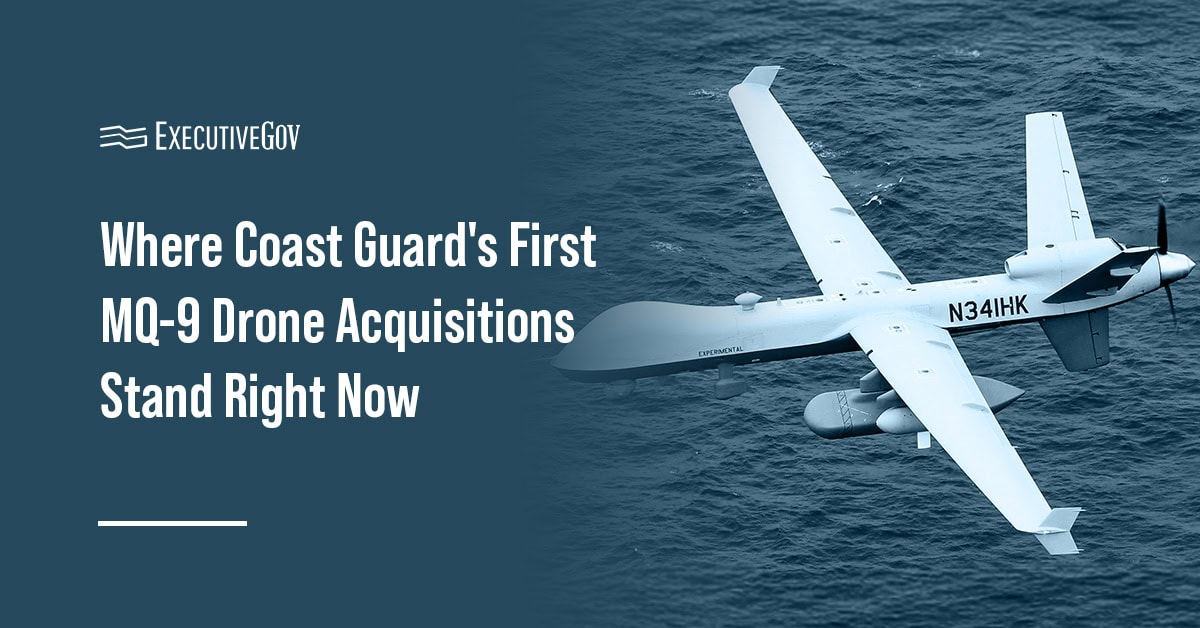
- Coast Guard evaluating its first organic MQ-9 fleet under a $266 million reconciliation buy
- Congress capped the eventual program at six unarmed drones, barring missile integration
- Unmanned systems will be a headline topic at POC’s Nov. 10 Homeland Security Summit
The Coast Guard’s push to fly its own long-range MQ-9 drones for the first time has moved well past the funding-announcement stage, with Congress now setting firm guardrails around the program even as the service works to finalize its own acquisition.
DHS Deputy Secretary Troy Edgar, Chief Procurement Officer Paul Courtney (pending confirmation) and a slew of tech and program leadership from across the Department of Homeland Security will take the stage at Potomac Officers Club’s 2026 Homeland Security Summit on Nov. 10. This is a critical meeting place for the industrial base supporting DHS efforts. Make sure you attend to join the conversation on drones, unmanned tech and beyond.
How Did the MQ-9 Program Start?
The Coast Guard first disclosed plans to buy its own MQ-9 Alpha long-range unmanned aerial systems in September 2025, when Lt. Cmdr. Steve Roth said about $266 million of the nearly $25 billion the service received through the One Big Beautiful Bill Act would fund the purchase, according to Military Times, which first reported the buy. At roughly $57 million per aircraft, the money could take the Coast Guard’s inventory from zero to as many as four unarmed drones.
“That’s ions of improvement on the way we’ve been doing it with manned aviation,” Lt. Cmdr. Andrew Denning, the Coast Guard’s long-range drone program manager, said at the time, contrasting the MQ-9’s roughly 24-hour endurance with the Coast Guard’s C-130 patrols (about 14 hours) and the Navy’s P-8 Poseidon flights (up to 10 hours).
Where Does the Program Stand Now?
By January 2026, lawmakers writing a compromise Homeland Security spending bill had confirmed the reconciliation funds would buy four MQ-9B drones and added a provision explicitly barring DHS from arming them with missiles, Roll Call reported. A pending fiscal 2026 DHS funding bill would bankroll two more MQ-9Bs for $98 million, bringing the potential fleet to six — all unarmed, in contrast to the Pentagon’s missile-capable MQ-9A Reapers.
“These aircraft provide a cost-effective platform to improve high-seas interdiction and maritime rescue,” the House report accompanying the bill said, adding that long-range drones could eventually take over the Coast Guard’s iceberg-patrol duties in the North Atlantic.
The Coast Guard’s own contract hasn’t landed yet, however. Rear Adm. David Barata, the service’s deputy commandant for operations policy, told a House Transportation and Infrastructure subcommittee in December that the Coast Guard was still “evaluating new long-range drones and supporting infrastructure” and intended to “execute those funds expeditiously.”
The nearest signal of momentum sits one agency over, but still within DHS: General Atomics secured a $265.5 million contract modification from U.S. Customs and Border Protection in March for additional MQ-9B aircraft, spares and upgrades to the shared San Angelo, Texas program the Coast Guard has flown alongside CBP since the mid-2000s — evidence the broader DHS MQ-9B enterprise is scaling even as the Coast Guard’s dedicated buy works through evaluation.
Where Does Counter-UAS Fit In?
The MQ-9 buy sits inside a wider unmanned systems build-out under the Coast Guard’s Force Design 2028 plan, run through a new robotics and autonomous systems program executive office. Earlier this year, that office surged mobile counter-drone teams to high-security domestic events, including the 2026 FIFA World Cup and America 250 celebrations, funded by a separate $150 million in reconciliation dollars.
“The Coast Guard is far more focused on a home game,” Capt. Roberto Herrera, who oversees the robotics PEO’s surface and underwater portfolios, said of that mission.
Staffing both efforts is its own challenge — the Coast Guard is cross-training traditional enlisted rates into a new robotics mission specialist rating, targeting 2,000 to 3,000 personnel as the service grows by 15,000 people over two years.
It’s exactly the kind of platform coordination and workforce build-out that anchors two 2026 Homeland Security Summit sessions: Safeguarding the Homeland: Coordination for Counter-UAS Operations, where CBP’s C-UAS Defense Capability Group executive director, Tony Crane, joins Mary Rupert of LMI, Christopher Ling of Ericsson Federal and Cathy Lanier of the NFL; and the Code and Drones: DHS’s Parallel Fights to Build Cyber Talent and Field Unmanned Systems lunch panel, featuring Dave Abel of Protora, Yusuf Abdul-Salaam of Xpect Solutions and John Woods of CACI.
Why Attend the 2026 Homeland Security Summit?
Beyond drones, the premier DHS summit‘s lineup tracks the same ground shaping DHS’s tech investment priorities:
- Modernizing the Homeland Security Mission: Edge Capabilities for the Border and National Events, with Kris Levin-Snow of AT&T.
- Our Soil, Our Rules: Public-Private Collaboration on Security in Lead-Up to LA28, moderated by Chris Casey of T-Mobile — a natural extension of the Coast Guard’s World Cup and America 250 counter-drone work.
- Mission Confidence — Building Trust in Homeland Security Technologies, with Bob Kolasky of Exiger and Christine Palmer of Peraton.
For contractors tracking where DHS is directing reconciliation dollars and drone-program growth, the 2026 Homeland Security Summit offers a direct line to the officials and industry leads shaping those decisions. Don’t miss this key networking and business enablement opportunity—register now!