- The Air Force has conducted AI-enabled battle management tests during its Decision Advantage Sprint for Human-Machine Teaming, or DASH, experiments
- In 2025 DASH experiments, AI systems generated over 6,000 solutions to 20 battlefield problems
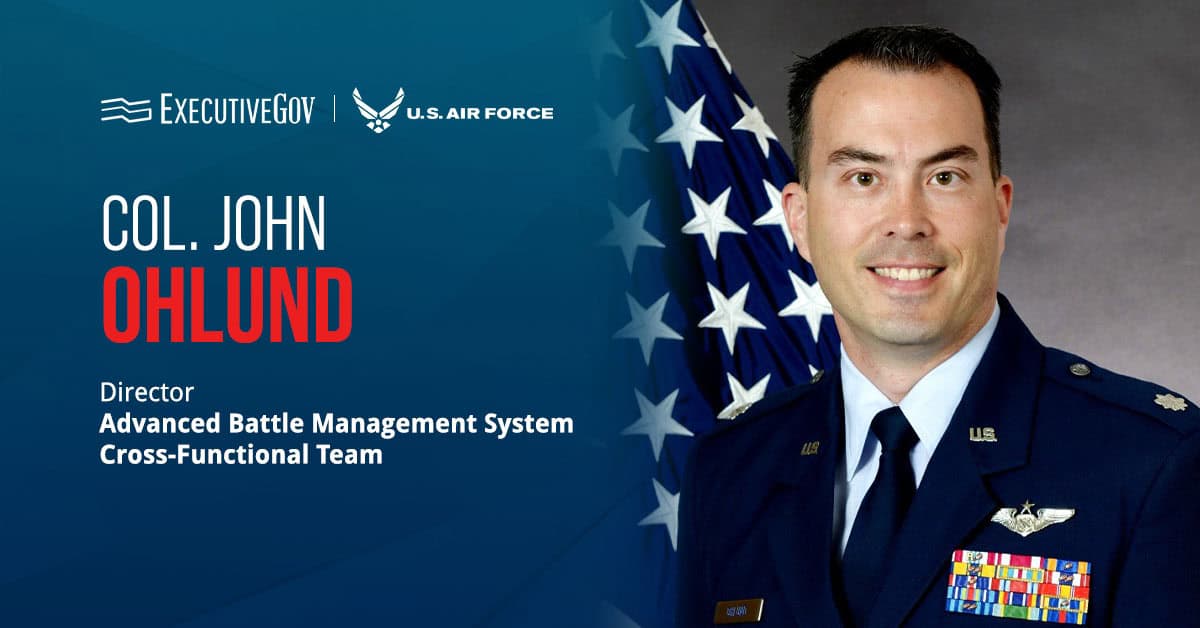
- Air Force Col. John Ohlund, director of the ABMS CFT, will further discuss the use of AI in warfighting at the 2026 Air and Space Summit on July 30
The U.S. Air Force is placing artificial intelligence on the front lines of battle management to aid commanders in making faster and more accurate decisions.
The service has been experimenting with AI-enabled battle management through its Decision Advantage Sprint for Human-Machine Teaming, or DASH, a series of wargames held in 2025. Led by the 805th Combat Training Squadron and the Advanced Battle Management System Cross Functional Team, DASH is intended to enhance the DAF Battle Network, the Air Force’s contribution to the Department of War’s Combined Joint All-Domain Command and Control, also known as CJADC2.

Join Col. John Ohlund, director of the ABMS CFT, at the 2026 Air and Space Summit on July 30. Ohlund will discuss AI deployment on the tactical edge on the From Data to Decision: Advancing Multi-Level Security With AI/ML for the Modern Warfighter panel alongside other Air Force leaders and industry representatives. Tickets are now available here.
How Is the Air Force Applying AI in Battle Management?
Generate Battle Courses of Action
One of the primary ways the Air Force wants to use AI is by generating courses of action, or COAs, to guide commanders’ response to threats.
In a DefenseScoop report published in August, Col. John Ohlund, director of the ABMS CFT, shared that two vendor systems generated over 6,000 solutions to 20 problems in one hour and ranked each recommendation based on the situation and the commanders’ intent
“Our initial insights show the machines made recommendations 16-fold faster, and a 30-fold increase in the quantity of solutions,” the official revealed.
Ohlund also commented in an Air Force press release that the volume of output ensures that commanders will have options to execute multiple kill chains simultaneously.
Reduce Personnel Cognitive Load
The experiment involved using AI-enabled microservices built by the industry to shift cognitive load from humans to machines. For DASH 2, coders developed a microservice for a function known as match effectors, or deciding what available weapon system to use to eliminate a target.
According to Capt. Steven Mohan, chief of standards evaluations for the 729th Air Control Squadron, the process of identifying the most suitable platform to use against a threat takes time.
“As we get into the more complicated tasks, I am not saying, ‘Okay, I want a bomb on this airplane.’ It is, ‘I need this weapon on this airplane, plus another weapon on another airplane, plus an intelligence aircraft that is providing support, plus I need a data link.’ Finding all of those effects together takes time, and it is a very slow process.”
An AI-enabled microservice can lighten the cognitive load for battle managers by ingesting battlefield data and ranking available effectors. In most cases, the AI provided the reasoning behind the ranking to better support decision-making, Senior Airman Besner Carranza of the 729th Air Control Squadron added.
Faster Decision-Making
The Air Force reported that AI has outperformed humans in terms of speed and in other aspects of battle management planning during the DASH experiments. In one test, military personnel from the U.S., Canada and the United Kingdom competed against industry-made AI tools to solve hypothetical combat management problems.
The service found that AI systems generated recommendations 90 percent faster than humans, with 97 percent viability and tactical validity, National Interest reported. For comparison, the human participants took an average of 19 minutes to generate COAs with 48 percent viability and tactical validity.
Ohlund said the “dramatic reduction in time and improvement in the quality of solutions” demonstrated during the test shows how AI can support decision-making while ensuring that humans still make the final decisions on the battlefield.
Can AI Be Trusted in Battlefield Decision-Making?
According to the Air Force, the DASH experiments also focused on testing the operational effectiveness of AI systems, and part of the effort aimed to address the risk of so-called AI hallucinations, or when the technology produces incorrect outputs. The systems used in the experiments were specifically designed to reduce hallucinations, the service said.
Ohlund shared that no AI hallucinations were observed during the experiments.
Participants also reported increased confidence in AI following the sprint. One service member revealed initial skepticism about the role of AI in decision-making, but they eventually saw that the systems were not intended to replace human decision-makers. Rather, the technology generated starting points that operators can build on.
Who Is John Ohlund?
Ohlund has served as director of the ABMS CFT since June 2025. Before his current role, he commanded the 805th Combat Training Squadron, according to his profile on LinkedIn. Earlier assignments include assistant director of operations for the 621st Air Control Squadron and operations officer for the Cruise Missile Support Activity-Atlantic.
He also served as an air battle manager instructor with the USAF Weapons School, 325th Air Control Squadron and 964th Airborne Air Control Squadron earlier in his career.
Ohlund holds a bachelor’s degree in aerospace, aeronautical and astronautical engineering from Embry-Riddle Aeronautical University and a master’s degree in international relations and national security from American Military University.
Defense Leaders to Discuss Military AI at the 2026 Air and Space Summit
Ohlund will further discuss the increasing role of AI in warfighting in the From Data to Decision: Advancing Multi-Level Security With AI/ML for the Modern Warfighter panel at the 2026 Air and Space Summit on July 30. The panel will evaluate the challenges and opportunities of using AI for threat analysis at the tactical edge.
Joining Ohlund in the panel are:
- Steven Butow, senior adviser to the director and executive committee member at the Defense Innovation Unit
- Randy Fields, chief technology officer at Ultra I&C
- Ilya Levtov, CEO of Craft
- Dr. Merrick Watchorn, chief cyber, quantum and cognitive information services architect at the Air Force (pending confirmation)
Other summit speakers from the Air Force include:
- Gen. John Lamontagne, vice chief of staff
- Anthony Baity, assistant deputy chief of staff for logistics, engineering and force protection
- Eliahu Niewood, director of the Integrated Capabilities Office
- Dr. Robert Antypas, space access mobility and logistics mission area lead at the Air Force Research Laboratory
- More will be announced in the coming weeks!
The 2026 Air and Space Summit on July 30 is an important forum where leaders from the Air and Space Forces and industry will exchange insights and discuss opportunities about the emerging defense capabilities warfighters need to combat evolving threats. Book your spot today!