
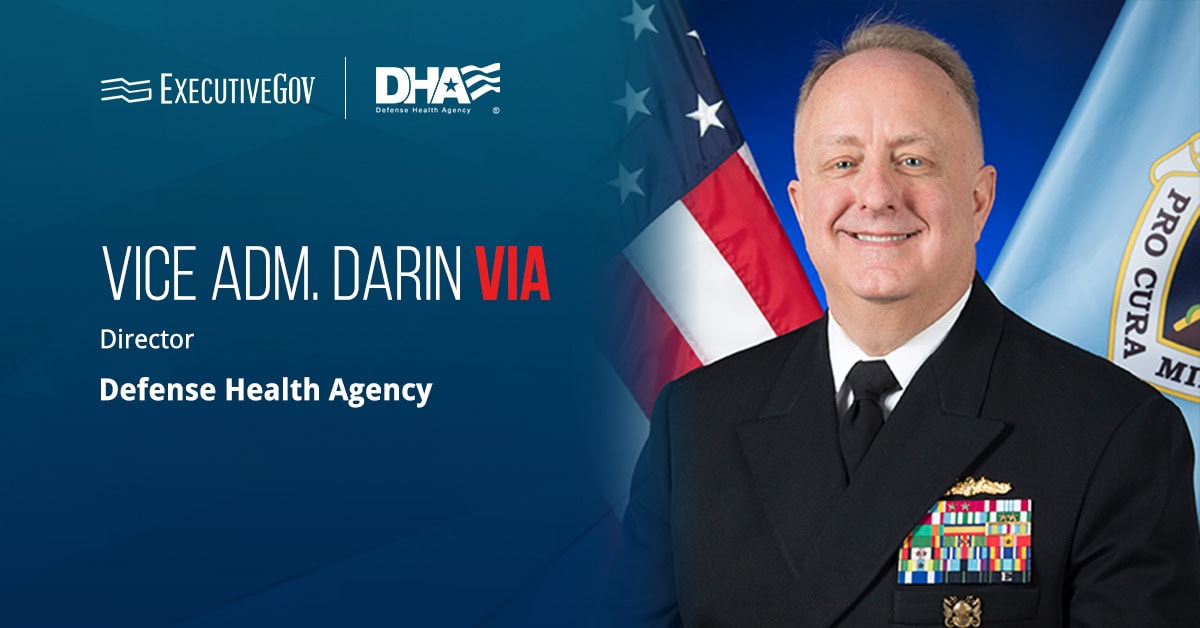
- Defense Health Agency officials led by Vice Adm. Darin Via have outlined strategies toward a data-driven health IT enterprise
- Via said that they plan to accelerate acquisition of commercial technologies that provide measurable outcomes
- DHA officials including Chief Data and Analytics Officer Jesus Caban backed Via’s vision for military healthcare
Vice Adm. Darin Via, director of the Defense Health Agency, has laid out a vision for turning military medicine into a faster, more connected and technology-driven enterprise, the agency reported Thursday.
“I believe the Military Health System can be the most advanced health system in the world, and my interest is in taking actions every day that move us in that direction,” Via said Tuesday during a symposium in New Orleans. “We have an obligation … to be on the front edge of medicine,” he added.

DHA officials and other federal health leaders are converging on December 3 to reveal their FY27 contracting priorities and modernization plans. Register now for the 2026 Healthcare Summit to hear directly from senior officials shaping billions in health IT, artificial intelligence and access initiatives.
What Is Via’s Vision for the DHA’s Health IT Enterprise?
Via tied his remarks to four strategic priorities aimed at building a faster, better-connected health IT system capable of converting medical data into actionable decisions that support joint warfighting operations. He pointed to AI, drone technology and the proliferation of sensors as forces reshaping the battlefield.
According to Via, the DHA already possesses vast amounts of data, but that information is often trapped in disconnected systems rather than structured to produce results. He called for consolidating that data and delivering it directly to providers, medics, corpsmen and other medical personnel to keep them prepared to support service members. Via described the effort to capture, move and secure data more quickly as central to the department’s mission. He characterized it as “a warfighting function … not just a support function.”
Via said the DHA intends to shift its approach to acquiring technology, placing greater emphasis on measurable outcomes rather than specific products. To speed adoption of new technology in support of warfighter health needs, Via said the DHA plans to pursue commercial technologies through a faster acquisition process. He argued that if the agency aims to be recognized as the world’s leading health system, it must support that goal with integrated technology systems that give service members a genuine advantage.
Via also described a shift toward proactive care aimed at identifying and preventing serious illness before it progresses, rather than focusing primarily on treatment after diagnosis. He pointed to precision treatments, genetic testing, early detection tools and nanotechnology as capabilities that will define the next generation of military healthcare, calling that future within reach.
What Did Other DHA Officials Say to Support Via’s Remarks?
Via’s data-driven strategy for the DHA was backed by other agency officials attending the symposium. Rear Adm. Tracy Farrill, director of the agency’s newly formed Office of Warfighter Health Advantage and past speaker at the Potomac Officers Club’s 2025 Healthcare Summit, said that the office will steward the agency’s data-driven decision-making, performance optimization and innovation efforts. “We’ve assembled a corps of experts to include strategy, data and analytics, health informatics, and digital platforms with the goal of increased, cross-functional collaboration to ensure synergy across planning, development, and execution,” Farrill explained.
DHA Chief Data and Analytics Officer Jesus Caban, who also spoke at the 2025 Healthcare Summit, added that people, not technology alone, will determine whether the agency’s modernization efforts succeed. He noted that even the most advanced tools and models depend on a capable workforce to drive change.
Caban discussed how artificial intelligence could deliver innovative technologies for military medicine, while cautioning that AI should support rather than substitute for human decision-making.
“The Department of War’s AI strategy is very clear — we will become an AI-first workforce across all domains,” he said. “But AI-first does not mean AI-only or AI-dependent … human accountability, clinical judgments, security, privacy, and mission continuity are preserved in every AI-enabled process, and mission-critical functions retain the human proficiency and fallback.”