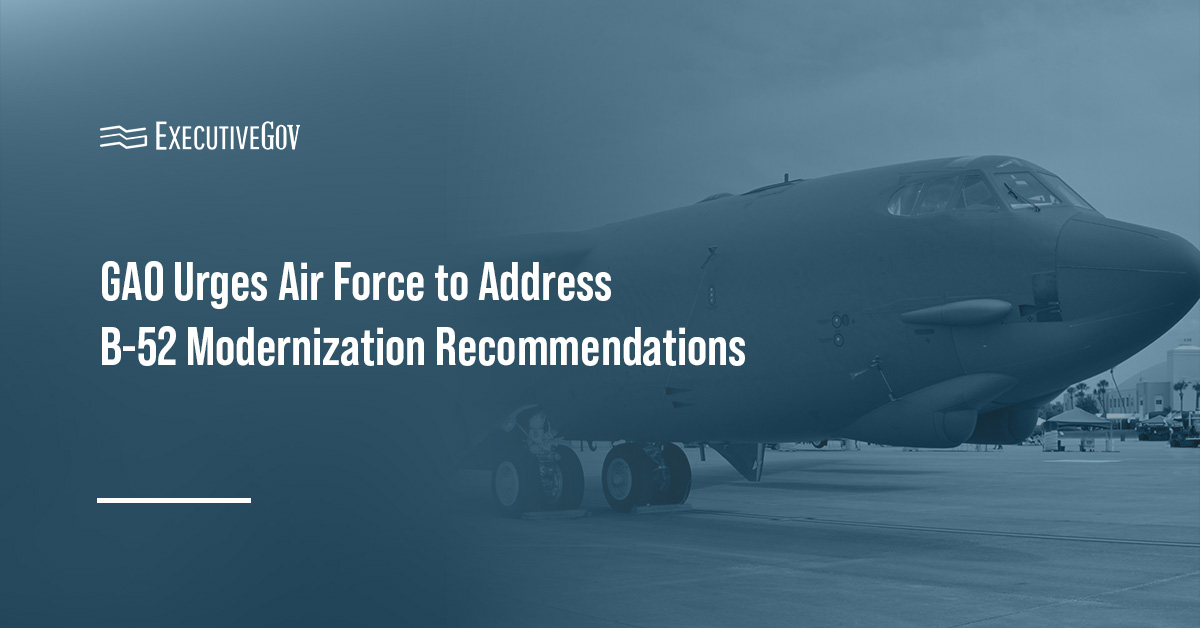
- GAO issued six recommendations to improve B-52 modernization planning and management
- The Air Force fully concurred with five recommendations and partially concurred with one
- GAO recommended delaying the CERP production decision until cost and schedule risks are reassessed
The Government Accountability Office has found that most of the Air Force's efforts to modernize its B-52 Stratofortress fleet are running into cost, schedule or performance problems, including a risk that the service's costliest engine replacement program will begin production before completing critical flight testing.
The report, issued Friday, examines 13 ongoing modernization programs that together make up an estimated $21 billion investment meant to keep the bomber flying into the 2050s.
What Are GAO's Recommendations to the Air Force?
GAO's first recommendation calls on the secretary of the Air Force to delay the Commercial Engine Replacement Program's—or CERP—production decision until the program office completes an analysis accounting for recent cost growth and schedule delays. The engine program, the costliest of the 13 modernization efforts, plans to begin production around the same time developmental flight testing begins — an overlap GAO said increases cost, schedule and performance risk.
A second recommendation directs the program office to assess the practicality, benefits and affordability of digital engineering tools such as digital twins across current modernization efforts. Three more recommendations call for updating the B-52 Platform Integration Plan to prioritize programs and align them with strategic goals and for revising B-52 repair plans to account for potential modernization delays.
A sixth recommendation asks the Air Force to issue guidance clarifying which organization is responsible for the lifecycle management of B-52-specific support equipment.
How Has the Air Force Responded to GAO's Recommendations?
The Air Force fully concurred with five of GAO's six recommendations and partially concurred with the recommendation to delay the CERP production decision. In written comments, the service said its acquisition executive has already assessed and will continue to balance engine program costs, schedule and concurrency risks against projected declines in fleetwide aircraft availability tied to the current TF33 engines.
The Air Force acknowledged the value of conducting the analysis GAO recommended but said doing so does not necessarily mean the production decision itself should be delayed. GAO noted that the production decision is not scheduled until fiscal year 2029, giving the service roughly two years to complete the analysis, and said it continues to believe the decision should wait if that analysis is not done.
How Does This Align With Other Air Force Modernization Reviews?
The recommendations follow years of GAO scrutiny of B-52 sustainment and modernization, including prior findings on parts obsolescence and engine supportability issues that have affected the bomber's mission capable rates. GAO has also tracked progress on the B-52 radar modernization program, one of the two largest efforts alongside the engine replacement work, as the Air Force works to keep the aircraft operational alongside the newer B-21 Raider bomber into the 2050s.