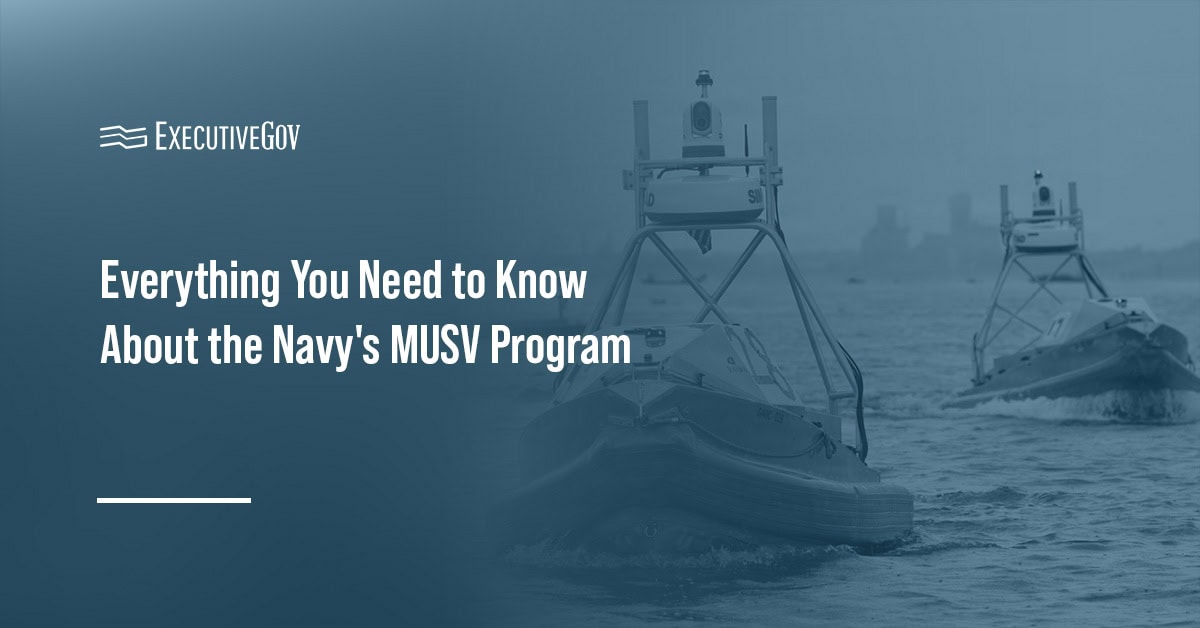
- The Navy relaunched its MUSV program with a marketplace acquisition model
- The Navy plans to acquire 36 MUSVs in FY26 and purchase MUSVs from FY27 through FY31
- The 2026 Navy Summit on Aug. 27 will host a Golden Fleet-focused panel featuring military and industry speakers
The centerpiece of the U.S. Navy’s Golden Fleet announced in December will be the Trump-class battleships that are envisioned as heavy combatants equipped with powerful weapons, including hypersonic missiles.
As important in the service’s future fleet design are more agile unmanned surface vessels capable of carrying out various missions. As part of the Golden Fleet, the Navy is fast-tracking its acquisition of medium unmanned surface vessels to expand its operational footprint and project naval power.
Join the architects behind the Golden Fleet at the 2026 Navy Summit on Aug. 27. Hung Cao, acting secretary of the Navy, will deliver a keynote at the event. The summit will also have a dedicated panel, Building the Golden Fleet With Software: AI, Digital Engineering and the New Shipbuilding Stack, featuring Shery Thomas, enterprise IT officer at the Navy Installation Command; Robert Keisler, senior scientific technical manager at the Naval Information Warfare Center; Edmond Kuqo from the U.S. Navy; David Voelker, zero trust architecture lead at the Navy; and retired Navy Capt. Rich Sussman, director of business development at SAIC. Secure your tickets here!
What Are the Navy’s Requirements for MUSVs?
The Navy resumed its MUSV vessel family of systems program in March with a request for prototype proposals, or RPP, posted on SAM.gov. According to the solicitation, the service is looking for unmanned vessels with adaptable, modular designs to address evolving maritime threats.
The Navy also wants its MUSVs to carry at least two 40-foot ISO container-style payloads. Rebecca Gassler, portfolio acquisition executive for robotic and autonomous systems at the Navy, told reporters at a virtual media roundtable that each container could have sensors, repair equipment and other payloads that can easily be swapped based on mission requirements, Naval News reported.
Gassler emphasized speed, saying that the program will not have a year-long prototyping and development timelines.
The official revealed that the Navy will test vessels throughout the summer. On-water tests must be completed by the end of the year and the first production MUSV must be delivered in fiscal 2027.
MUSV is a replacement for the Modular Attack Surface Craft, or MASC, effort launched in 2025 to develop adaptable and resilient USVs for various operational needs.
Capt. Jeremiah Daley, the Navy’s deputy assistant secretary for robotic autonomous systems, is joining the Hybrid Fleet in Production: Autonomy at Scale panel at the 2026 Navy Summit. The panel will explore the challenges and opportunities of crewed-uncrewed teaming and adopting commercial technologies to build attritable mass. Tickets are available here!
How Will the Navy Acquire MUSVs?
The MUSV program will serve as a marketplace to accelerate the development and acquisition of unmanned platforms.
Gassler shared that the service aims to create a “regular and recurring marketplace,” with plans to apply the same procurement model to purchase other classes of vessels, Breaking Defense reported.
The Portfolio Acquisition Executive for Robotic and Autonomous Systems organization announced in July that it is reopening the MUSV marketplace to new entrants. In a presolicitation notice on SAM.gov, an upcoming RPP will detail requirements for a high-capacity MUSV that would support logistics operations.
Which Companies Were Chosen to Participate in the MUSV Program?
The Navy has already selected seven companies to submit MUSV prototypes for at-sea testing, which began in June and will end in October. The seven companies that were approved to join the program are:
- Birdon
- Galliano Marine Services
- Huntington Ingalls Industries
- Leidos
- PacMar Technologies
- Saronic Technologies
- Sea Machines
The companies whose designs meet Navy requirements and pass at-sea testing will receive $15 million and qualify for production.
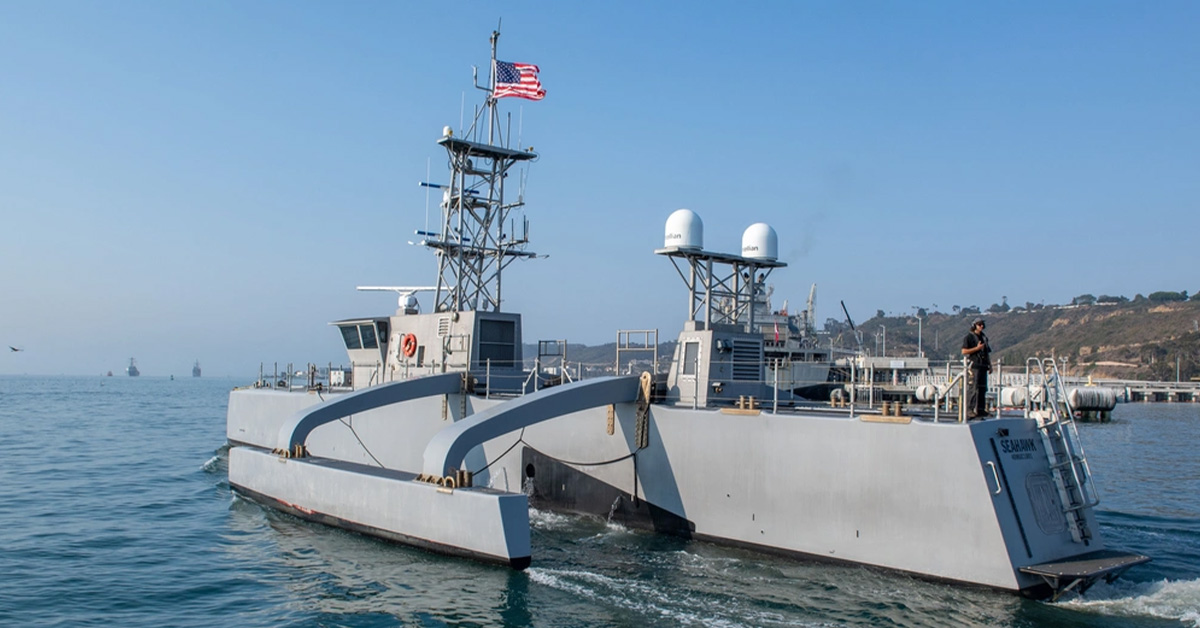
Leidos is already making MUSVs for the Navy. Its Seahawk MUSV is set to accompany USS Theodore Roosevelt, a Nimitz-class aircraft carrier, on an upcoming deployment.
Conrad Chun, the company’s defense communications vice president, noted in a statement to Breaking Defense that the company brings extensive experience in maritime autonomy to the MUSV program.
“Leidos brings more than a decade of investment and operational experience in maritime autonomy, including Seahawk, which joined the Navy’s operational fleet in April,” he said. “The effort aligns with the Navy’s priority of rapidly fielding this critical capability.”
HII has a line of MUSVs called Romulus, which is powered by the company’s Odyssey autonomy systems.
Andy Green, HII executive vice president and president of mission technologies and an eight-time Wash100 winner, pointed to Odyssey as “a key differentiator of our solution” in a company press release.
“Demonstrated across programs supporting the U.S. Navy, U.S. Marine Corps, U.S. Coast Guard, and allied partners, Odyssey enables intuitive command and control of autonomous platforms and swarms across domains, enhancing fleet lethality, survivability, and operational effectiveness,” he added.
Sea Machines offered its Steamracer autonomous surface ship, which made it to the final competitive evaluation phase of MASC before the program’s cancellation earlier this year. The company has partnered with St. Johns Ship Building, Incat Crowther, Ring Power, TOTE Services and EMI-W&O to bolster its shipbuilding capacity.
Saronic submitted its Marauder MUSV for the program. The 180-foot platform can travel up to 5,400 nautical miles and carry payloads weighing up to 150 metric tons. The first Marauder MUSV entered on-water trials at Saronic’s shipyard in Franklin, Louisiana, in June.
Birdon America signed a memorandum of understanding with Mythos AI in April to build a mission-capable MUSV for the Navy. Birdon President Tony Ardito stated that the company’s strategy is to build “scalable, production-ready capacity for the future defense market.”
PacMar Technology announced a partnership with HavocAI in May to design deployment-ready autonomous vessels, including the 38-foot Seahound USV and 42-foot, ocean-capable platform.
Galliano Marine Service was selected for two MUSV concepts, USNI News reported.
How Much Funding Will Be Allocated for MUSVs?
The Navy intends to acquire 36 MUSVs in fiscal 2026 using $5 billion funding in the 2026 Reconciliation Act, USNI News reported. The Navy also plans to invest $3.11 billion across the Future Years Defense Program to procure 47 MUSVs from FY27 through FY31, according to the most recent Navy Shipbuilding Plan
What Role Will MUSVs Play in the Golden Fleet?
In the Navy’s shipbuilding plan, the service described the MUSVs’ role in the future fleet.
“MUSVs will be able to compose formations to bolster scouting, screening, deceiving, denying or striking through their ability to accommodate containerized payloads to perform a wide variety of functions from sensing to strike,” the service wrote.
Adm. Daryl L. Caudle, chief of naval operations, told lawmakers during his nomination hearing in July that unmanned systems can serve as a force multiplier and can reduce risk to the force and mission.
“When paired with manned platforms, unmanned systems expand capacity and provide increased flexibility that is central to the success of Distributed Maritime Operations,” he explained in a report by Workboat. “The Navy is building a mix of high-end warfighting systems and affordable, attritable and attainable systems that provide mass and scale to challenge our adversaries.”
Speakers of the Building the Golden Fleet With Software: AI, Digital Engineering and the New Shipbuilding Stack panel at the 2026 Navy Summit on Aug. 27 will evaluate the potential of artificial intelligence and digital engineering to accelerate the shipbuilding process. Tickets are selling fast. Register now before seats run out!