- The National Reconnaissance Office is urging industry to prioritize scalable innovation to support the agency’s data architecture
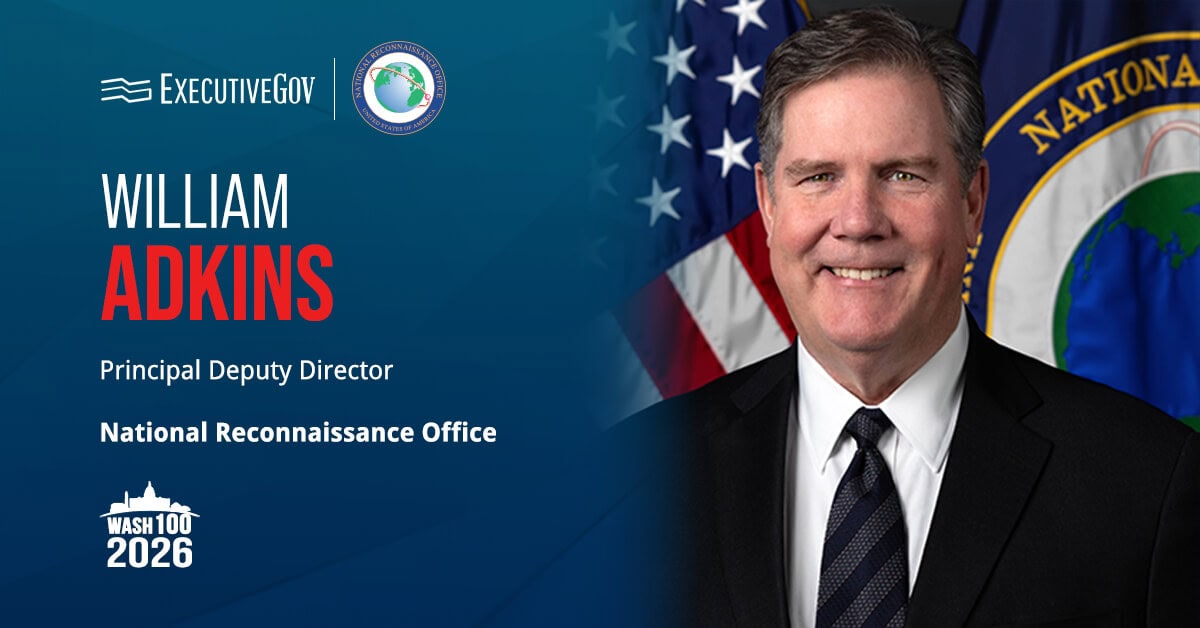
- NRO Principal Deputy Director William Adkins stressed the importance of commercial partnerships in data collection and distribution
- Adkins said the agency is looking for more competing vendors with scalable products with meaningful mission impact
The National Reconnaissance Office is pressing its commercial partners to think beyond individual breakthroughs and instead focus on technologies that can be scaled quickly across its growing satellite architecture, as the agency contends with a more volatile threat landscape and surging demand for the intelligence data it produces.
NRO Principal Deputy Director and 2026 Wash100 Award recipient William Adkins said Thursday that the agency’s capabilities, while extensive, have limits. He stressed that NRO systems need to be built for speed and adaptability so the agency can shift priorities on short notice in response to unfolding events — whether that’s a conflict overseas or a direct threat to its own satellites in orbit.

Get an inside look at how the NRO and its intelligence community counterparts are scaling AI, data and cyber capabilities to meet mission demands at the 2026 Intel Summit on September 24, featuring NRO’s Ryan Lewis alongside leaders from the FBI, CIA, NSA and DHS. Register now and build your strategic connections with the industry partners driving that mission forward.
What Are the NRO’s Challenges in Working Toward Technological Agility?
The NRO said it has been working to achieve agility by blending its established, high-performance satellites with a growing constellation of proliferated systems designed to add durability and staying power to the overall architecture. The agency has launched over 200 satellites in recent years to expand the volume of data it now gathers and distributes. That expansion, Adkins acknowledged, comes with its own complications.
“We’re trying to find more needles in bigger haystacks, and we don’t have enough humans to go through all this,” Adkins said. “So we have to figure out how to leverage tools like AI to be able to get through that data at speed and at scale to support our customers.”
He also described scalability as one of the agency’s central challenges going forward, whether that means more satellites, more data streams or more capacity across the board.
What Did Adkins Say About The Role of Industry in the NRO’s Data Architecture?
Adkins pointed to the agency’s commercial partnerships, along with progress in commercial launch capabilities, satellite buses and spacecraft components, as key factors enabling the NRO to expand its architecture in a cost-effective way. He explained that government engineers recognized the potential in commercially available technology and found ways to pair it with specialized government payloads — a combination that made large-scale proliferation both technically achievable and financially sustainable.
The commercial industry also plays a critical role in scalability, Adkins said. A strong concept, he noted, only becomes valuable to the NRO once it can be scaled up and integrated into an actual mission. Prospective partners can make use of mechanisms such as broad agency announcements, other transaction authorities and commercial solutions openings to bring in new technology to the agency.
“If there’s one thing I think we would like to have, it is more competition, more competitors — not just to come in to show us what your latest, greatest thing is, but to be able to take something that actually has meaningful mission impact and be able to scale that,” Adkins remarked.