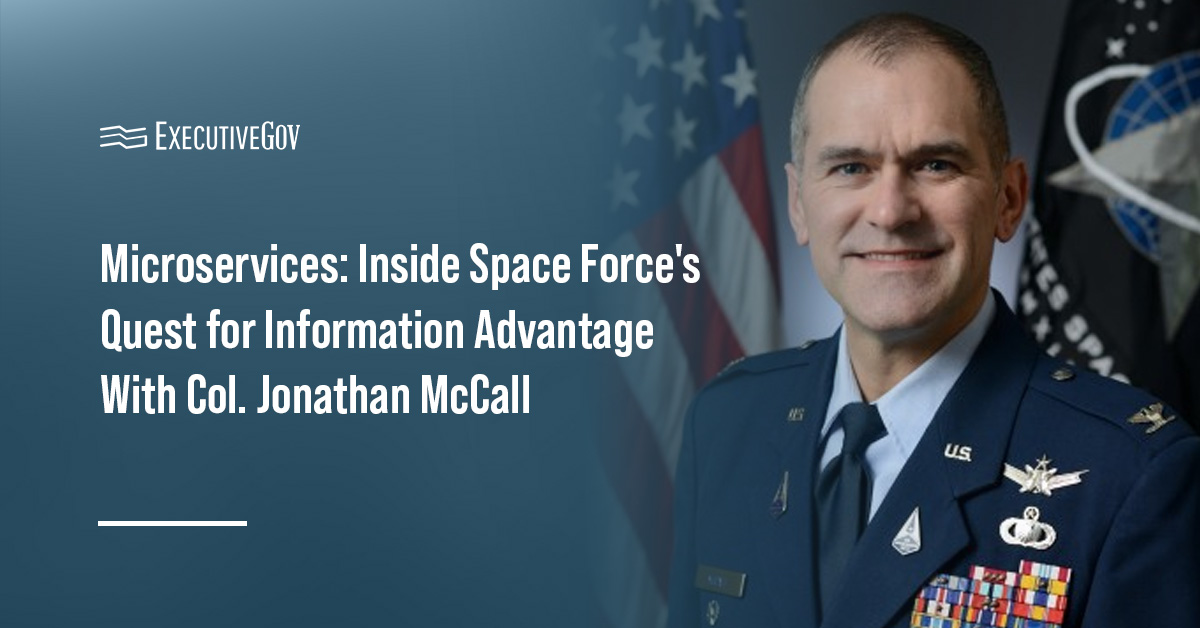
- The Space Force seeks faster, better decision-making to give it an advantage over adversaries in future warfare.
- It believes offloading human cognitive decision-making onto machines via microservices could give it this decision advantage.
- Hear directly from Col. Jonathan McCall, Space Force deputy director for space and the Air Battle Management System cross-functional team, during a panel at the 2026 Digital Transformation Summit on April 22!
The Space Force believes making faster and better decisions than its adversaries will bring it success in future warfare. It believes microservices will give it this decision advantage similar to its technological advantage in other warfare domains.
Col. Jonathan McCall, Space Force deputy director for space and the Air Battle Management System cross-functional team, told ExecutiveGov in an exclusive interview ahead of his panel discussion at the 2026 Digital Transformation Summit on April 22 that the Space Force believes future combat will involve machines talking to machines to make decisions. The service, he said, wants to offload the cognitive work typically performed by humans onto machines and improve the speed, scale and quality of its decision-making.
What Is a Microservice?
McCall defined a microservice as the opposite of an “all-in-one monolithic” software tool. Instead of modern command-and-control visualization tools that package and present data inside a closed and proprietary ecosystem, microservices have inputs, outputs and transformation specifically defined by the Space Force.
Hear directly from McCall during his panel discussion on Operationalizing AI in High-Security Federal Environments at the Potomac Officers Club’s 2026 Digital Transformation Summit on April 22! Dive into scaling cloud and artificial intelligence without disrupting operations and accelerating delivery in 24/7 operational environments. Secure your seat today!
The service, McCall said, expects to call that microservice function from any other software tool or microservice and visualize it in a way that makes sense for a particular mission. The goal is to have open architectures between software tools performing specific decisions.
McCall said this is because there’s a lot of overlap between the types of decisions made when fighting a sea, air or space domain battle.
“We don’t need to be paying for visualizations for each one of those, when the underlying math is basically the same,” McCall said.
He said while ubiquitous data is an enabler, it doesn’t constitute decision advantage. The Space Force, instead, needs to be able to transform that data in a cognitive-like way. The service is looking for microservices and software tools that perform those transformations and don’t just present “prettier dashboards” to operators to make the decisions themselves.
How Is the Pentagon Experimenting With Microservices?
The Air Force has been performing experiments with microservices called Decision Advantage Sprint for Human-Machine Teaming, or DASH. A DASH experiment held in mid 2025 in Las Vegas brought together U.S. and Canadian warfighters, industry and Shadow Operations Center-Nellis software developers to prototype microservices in high-tempo battle management scenarios.
The DASH experiment demonstrated how machine support can dramatically slash decision time while improving quality for air battle managers working in complex operational environments, according to a USAF statement. The service described the DASH experiment as a step toward future C2 capabilities.
The Potomac Officers Club’s 2026 Digital Transformation Summit on April 22 is the premier forum for discovering new business opportunities in essential emerging technologies like AI, cyber, human-machine teaming and enterprise IT. Hear Pentagon Chief Information Officer and Wash100 Award winner Kirsten Davies’ spending priorities for 2026 during her illuminating keynote. Network with other ambitious GovCon titans and score that big contract. Buy your ticket now!
How Do DASH Experiments Measure Offloading Cognitive Decision Work?
McCall said these experiments demonstrate the measured utility of offloading cognitive decision work usually performed by humans onto machines. Instead of a human having six screens to view and four headsets on trying to transform data, why not have the human monitor a set of microservices transforming that data?
In this scenario, the machines can monitor the headsets and screens, and provide a suite of options that the human operators can pick from. There are three more DASH experiments planned so far in 2026: ones in May, July and in the fall that will focus on specific decisions, and collections of decisions, that work synergistically and measure the impact of offloading that cognitive work to machines.
“[DASH experiments] are opportunities to experience firsthand what successful decision advantage [via] microservice implementation looks like,” McCall said. “That’s pretty valuable for these businesses.”
McCall said future business opportunities in microservice implementation will come from the Air Force’s Command, Control, Communications and Battle Management, aka C3BM, program acquisition executive as requirements solidify. The C3BM PAE had a classified industry day in Marc and is hosting an unclassified engagement day on May 13 in Dayton, Ohio. A request for comment was left with Air Force Material Command, home of the C3BM PAE, about future industry days.