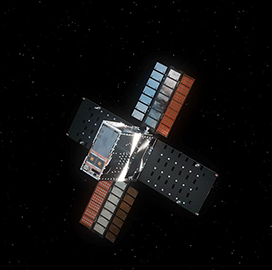
- NASA selected five organizations to conduct studies for NOAA’s Space Weather Next PHOMI instrument
- The studies are meant to mature technologies, refine instrument concepts and help establish performance requirements for a future PHOMI acquisition
- PHOMI is designed to improve solar magnetic field observations, enhancing space weather forecasting and coronal mass ejection prediction capabilities
NASA has selected five organizations to conduct formulation studies for the Space Weather Next PHOtospheric Magnetograph Imager, or PHOMI, instrument on behalf of the National Oceanic and Atmospheric Administration, advancing the federal government’s next-generation operational space weather monitoring capabilities.
The selected organizations each received a nine-month firm-fixed-price contract valued at approximately $900,000.
The selected contractors are:
- Johns Hopkins Applied Physics Laboratory
- BAE Systems Space & Mission Systems
- Lockheed Martin
- Regents of the University of Michigan
- Southwest Research Institute
What Are the PHOMI Studies Expected to Deliver?
Under the contracts, the organizations will evaluate PHOMI mission requirements, develop notional instrument concepts, perform technology maturation activities and support technical risk reduction. The studies will also assess potential instrument performance, development costs, program risks and implementation schedules.
NASA and NOAA will use the findings to establish performance requirements for a future competitive acquisition to develop and deliver the operational PHOMI instrument.
How Might PHOMI Improve Space Weather Forecasting?
The proposed PHOMI instrument is intended to generate magnetic field maps of the sun’s photosphere, providing critical observations to characterize solar active regions and improve modeling of the solar wind and coronal mass ejections.
What Is NOAA’s Space Weather Next Program?
NOAA’s Space Weather Next program is designed to sustain and expand operational space weather observations from multiple vantage points in space, providing continuous monitoring of solar activity and the near-Earth space environment.
The program was developed by NOAA’s National Environmental Satellite, Data, and Information Service in collaboration with NASA’s Goddard Space Flight Center. Its primary objective is to provide the National Weather Service’s Space Weather Prediction Center with the operational data necessary to improve space weather watches, warnings, alerts and forecasts.
The initiative supports several national policy priorities, including President Donald Trump’s “Ensuring American Space Superiority” executive order, which directs federal agencies to strengthen U.S. leadership in space exploration, improve space and Earth weather forecasting capabilities, accelerate commercial space partnerships and return astronauts to the Moon by 2028 while establishing the initial elements of a permanent lunar outpost by 2030.