- DIU Director Owen West has stood up the Bridge Program to remove tech adoption hurdles
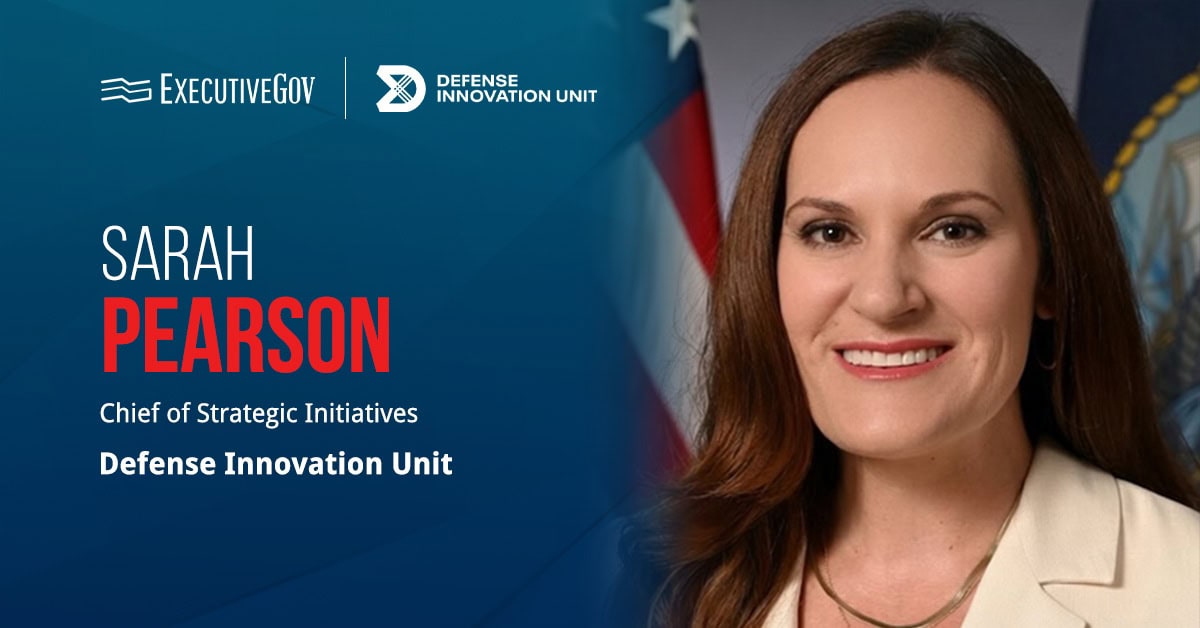
- Sarah Pearson, a former Navy officer, will lead the effort across three lines of effort
- The 2026 Navy Summit on Aug. 27 will explore AI, digital engineering and more
Owen West, director of the Defense Innovation Unit and a 2026 Wash100 awardee, has authorized the Bridge Program, a new business unit designed to eliminate critical bottlenecks slowing the military’s adoption of commercial technology.

As the Department of War works to speed up the adoption of commercial defense technology across the military services, the Potomac Officers Club will host the 2026 Navy Summit on Aug. 27 — the organization’s final DOW summit of 2026. Government and industry leaders will discuss AI, digital engineering, autonomous systems, network modernization, shipbuilding and other priorities shaping the future maritime force. Reserve your spot now!
According to a LinkedIn post published Wednesday, West signed a memorandum on Monday establishing the Bridge Program, which is now led by Sarah Pearson, DIU’s chief of strategic initiatives.
What Are the 3 Lines of Effort of the Bridge Program?
DOW said Tuesday the Bridge Program’s first line of effort focuses on evolving the model for classified space design, construction, accreditation and operation. The department is combining commercial technologies, process improvements, rapid contracting, policy and congressional support to address the value chain around classified infrastructure.
The program reached its first major contracting milestone in July, when President Donald Trump announced a $10 billion investment in Pennsylvania’s defense industry that included funding for four shared commercial classified facilities, one of which will be built in Pittsburgh using the joint funding model the Bridge Program is testing. Beyond Pittsburgh, the program has contracted for nine additional commercially owned and operated sites, including locations in Austin, Texas; San Francisco; Boston; Charleston, South Carolina; Chicago; Cleveland; Louisville, Kentucky; and New York.
The second line of effort centers on building the fastest and most trusted accreditation portfolio within the department, an objective DIU has tied to cybersecurity expertise, risk management practices and artificial intelligence capabilities intended to condense authorization timelines.
The third line of effort covers test and evaluation, an area DIU officials described as a core competency of the organization. The program is working to connect capability development with existing and emerging test infrastructure for both physical and digital applications, with testing opportunities built into the contract lifecycle.
Who Is Sarah Pearson?
Pearson is a former Navy officer and technology executive who serves as chief of strategic initiatives at DIU. She conceived and developed the Bridge Program over the past year to drive long-term, systemic reform across DOW. Her industry career included time at Google and GE, according to her LinkedIn profile.
Pearson said the program’s goal is a new model for classified infrastructure.
“When successful, we will have demonstrated a new model, a model where classified infrastructure is resourced based upon usage and becomes operational within months — not years — of the need arising,” she outlined.
Pearson credits cross-department collaboration for the program’s early progress, noting that partners across the offices of the undersecretary of war for intelligence and security, acquisition and sustainment, and research and engineering — along with the Defense Intelligence Agency, the Defense Counterintelligence and Security Agency and the armed services — have been central to that momentum.
On accreditation, Pearson said the team plans to shift the risk management framework process earlier in prototype development to help the services field cybersecure solutions more easily.
What Recent Organizational & Industry Moves Has DIU Made?
Under West, DIU consolidated its legacy technology areas into three mission-focused portfolios to accelerate the transition of emerging technologies into military applications. DIU has since filled out that leadership structure, naming Jarred Conley as director of its autonomous warfare portfolio and David Payne as director of its kill web portfolio.
The new structure is already shaping DIU’s outreach to industry. The agency opened a challenge offering up to $100 million for unmanned surface vessels equipped with armed drones; launched the Specular MIST Prize Challenge for maritime payload technologies; and rolled out the G-BAM Prize Challenge for long-range precision strike systems. DIU also issued a solicitation for a new class of massed modular aircraft to give the Joint Force lower-cost, theater-range unmanned systems for contested environments.