Executive Gov
  • Home
  • Acquisition & Procurement
  • Agencies
    • DoD
    • Intelligence
    • DHS
    • Civilian
    • Space
  • Cybersecurity
  • Technology
  • Awards
  • News
  • About
  • Wash100
  • Contact Us
    • Advertising
    • Submit your news
No Result
View All Result
Executive Gov
  • Home
  • Acquisition & Procurement
  • Agencies
    • DoD
    • Intelligence
    • DHS
    • Civilian
    • Space
  • Cybersecurity
  • Technology
  • Awards
  • News
  • About
  • Wash100
  • Contact Us
    • Advertising
    • Submit your news
No Result
View All Result
Executive Gov
No Result
View All Result
Home Artificial Intelligence

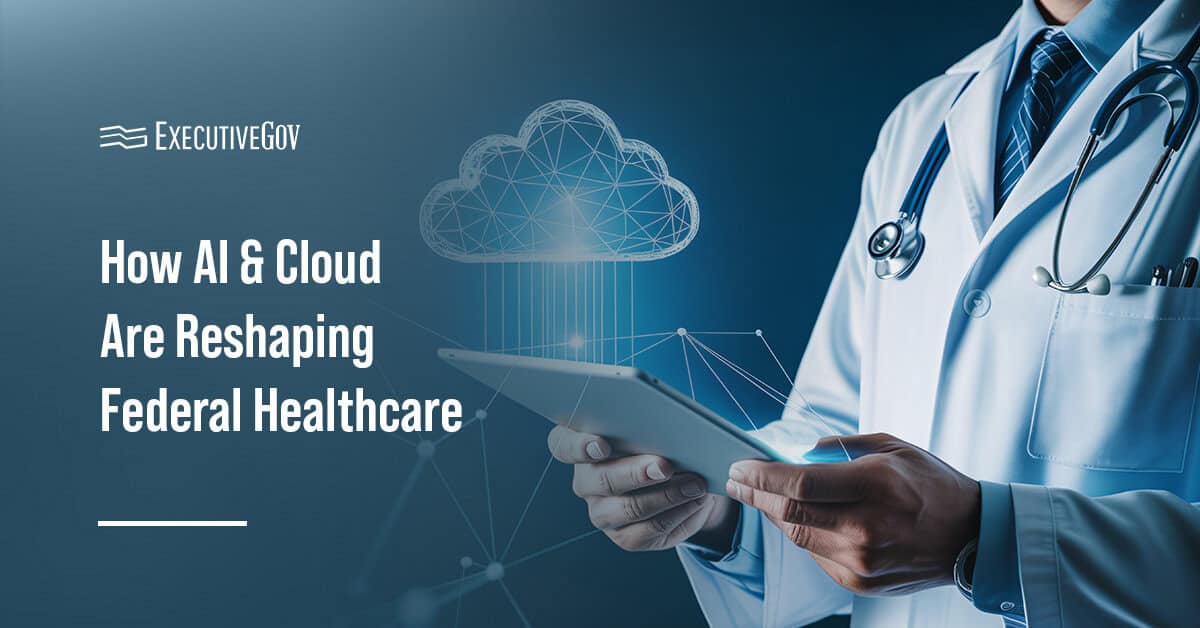
How AI & Cloud Are Reshaping Federal Healthcare—From Battlefield Care to Biomedical Research

by Elodie Collins
January 15, 2026
in Artificial Intelligence, Healthcare IT, News
AI and cloud are transforming how federal agencies are performing healthcare services.

AI and cloud are transforming how federal agencies are performing healthcare services.

Artificial intelligence and cloud technologies are becoming increasingly more prevalent across government as federal agencies pursue modernization initiatives. 

Table of Contents

    • You might also like
    • Cornelis Networks Deploys Lynx Supercomputing Cluster at LLNL
    • OpenAI to Launch ChatGPT on Pentagon's GenAI.mil in July
    • DOW Accepts 1st Batch of UAS, Advances Drone Dominance Program Gauntlet II
  • How Can Cloud, AI Improve Organizational Efficiency?
  • How Does Advanced Tech Improve American Healthcare Outcomes?
  • What Are the Roles Cloud & AI Play in Biomedical Research?
  • Can AI Stop Fraud?

You might also like

Cornelis Networks Deploys Lynx Supercomputing Cluster at LLNL

OpenAI to Launch ChatGPT on Pentagon's GenAI.mil in July

DOW Accepts 1st Batch of UAS, Advances Drone Dominance Program Gauntlet II

A Government Accountability Office report published in July found that AI use across 11 federal agencies increased from 571 to 1,110 instances from 2023 to 2024, with generative AI use in government also growing from 32 to 282 usage cases in the same period.

Cloud migration from legacy systems has also been a long-time priority across government. Data from The Global Statistics revealed that federal civilian agencies invested $8.3 billion in cloud computing initiatives in fiscal 2025. For comparison, the same agencies spent $4.4 billion in cloud products and services in 2020. 

For this article, we dove deep into cloud and AI use cases in healthcare across the government. 

How AI & Cloud Are Reshaping Federal Healthcare—From Battlefield Care to Biomedical Research

The Potomac Officers Club is hosting a panel on cloud and AI in healthcare featuring leaders from government and industry at the 2025 Healthcare Summit on Feb. 12 (rescheduled due to the fall’s government shutdown). The event will convene government and industry leaders to examine the future of healthcare technology. Get your tickets today.

How Can Cloud, AI Improve Organizational Efficiency?

Health agencies are looking to cloud and AI to reduce routine tasks, simplify workloads and accelerate mission execution. 

For instance, the Department of Veterans Affairs’ partnership with cloud company Oracle to modernize its electronic healthcare record system is intended to provide a secure and interoperable medical record system, allowing healthcare professionals across federal and commercial partners to share data and coordinate care. 

Meanwhile, General Dynamics Information Technology is one of the companies providing the government with AI tools to bolster the productivity of the federal workforce. The company is utilizing AI and automation to improve benefits coordination, digital imaging, secondary payer assessment and debt determination, waivers and appeals, data management, and debt collection for the Centers for Medicare & Medicaid Services’ Benefits Coordination & Recovery Center.

Martin Makary, commissioner of the Food and Drug Administration, highlighted the potential of AI to improve efficiency when he announced in May an agency-wide rollout of the technology to support scientific reviewers. 

“The agency-wide deployment of these capabilities holds tremendous promise in accelerating the review time for new therapies,” Makary said at the time. 

“The opportunity to reduce tasks that once took days to just minutes is too important to delay,” he added.

How Does Advanced Tech Improve American Healthcare Outcomes?

Many agencies are exploring AI to improve patient care, especially because of the technology’s capability to process large volumes of data and generate insights. 

Jim O’Neill, deputy secretary of the Department of Health and Human Services, said in a report by FedScoop in September that OpenAI’s ChatGPT can “promote rigorous science, radical transparency and robust good health.” O’Neill added that ChatGPT has received an authority to operate, or ATO, while OpenAI has achieved Federal Information Security Management Act moderate level certification. 

The Defense Health Agency also wants AI deployed in the Military Health System, or MHS, a program providing virtual health care capabilities on the battlefield. 

Stephen Ferrera, acting assistant secretary for health affairs for the Department of War, said on a Federal News Network podcast that AI can serve as a force multiplier for field personnel. 

“We can have specialists, whether they’re trauma specialists, intensivists, surgeons — you name it — be able to, in real time, help guide people that are on the ground at the front line,” he shared. 

One potential use of AI in healthcare is to monitor patient conditions in real time and generate informed clinical support to a battlefield provider. 

Jesus Caban, chief data and analytics officer at DHA, will participate in a panel discussion on integrating cloud and AI capabilities to public health services at the Potomac Officers Club’s 2025 Healthcare Summit on Feb. 12. Register here.

What Are the Roles Cloud & AI Play in Biomedical Research?

In biomedical research, cloud and AI offer opportunities to aid scientists and accelerate scientific discovery. In November, President Trump signed an executive order establishing the Genesis Mission to promote the use of AI in federal research and development activities, including in finding new drugs and other breakthroughs.

The National Institutes of Health also sees the benefits of cloud computing in biomedical research. The agency said cloud offers scalable computing power and storage and provides access to extensive datasets, which are especially valuable to research institutions with limited on-premise capability.

Its Cloud Resources Program is designed to empower NIH researchers to utilize cloud resources in their research, with the latest cohort announced in March.

Can AI Stop Fraud?

One way the federal government wants to utilize AI capabilities is to detect fraudulent activities related to Medicare. According to CMS, Medicare’s traditional fee-for-service program reported $31.7 billion in improper payments in fiscal year 2024. Medicaid $31.1 billion in improper payments for the same period.

The One Big Beautiful Bill, which was signed into law in July, includes a $25 million in funding for HHS to develop AI tools that can prevent and recoup improper Medicare payments.

In August, CMS launched the Crushing Fraud Chili Cook-Off Competition, a research challenge that aims to identify data-driven methodologies for analyzing volumes of data and detecting unusual patterns or behavior that may signify fraud. 

Don’t miss the Cloud‑First, AI‑Ready: Powering the Next Generation of Public Health Services panel featuring expert perspectives on the role of cloud and AI in healthcare at the Potomac Officers Club’s 2025 Healthcare Summit. Secure your tickets today.

How AI & Cloud Are Reshaping Federal Healthcare—From Battlefield Care to Biomedical Research
Stay connected via Google News
Follow us for the latest travel updates and guides.
Add as preferred source on Google
Share5Tweet19

Recommended For You

Cornelis Networks Deploys Lynx Supercomputing Cluster at LLNL

by Miles Jamison
June 18, 2026
Cornelis Networks logo. Cornelis has deployed the Lynx supercomputing cluster at Lawrence Livermore National Laboratory.

LLNL has brought the new Lynx supercomputing cluster online to support national security computing missionsThe 952-node system expands computing capacity for NNSA's Advanced Simulation and Computing programLynx combines...

Read moreDetails

OpenAI to Launch ChatGPT on Pentagon's GenAI.mil in July

by Jane Edwards
June 18, 2026
Pentagon. OpenAI plans to roll out ChatGPT on the Pentagon's GenAI.mil platform in July.

Mohammed Husain, strategic delivery lead for cyber at OpenAI, said the artificial intelligence company plans to deploy ChatGPT on GenAI.mil, the Pentagon's enterprise generative AI platform, in July.Register...

Read moreDetails

DOW Accepts 1st Batch of UAS, Advances Drone Dominance Program Gauntlet II

by Jane Edwards
June 18, 2026
Owen West. The DIU director commented on drones acquired under the Drone Dominance Program.

The Department of War has accepted the first batch of unmanned aerial systems under the Drone Dominance Program and shipped nearly 2,000 additional units to military services. DIU...

Read moreDetails

DISA Taps Red Canyon Technologies to Set Up Computing Modernization PMO

by Jamie Bennet
June 18, 2026
DISA. The agency is establishing the ReForged project management office to transition legacy codes to AI-based tools.

The Defense Information Systems Agency selected Red Canyon Technologies to set up its ReForged program management office for warfighting computing modernization. The initial task order is valued at...

Read moreDetails

Army Issues RFP for Commercial Power Generation Under Strategic Capital Initiative

by Miles Jamison
June 18, 2026
Army logo. The U.S. Army is seeking proposals for commercial power generation projects at seven installations.

The U.S. Army has issued a request for proposals for commercial power generation projects at seven installations as part of the second tranche of its Strategic Capital Initiative.

Read moreDetails
Sign Up For Our Newsletter
Subscribe to our mailing list to receives daily updates direct to your inbox!
Invalid email address
Your privacy is guranteed.
Thanks for subscribing!

Sponsors

About ExecutiveGov

ExecutiveGov, published by Executive Mosaic, is a site dedicated to the news and headlines in the federal government. ExecutiveGov serves as a news source for the hot topics and issues facing federal government departments and agencies such as Gov 2.0, cybersecurity policy, health IT, green IT and national security. We also aim to spotlight various federal government employees and interview key government executives whose impact resonates beyond their agency.

CATEGORIES

  • Acquisition & Procurement
  • Announcements
  • Articles
  • Artificial Intelligence
  • Awards
  • Big Data & Analytics News
  • C4ISR
  • Civilian
  • Cloud
  • Contract Awards
  • Cybersecurity
  • Defense And Intelligence
  • Defense Security Cooperation
  • DHS
  • Digital Modernization
  • DoD
  • Events
  • Executive Moves
  • Executive Spotlights
  • Federal Civilian
  • Financial Reports
  • Foreign Military Sales
  • General News
  • GovCon Expert
  • Government Technology
  • GSA
  • Healthcare IT
  • Industry News
  • Intelligence
  • Legislation
  • M&A Activity
  • National Security
  • News
  • Policy Updates
  • Press Releases
  • Profiles
  • Space
  • Videos
  • Wash100
Sign Up For Our Newsletter
Subscribe to our mailing list to receives daily updates direct to your inbox!
Invalid email address
Your privacy is guranteed.
Thanks for subscribing!

Copyright 2026 Executive Mosaic. All Rights Reserved.

No Result
View All Result
  • Home
  • Acquisition & Procurement
  • Agencies
    • DoD
    • Intelligence
    • DHS
    • Civilian
    • Space
  • Cybersecurity
  • Technology
  • Awards
  • News
  • About
  • Wash100
  • Contact Us
    • Advertising
    • Submit your news

Copyright 2026 Executive Mosaic. All Rights Reserved.

Get your free GovCon news!

Get your latest GovCon news and insights. Become a VIP and subscribe to the GovConWire Daily News.

Invalid email address
We promise not to spam you. You can unsubscribe at any time.
Thanks for subscribing!